


In November 1675 CE, Guru Tegh Bahadur Ji was martyred at Chandni Chowk in Delhi, where he was beheaded. After the martyrdom, Bhai Jetha Ji, Bhai Nannu Ram, and Bhai Ude Rathore Ji lifted the Guru’s severed head and, while evading Mughal forces, brought it to Chak Nanaki to Guru Gobind Singh Ji.

In Chak Nanaki, Guru Gobind Singh Ji performed the cremation rites of the Ninth Guru’s head in front of his residence, Guru ke Mahal. There, he embraced Bhai Jetha Ji and honoured him with the title “Ranghrete Guru ke Bete” (the Ranghreta are the Guru’s sons).After the cremation, Guru Gobind Singh Ji sat at the Akal Bunga and addressed the entire Sikh congregation. He asked Bhai Jetha Ji: when Guru Tegh Bahadur Sahib was martyred, why were there no Sikhs present there? Bhai Jetha Ji replied that the crowd was large, but it was not possible to identify who was Sikh and who was Muslim.

Sitting at the Akal Bunga, Guru Gobind Singh Maharaj declared that if Sikhs could not be recognised, he would create such Sikhs who would be clearly identifiable even among lakhs of people. On 13 April 1699, the day of Vaisakhi, Guru Gobind Singh Ji formed the Khalsa Panth, fulfilling these words and giving Sikhs a distinct identity.

Even before the creation of the Khalsa Panth, Guru Gobind Singh Ji had achieved success in battles such as Bhangani and Nadaun against the hill rulers. However, the Mughal rulers and the hill chiefs could not tolerate the Guru’s growing power. From 1699 to 1704, Anandpur Sahib was attacked multiple times, but the hill and Mughal forces faced defeat, and the Sikh army returned victorious each time.When, in 1705 CE, a combined army of the hill rulers and the Mughals laid siege to Anandpur Sahib for six to eight months, Guru Gobind Singh Ji, along with his family and the Sikhs, had to leave the fort of Anandgarh on the night of 6–7 Poh (winter month).
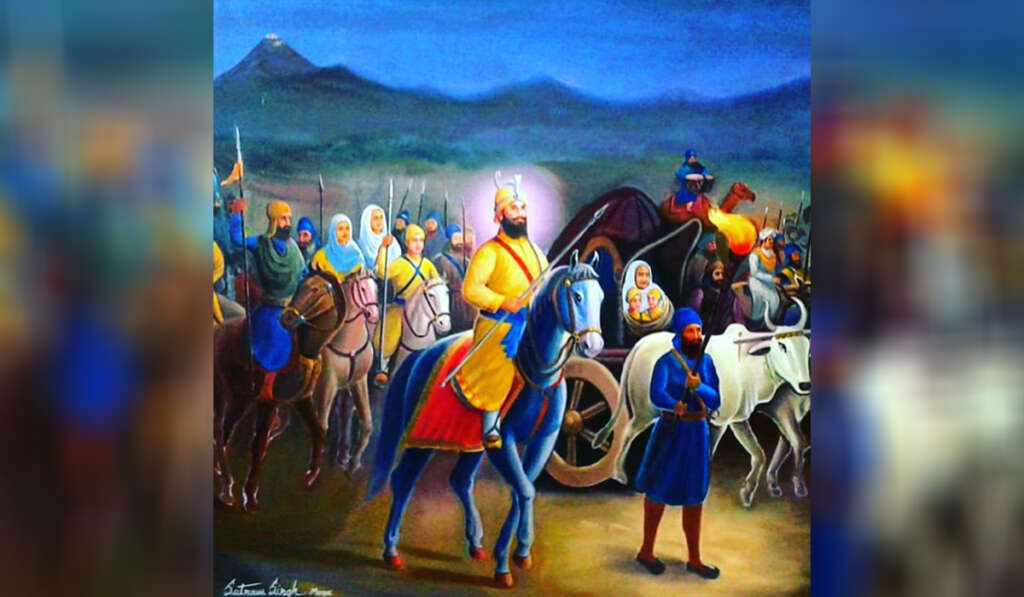
After Guru Gobind Singh Ji left Anandpur Sahib, the army of the hill ruler Ajmer Chand began widespread destruction in the city. Ajmer Chand was the son of Bhim Chand and the grandson of Dip Chand. The land of Anandpur Sahib had earlier been purchased by Guru Tegh Bahadur Ji from Dip Chand’s widow, Rani Champa.
On Ajmer Chand’s orders, the army demolished homes in Anandpur Sahib, caused heavy damage to the forts built by Guru Gobind Singh Ji, and destroyed all places connected with the Sikhs and the Sikh Gurus. Although the city was devastated, Ajmer Chand did not decide to settle there, because he feared that Guru Gobind Singh might return.
Before leaving Anandpur Sahib, Guru Gobind Singh Ji had appointed Mahatma Bhai Gurbakhsh Das (a disciple of Mahadev Udasi Sadhu) as the caretaker of all gurdwaras in Anandpur Sahib. Gurbakhsh Das was instructed to pay special attention to Sis Ganj Sahib and Guru ke Mahal. Although the army destroyed many sites, the place of Guru Tegh Bahadur Ji’s cremation survived in some form, and Bhai Gurbakhsh Das continued worship there and kept a sacred lamp burning.
Ajmer Chand did not take full control of Kiratpur Sahib and Anandpur Sahib until he received news of Guru Gobind Singh Ji’s passing into Jyoti Jot. A Hukamnama of Guru Gobind Singh Ji dated 15 October 1707 mentions that he wrote to the Sikhs that when he returned to Anandpur Sahib, his Sikhs should come to meet him. Because of this fear, Ajmer Chand did not enter Anandpur Sahib until after Guru Gobind Singh Ji had passed away. From December 1705 to October 1708, Kiratpur Sahib and Anandpur Sahib remained deserted. No family wished to live there due to Ajmer Chand’s fear. Even the descendants of Baba Suraj Mal living in Kiratpur Sahib left and moved towards Nahan. Only Bhai Gurbakhsh Das continued to look after the Guru’s sites in Anandpur Sahib. After Guru Gobind Singh Ji’s Jyoti Jot, Ajmer Chand took control of Kiratpur Sahib and Anandpur Sahib.

After Guru Gobind Singh Ji, when Banda Singh Bahadur came towards Punjab carrying the Guru’s Hukamnamas, he achieved several victories within the next one or two years and shook Mughal authority to its foundations. On 28 December 1710, Banda Singh Bahadur marched towards the Bilaspur border. Ajmer Chand had already received news of Banda’s arrival. A battle took place between the two armies, and Banda won. Ajmer Chand accepted defeat and offered gifts. Banda Singh Bahadur took compensation and spared Ajmer Chand’s life. After the victory over Bilaspur, life and activity began returning to Kiratpur and Anandpur Sahib, but the towns did not revive as before.
Soon after, in December 1715, Banda Singh Bahadur was captured by the Mughal army while fighting the battle of Gurdas Nangal, and on 9 June 1716 he was taken to Delhi and executed. Ajmer Chand once again took control of Kiratpur and Anandpur Sahib.
A few years later, two brothers from the Sodhi family of Kiratpur Sahib, Gulab Singh and Sham Singh, initiated talks with Ajmer Chand to purchase the towns of Kiratpur Sahib and Anandpur Sahib. They told Ajmer Chand that they wished to live in Anandpur Sahib with their families. Ajmer Chand demanded payment calculated per acre. Although Guru Tegh Bahadur Maharaj had earlier paid for this land, the Sodhi brothers again paid the full amount to Ajmer Chand. Thus, the families of Gulab Singh and Sham Singh became owners of Kiratpur Sahib and Anandpur Sahib. Gulab Singh began living in Anandpur Sahib, while Sham Singh’s family remained in Kiratpur.
Gulab Singh began addressing himself as the “Guru” of the Sikhs and started accepting gifts and offerings brought by Sikh families. Bhai Gurbakhsh Das objected and told him that as per the Guru’s command, the Guru of all Sikhs is now Sri Guru Granth Sahib. Gulab Singh then assaulted Bhai Gurbakhsh Das. After this, Bhai Gurbakhsh Das left Anandpur Sahib and went to live in the village of Nakkiyan. Soon, all four sons of Gulab Singh died, and Gulab Singh himself passed away shortly after.
After Gulab Singh’s death, his brother Sham Singh came to Anandpur Sahib and began accepting gifts and offerings from Sikh families, though Sham Singh never called himself a Guru.

The lineage of Sham Singh Sodhi continues in Anandpur Sahib even today. Initially, the Sodhi family controlled only certain sites: Guru ke Mahal, Bhora Sahib, Damdama Sahib, Sis Ganj Sahib, and Akal Bunga Sahib. The remaining area of Anandpur, which had been destroyed, remained under Ajmer Chand. In his final days, Ajmer Chand distributed this land among Rajput families of Anandpur Sahib. Government documents still record that the Numberdar of Chak Nanaki Anandpur Sahib, Sardar Hardyal Singh, belonged to a Rajput family.
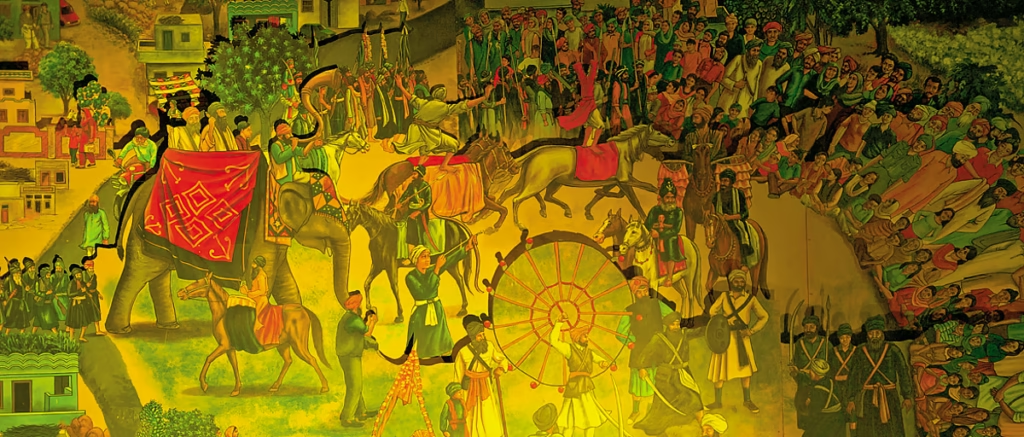
During the period of the Sikh Misls, many Sikh families settled in Kiratpur Sahib and Anandpur Sahib. Whenever Mughal forces or external invaders attacked the region, local Sikhs would move with their families towards the hill areas of Nahan and Mandi, then return later. During Hola Mohalla, many Sikh families would come to Anandpur Sahib, accept Sri Guru Granth Sahib Ji as their Guru, and celebrate Hola Mohalla there.
In the year 1753, when Sikh families were celebrating Hola Mohalla in Anandpur Sahib, Adina Beg, the chief Mughal governor of the Jalandhar region, attacked Anandpur Sahib and killed many Sikh families. In the second half of the 18th century, it became very difficult for Sikhs to live in Anandpur Sahib. During Mughal attacks, Sikhs would move towards the hills and later return.
In this difficult period, Bhai Sher Singh and Baba Jalmast Singh decided to stay in Anandpur Sahib and continued to care for the Guru’s sites. Bhai Sher Singh was killed in Mughal attacks, but Baba Jalmast Singh continued serving in Anandpur Sahib. After them, for about ten years, Baba Gurbakhsh Singh from the village of Leel performed service in Anandpur Sahib.
When Baba Gurbakhsh Singh went with 30 companions to Akal Takht in Amritsar, Ahmad Shah Abdali attacked Darbar Sahib on 1 December 1764. These 31 Sikhs confronted the Afghan army and attained martyrdom. The text states that they killed 3000 soldiers of Abdali. After Baba Gurbakhsh Singh’s martyrdom, Bhai Sukha Singh became caretaker of the sites of Anandpur Sahib. While living in Anandpur Sahib, Bhai Sukha Singh composed “Gurbilas Patshahi Dasvin.”
In 1790, Baba Baghel Singh, associated with the Karor Singhia Misl and known for building gurdwaras in Delhi, came to Sri Anandpur Sahib. Several gurdwara buildings in Anandpur Sahib were constructed by Baba Baghel Singh.

In the early 19th century, Raja Karam Singh of the Patiala state and his son Narinder Singh built several sarais in Anandpur Sahib, which were known as the Raja’s Bunga. Around the same time, Nahar Singh, the son of Sham Singh Sodhi, and later Surjan Singh Sodhi, the son of Nahar Singh, maintained the leadership of Anandpur Sahib.
In 1812, Mahan Chand, the grandson of Ajmer Chand, demanded an annual tax from Surjan Singh. Surjan Singh considered this unjust, since his forefathers had already paid Ajmer Chand for the land of Anandpur Sahib and Kiratpur Sahib. After consulting Sikh companions, Surjan Singh refused to pay. When Mahan Chand learned this, he threatened to attack Anandpur Sahib. Fortunately, Hukam Singh Chimni, a Subedar of Hazara (1814–1818) and a leading soldier in Maharaja Ranjit Singh’s army, had arrived near Anandpur Sahib with his forces. When Hukam Singh Chimni discovered Mahan Chand’s plan, he defeated and drove away Mahan Chand’s army. Seeing heavy losses, Mahan Chand accepted Hukam Singh’s terms, agreed not to levy any tax on Anandpur Sahib, and paid compensation for the war.

In 1814, due to differences between Maharaja Ranjit Singh and Akali Phula Singh, Akali Phula Singh left Amritsar on 28 August 1814 and came to Sri Anandpur Sahib. On 29 September 1814, Raja Pratap Singh of the Jind state, who opposed the British, reached Anandpur Sahib while fleeing and took refuge there. The British government sought help from Maharaja Ranjit Singh, the Raja of Nabha Jaswant Singh, and the Nawab of Malerkotla, and their combined forces moved towards Anandpur Sahib to arrest Akali Phula Singh and Raja Pratap Singh. Soon after, Sahib Singh Bedi mediated a compromise between Maharaja Ranjit Singh and Akali Phula Singh. After the settlement, Akali Phula Singh left Anandpur Sahib and returned to Amritsar.
After 1815, Bhai Karam Singh, Baba Kharak Singh, Baba Budh Singh, Bhai Puran Singh, and Bhai Amar Singh looked after the city of Anandpur Sahib and the Guru’s sites. From 1815 to 1900 CE, these Sikh devotees carried out work from time to time and kept the city inhabited.
At the beginning of the 20th century, Baba Sampooran Singh arrived at Sri Kesgarh Sahib, and the care of Sri Anandpur Sahib and Kesgarh Sahib came under him. He was described as a very wise person with deep knowledge of medicines, and he served at the Guru’s sites and the residents of Anandpur Sahib for a long time. After him, Bhai Amar Singh served the Guru’s sites in Anandpur Sahib until his last breath. He died there in 1948.

During Bhai Amar Singh’s time, he appointed Bhai Bakhshish Singh as the head granthi at Sri Kesgarh Sahib. Bhai Bakhshish Singh was among the first members of the Shiromani Gurdwara Parbandhak Committee (SGPC), Sri Amritsar Sahib.
After India’s independence, Anandpur Sahib became a place for Sikh camps, seminars, and major gatherings. Members of the Shiromani Akali Dal and Sikh Students Federation organised many religious camps in Anandpur Sahib. The movement led by Master Tara Singh for the demand of Punjabi Suba also began from the railway station of Sri Anandpur Sahib.

On 8 March 1966, the first Hindi signboard was removed from the Anandpur Sahib railway station as part of the Punjabi Suba demand. The Anandpur Sahib Resolution for Punjabi Suba was also passed here.

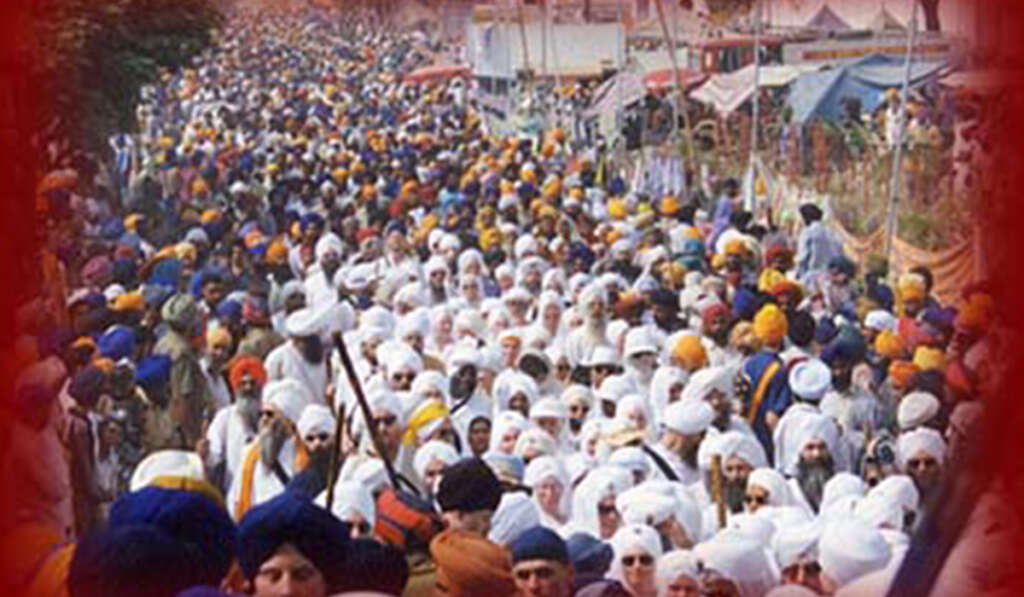
In April 1999, the SGPC celebrated the 300 years of the creation of the Khalsa Panth at Anandpur Sahib along with Hola Mohalla. According to government records, a total of 80 lakh Sikhs paid their respects at Anandpur Sahib between 8 April and 14 April 1999. The arrival of 80 lakh Sikhs in six days was described as a record.
From 1925 to the present, all the Guru-related sites and forts at Sri Kiratpur Sahib and Sri Anandpur Sahib have been under the management of the Shiromani Committee, and they have since been administered in an organised manner.


Leave a Comment