

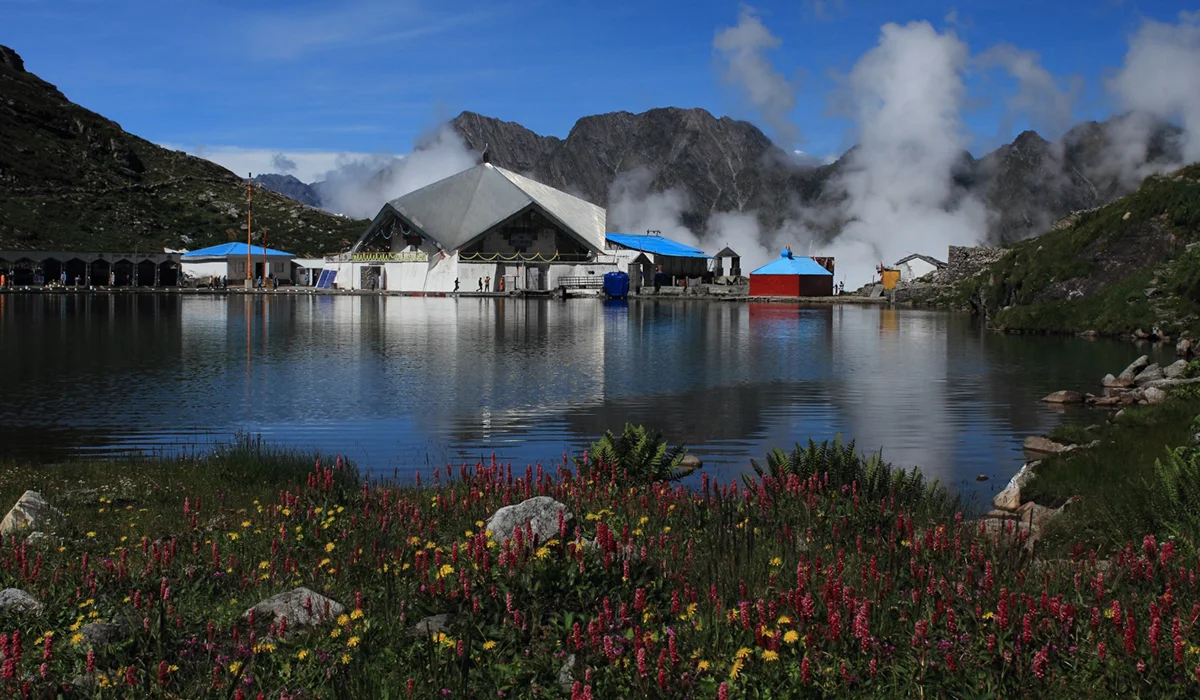

There is a lake in the Himalayas that a Sikh Guru wrote about three hundred years ago, and yet for most of those three centuries, no one could find it.
Hemkund Sahib sits at roughly 15,000 feet above sea level, cradled beside a glacial lake and ringed by seven snow peaks. For Sikhs, it is not simply a pilgrimage destination. It is the site where Guru Gobind Singh, the tenth Sikh Guru, is believed to have meditated in a previous life, attaining union with the divine through severe and prolonged austerity. The Guru himself described this place in precise and poetic terms in the sixth chapter of the Bachittar Natak, which forms part of the Dasam Granth.
He wrote:
“Hemkund Parbat hai jahan, Sapatsring sobhit hai tahan. Sapatsring tih naam kahawa, Pandraj jah jog kamawa. Tah hum adhik tapasya sadhi, Mahakal Kalka aradhi.”
The meaning is this: on a mountain called Hemkund, adorned by seven peaks known as Sapatsring, where the ancient Pandu king once practised yoga, the Guru performed intense meditation. He worshipped Mahakal and Kalika, and through that tapasya, transcended duality and realised the formless absolute.
The words were there for all to read. The location was not.
A Place Locals Already Knew
While the Sikh world searched, the Garhwali people of the surrounding hills had never lost their place. They called it Lokpal, which translates loosely as the guardian of the world, and they regarded it as a site of considerable sanctity, in some accounts more revered locally than Badrinath itself.
This detail would prove important.
In the latter half of the nineteenth century, a scholar named Pandit Tara Singh Narottam began examining the Dasam Granth alongside the Mahabharata, tracing references to King Pandu’s penances and cross-referencing them with the geographical clues embedded in the Guru’s own verses: a lake, seven peaks, extreme altitude. Narottam surveyed several sites and gathered notes on topography, elevation and vegetation. His conclusions were tentative but well-founded.
During one of his journeys, Narottam arrived at Mana, a village beyond Badrinath whose inhabitants call themselves the Rongpa. There, he encountered a group of women preparing to walk to Lokpal for Janmashtami. They intended to bathe in the lake. When Narottam pressed them for details, they told him that Lokpal held greater significance for them than even Badrinath. He asked permission to join the group, and they agreed.
What he saw near the Lokpal lake matched, closely enough, what the Bachittar Natak described. Seven peaks. A still, cold lake. A feeling of elevation in every sense of the word.
The Sikh community, however, paid little attention to his findings. The discovery, such as it was, did not take hold.
The Scholar Who Built the Bridge
Nearly half a century later, the search was revived through literature rather than travel.
Bhai Vir Singh (1872 to 1957) was one of the most consequential figures in modern Sikh intellectual life. A poet, historian, and a central figure in the Singh Sabha movement, he brought rigour and devotion to everything he studied. In 1929, he published Sri Kalgidhar Chamatkar, a title named after one of Guru Gobind Singh’s epithets. The Guru was known as Kalgidhar because he wore a distinctive plume, called a kalgi, in his turban.
In this book, Bhai Vir Singh drew together the verses of the Bachittar Natak, the 1843 work Suraj Prakash by poet Santokh Singh, and scientific observations about Himalayan flora and fauna, weaving them into a coherent argument for the physical existence of a specific, locatable site. The book circulated widely. It stirred something in its readers.
One of those readers was a retired army man serving as a voluntary granthi at a gurdwara in Tehri Garhwal.
The Men Who Made the Journey
Sant Sohan Singh had spent his working life in the military. In retirement, he found himself absorbed by Bhai Vir Singh’s account of Hemkund. He made his first attempt to locate the site in 1933, but failed. He returned in 1934, this time with the assistance of local Lokpal devotees who knew the path.
He found what the Guru had described. The lake was there. The seven peaks were there. Pandu Keshwar lay within reasonable proximity. And Sohan Singh, by his own account, experienced something at that altitude that he could not explain in ordinary terms, a spiritual encounter that left him certain he had found the right place.
When he returned and reported his discovery, the initial response was scepticism. Some thought the whole account a product of wishful thinking. Sohan Singh travelled to Amritsar and met Bhai Vir Singh directly. The two men visited the site together. The identification was confirmed.
Bhai Vir Singh donated 2,100 rupees for the construction of a small gurdwara on the spot.
Working alongside Havildar Modan Singh, a retired Bengal Sapper, and a local merchant named Hayat Singh Bhandari, Sohan Singh oversaw the building of a ten-by-ten-foot structure in 1935 and 1936. A handwritten copy of the Guru Granth Sahib was installed within it. Nanda Singh Chauhan of Pulna village in the Bhyundar Valley also provided substantial assistance to the effort.
When Sohan Singh died in 1939, the work of placing Hemkund Sahib firmly on the map of the Sikh world fell entirely to Modan Singh. That retired havildar carried the effort forward for years, and the people of the surrounding region still refer to him as Baba Modan Singh.
The Gurdwara That Stands Today
The present structure dates to the 1960s, when Major General Harkirt Singh of the Indian Army oversaw a larger building effort. The architect Manmohan Singh Siyali made repeated annual visits to oversee the work, inspecting progress through conditions that would have discouraged most construction projects. The result has endured. Decades of severe weather, seismic activity and the passage of time have not displaced it.
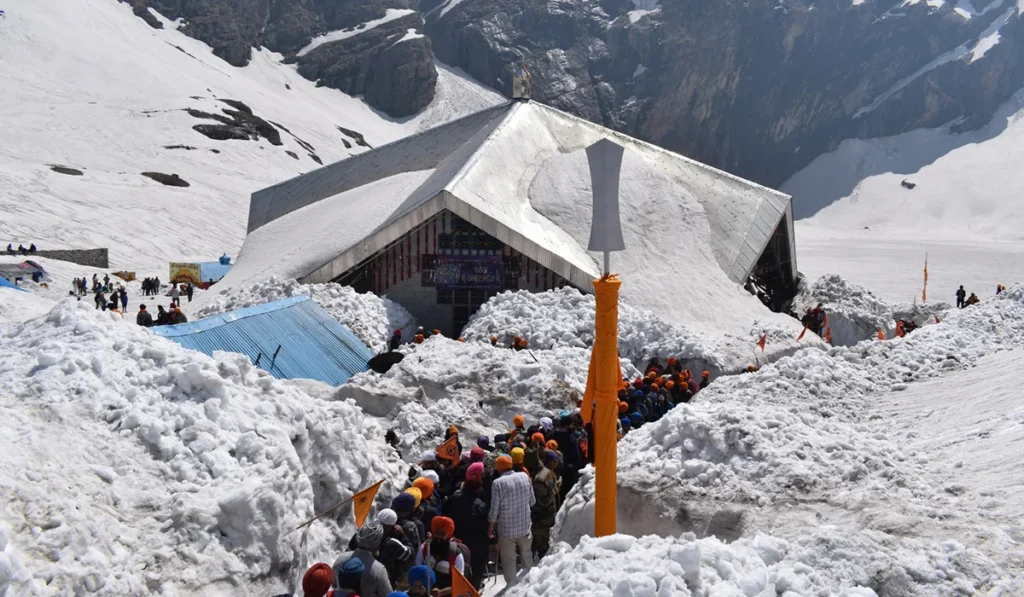
Hemkund Sahib is accessible from Govindghat, with a first stop in Ghangaria and a further six kilometres to the lake. The route is open from June through October each year. Tens of thousands of pilgrims make the journey annually.
The Valley of Flowers lies close by, adding a layer of natural beauty to a place already considered extraordinary by those who reach it.
What the Search Actually Was
The story of Hemkund Sahib’s rediscovery is not simply religious, though it is certainly that. It is an account of how a piece of sacred literature sat in plain sight for generations, pointing at a specific place, while the community it mattered most to lacked the means to act on it.
It took a nineteenth-century scholar cross-referencing texts on foot, a twentieth-century poet compiling evidence into a readable book, and two retired soldiers willing to climb a high-altitude mountain to close the gap between scripture and geography.
The lake was always there. The seven peaks did not move. What changed was the accumulation of effort, faith and practical stubbornness that finally brought people to the shore.

Leave a Comment