
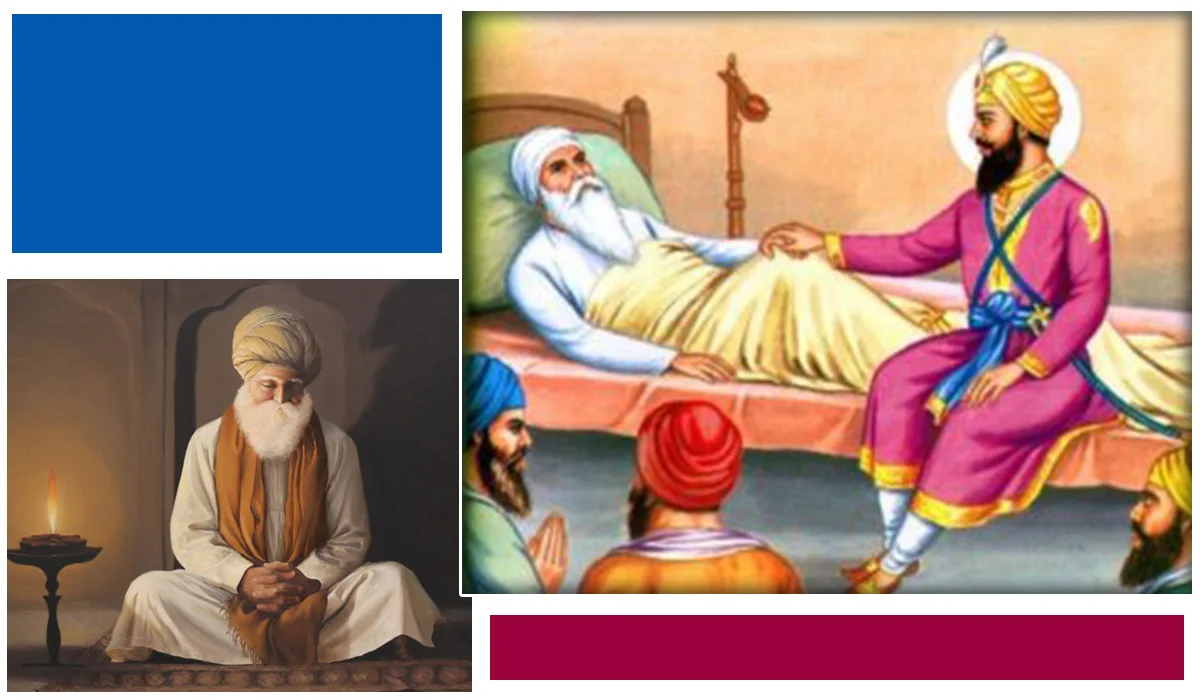

In the late fifteenth century, a child tending buffaloes on the outskirts of a village near Amritsar asked a question that most grown men never think to ask. He wanted to know how to escape death.
The man he asked was Guru Nanak Dev Ji, founder of the Sikh faith, who had by then completed his four great journeys across the subcontinent, spreading the teaching of the Name in every direction. After those travels, Guru Nanak had settled at Kartarpur, in what is now Pakistan, and thousands came daily to sit with him, hear the kirtan, share the langar, and find in his presence something they could not name but plainly needed.
Among those thousands, history remembers twenty by Name. The poet-scholar Bhai Gurdas Ji recorded them in his writings as those who had truly attained a higher station of life. The eighteenth on that honoured list was a man known to Sikhs everywhere as Baba Budha Ji, and the line Bhai Gurdas Ji wrote about him is simple and exact: “Budha meditates with single mind.”
That single line carries the weight of a century of devoted service.
The Child Named Budha
According to the Mahankosh, Baba Budha Ji was born on October 22, 1506, in the village of Kathu Nangal near Amritsar. His father was Bhai Sunghe Randhawa, a Jat farmer, and his mother was Mata Gauran. The family gave him the Name Bura. Not long after his birth, the family moved to the village of Ramdas, and it was there, tending the family’s buffaloes in the fields, that the boy had his first encounter with Guru Nanak.
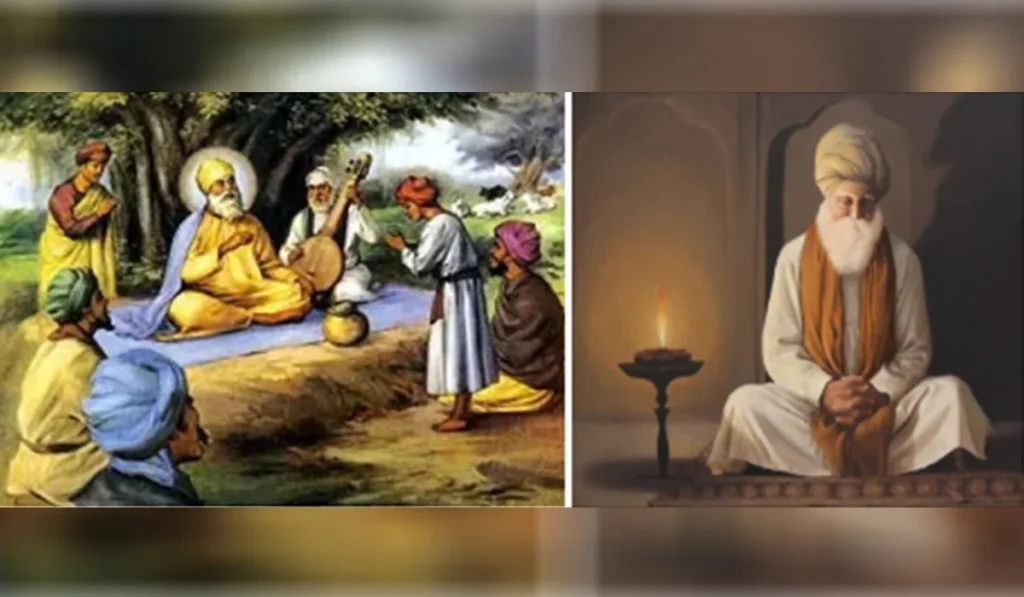
He was eleven or twelve years old. The Guru had stopped near the village, and Bura made his way to where the holy man sat. He listened, and something in what he heard stayed with him. From that day, he returned regularly, sitting quietly, absorbing every word.
One visit changed everything. The boy brought a bowl of milk as an offering and spoke directly to the Guru: “O Benefactor of the humble, I have had your darshan. May my cycle of birth and death be ended.”
Guru Nanak smiled at the child and asked his Name and occupation. The boy answered. Then the Guru said, gently, that a child his age should be thinking of play, of food, of the pleasures of youth. Death and liberation were topics for older men. Come back when you are grown.
Bura’s reply is worth recounting exactly. He said that not long before, Pathan soldiers had passed through the village and cut down the crops without asking, the ripe ones, the unripe ones, and even the half-grown ones together. Since that day, he had not been able to stop thinking that death works the same way. It takes the young and the old and those in between, whenever it chooses, without permission. Who is there to stop it? If no one could stop the Pathans, who would stop death? He might never live to become old. That was why he had come.
Guru Nanak heard the boy out and then laughed, not in mockery but in recognition. He said: “You are no child. Your thinking is that of an older man. You are already old, young Bura. God is far greater and far stronger than death. If you belong to Him, death will not frighten you. It will fear you instead. Remember God at all times. Recite His Name. Love the beings He has created and serve them with love. If the fear of God fills your heart and you work to please Him, love for Him will take root inside you, and then every fear, including the fear of death, will go.”
From that day, his Name was settled. Guru Nanak himself called him Budha, the old one, for the wisdom he carried in a young body. The Sikh community has called him Baba Budha Ji with reverence ever since.
The Weight of the Tilak
Baba Budha Ji left his household and attached himself to Guru Nanak’s court at Kartarpur. He worked the fields, served the congregation, recited the Name, and, in every visible way, embodied the three pillars of Sikh teaching: meditate on God, earn by honest labour, and share what you have. His devotion was not private or hidden. It showed in daily life.
When Guru Nanak chose the moment to pass the succession to Guru Angad Dev Ji, a final test was set for those who remained. Baba Budha Ji was among the three who stood at the end. The Guru told him, “You shall never be hidden from my sight.” And when the ceremony of succession was performed, it was Baba Budha Ji whom Guru Nanak asked to apply the tilak, the mark of guruship, to Guru Angad Dev Ji’s forehead. The honour of applying that tilak passed to his descendants after his death, a recognition of the height to which he had risen.
He performed the same office for each of the next four Gurus in turn: Guru Angad Dev Ji, Guru Amar Das Ji, Guru Ram Das Ji, and Guru Arjan Dev Ji. No other figure in Sikh history applied the tilak to five successive Gurus.
Pillars Built by His Hand
His service was never ceremonial alone. When the sangat could not find Guru Angad Dev Ji, who had gone into seclusion after the passing of Guru Nanak, they came to Baba Budha Ji. He spent the night in prayer and meditation, and in that stillness saw the Guru sheltering in the house of Mai Bhirai at Khadur Sahib. He went there the next morning and brought the congregation to the Guru’s presence. Guru Angad Dev Ji honoured him with words that few could claim: “What teaching would one give to a man who had Guru Nanak himself as teacher?”
When Guru Amar Das Ji went into hiding to avoid Datu’s anger, it was again Baba Budha Ji who found him, broke down the wall of the room where the Guru sat concealed, and persuaded him to show himself to the congregation. Guru Amar Das Ji called him “the perpetual flame of Sikhi.”
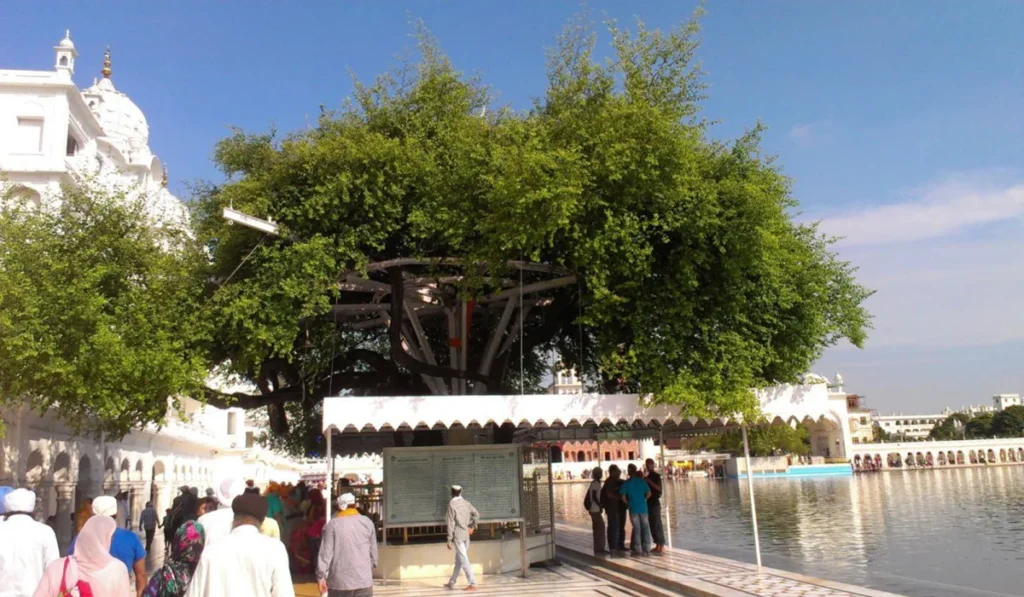
When Guru Arjan Dev Ji undertook the construction of Sri Darbar Sahib at Amritsar, Baba Budha Ji served as the chief administrator of that work. He sat under a ber tree in the northeast corner of the parikrama, supervised the volunteers, and paid the labourers. That ber tree remains at the same spot today. He became the first head granthi of Sri Darbar Sahib and took the first hukamnama from the Guru Granth Sahib after it was installed.
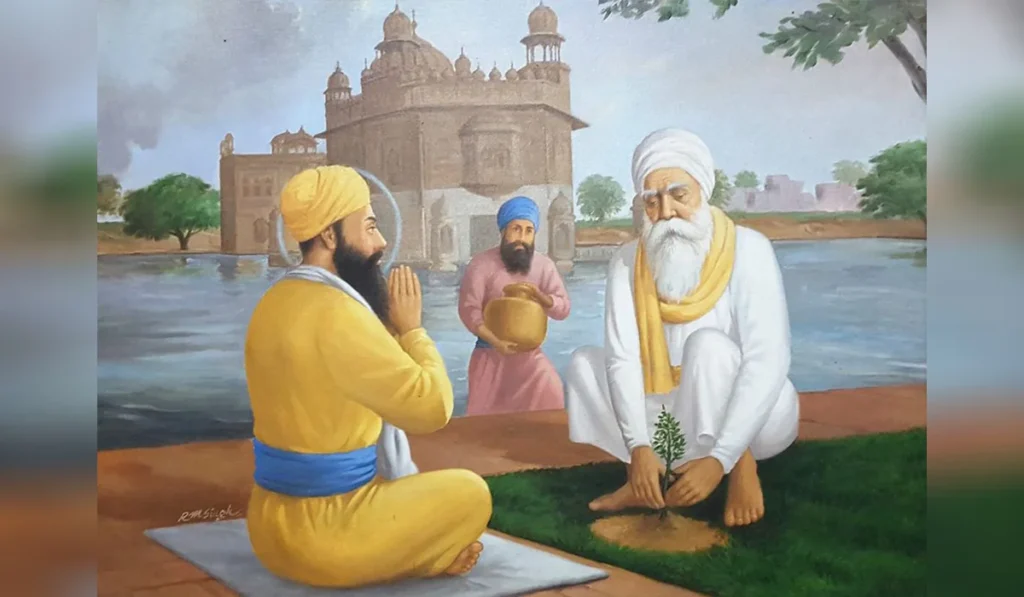
He educated Guru Arjan Dev Ji’s son, the future Guru Hargobind Sahib, teaching him Gurbani, Sikh history, horsemanship, the use of weapons, and wrestling. Later, he did the same for Guru Hargobind Sahib’s own sons. When Guru Hargobind Sahib was imprisoned at Gwalior Fort by Emperor Jahangir, it was Baba Budha Ji whom Mata Ganga Ji sent to carry news of the Guru’s welfare back to the congregation. And it was during that same period of imprisonment that Baba Budha Ji instituted the tradition of evening chaunkis at Darbar Sahib, congregations moving in procession, reciting shabad, and offering ardas. Guru Hargobind Sahib approved the practice and declared it permanent. It continues to this day.
The Final Departure
In 1631, at the age of one hundred and twenty-five, Baba Budha Ji sent word to Guru Hargobind Sahib requesting his presence. The Guru came. Baba Budha Ji placed his son Bhana’s hand in the Guru’s hand and asked that the boy be kept under his shelter. Then, with the Guru’s hands holding his own, he left the body.
The verse that records what followed is brief and plain. When the Guru placed Baba Budha Ji’s body upon the funeral pyre, two tears ran down his face.
For a man who had dedicated more than a century of life to six generations of Sikh Gurus, building their institutions, educating their children, finding them when they were hidden, and guarding what they had built, two tears from a Guru are not a small tribute. They are the most honest record of what Baba Budha Ji was worth.


Leave a Comment