

The Geography of Supply
A six-part reckoning with the drug crisis that is hollowing out India’s most storied martial state — and what it will actually take to stop it
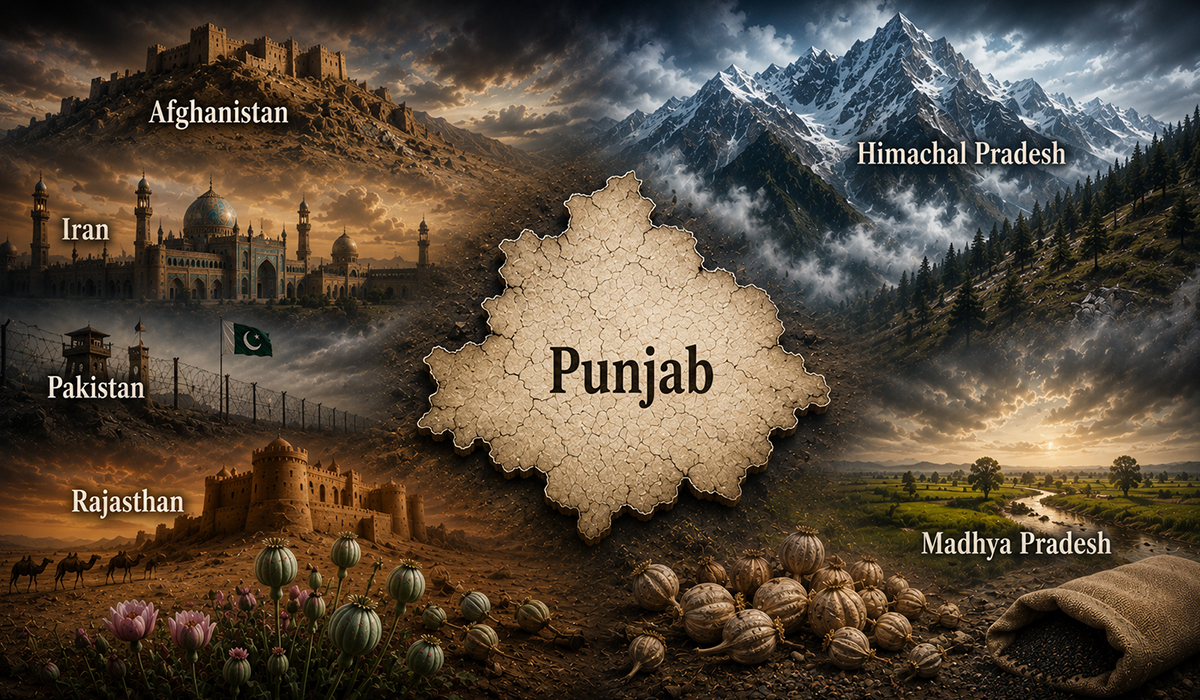
Punjab does not cultivate opium. Heroin is not produced here either. The state also does not have a major chemical industry that supplies precursor chemicals used for manufacturing narcotic substances on a large scale. A major share of the drugs affecting Punjab’s youth comes from outside the state. Therefore, investigating and blocking this supply chain seriously is not only a matter of state policing, but also an important issue of national security and inter-state coordination.
Several drug supply chains reaching Punjab trace back to routes outside the state. Charas comes through Himachal Pradesh. Opium and poppy husk come from Rajasthan and Madhya Pradesh. The biggest concern is heroin, commonly called “chitta”, which is often linked to the Afghanistan-Iran-Pakistan region known as the “Golden Crescent”. Within the international supply chain, its price rises sharply. While one kilogram of heroin is reportedly much cheaper in Afghanistan, by the time it reaches its destination in India, its value can rise to several crores of rupees. This extraordinary profit is the main driver of the illegal trade.
The sea route has also become a serious concern in recent years. The NIA told the Supreme Court that the 2,988 kg heroin seized from Gujarat’s Mundra port in September 2021, valued at around ₹21,000 crore, was not merely a drug smuggling case, but also had international criminal and security dimensions. According to the NIA, the consignment may have been linked to a larger syndicate, and parts of earlier consignments were suspected to have reached Delhi and Punjab. Such cases make it clear that Punjab’s drug crisis cannot be viewed only as a local crime problem.
The Geography of Drug Spread: Signals from a Village-Level Survey
An important ground-level mapping of Punjab’s drug geography was carried out through the Guardians of Governance programme. This programme was launched in 2017 during Captain Amarinder Singh’s government. Lieutenant General T. S. Shergill (Retd.), who led the programme as senior adviser to the Chief Minister, shared some survey findings with this series. According to him, around 4,000 anti-drug officials covered more than 12,000 villages in Punjab. This level of coverage made it an important village-level drug-mapping exercise.
The data was shown on the Punjab map through colours. Red was used for villages where 30 or more drug users were recorded. Villages with lower levels of impact were shown in other colours, including pink, blue and green. Green meant that no drug problem had been recorded in that village.
This data revealed an interesting geographical pattern. The worst-affected rural areas were not limited only to districts bordering Pakistan, such as Amritsar, Tarn Taran and Gurdaspur. Serious signs of concern also appeared in southern Punjab districts such as Mansa, Bathinda, Muktsar and Fazilka. Hoshiarpur and Pathankot were reported to be relatively less affected. Some specific hotspots were recorded in Gurdaspur and Amritsar, but the broader pattern was not confined to border districts.
Lieutenant General Shergill draws two policy conclusions from this data. First, in areas along the Rajasthan border, the older use and trade of poppy husk and opium created certain routes and social acceptance structures, which may later have been used for smuggling other narcotics. Second, today’s major concern is not only traditional opium or poppy husk, but tablet-based pharmaceutical drugs, which can spread through medical and semi-medical channels. According to Shergill, tablets have now become a more serious challenge than poppy husk or opium.
Had the GoG village-level data been systematically used by the police, health department and administration, it could have become the basis for a geographically targeted prevention strategy. The programme was later discontinued. As a result, a ground-level dataset that could have helped drug policy moved out of administrative use.
Drone Smuggling: A New Dimension
In the past few years, the movement of drugs and weapons through drones has emerged as a new and serious challenge. In 2021, only a few cases of drug drops through drones were reported, but by 2024 the number had risen significantly. These cases are said to be mainly concentrated in border districts such as Amritsar, Tarn Taran, Ferozepur and Gurdaspur.
Some Chinese-made hexacopter-type drones are reportedly capable of carrying consignments weighing between five and fifteen kilograms. When the cost of a drone is very low compared to the value of the consignment, smugglers find it commercially viable to use them.
After anti-drone surveillance and action increased in Punjab, there were also indications that smuggling routes could shift towards Jammu and Rajasthan. This means that despite local success, the problem may simply move geographically. Therefore, this challenge cannot be solved only at Punjab’s level. It requires national and inter-state coordination.
BSF: Jurisdiction and Operational Limits
In October 2021, through a notification by the Union Home Ministry, the BSF’s jurisdiction inside the international border in Punjab was increased from 15 km to 50 km. This decision triggered considerable political debate. However, one important operational point often remained behind in this debate: in cases related to narcotics, weapons and customs laws, the actual operational limits of the BSF apply differently.
The extended 50 km jurisdiction mainly applies under the CrPC, Passport Act and Passport Entry Act. Therefore, in matters of anti-drug enforcement, the real administrative significance of this change needs to be understood separately from political claims or fears.
Himachal’s Back Route
Himachal Pradesh is an important pharmaceutical hub in India. Hundreds of licensed manufacturers operate in areas such as Baddi, Nalagarh, Kala Amb and Paonta Sahib. This industry is legally and economically important, but the illegal diversion of some medicines remains a serious concern.
The misuse and illegal distribution of drugs such as tramadol, alprazolam, codeine and benzodiazepines have created new challenges for Punjab and several other states. Some cases of such diversion have been recorded by investigative agencies. Punjab’s STF had claimed to have exposed an inter-state opioid racket linked to a Baddi-based firm, in which the sale of a large number of alprazolam tablets came to light. In 2025, the NCB seized a large quantity of psychotropic tablets and codeine-based cough syrups in a case linked to Digital Vision Pharma in Kala Amb.
These cases show that the monitoring, licensing and audit systems of the pharmaceutical supply chain need to be strengthened further.
There is also a need for a clear and certified national protocol for the secure handling and timely destruction of seized drugs and narcotic substances. After preserving the required samples for forensic evidence, allowing the remaining seized material to lie in warehouses for long periods is risky. It creates the possibility of leakage, substitution or diversion. Therefore, the management and destruction of case property must be made more transparent, time-bound and subject to judicial oversight.
Punjab does not produce this poison. But Punjab is bearing its major social and human burden. Therefore, viewing this crisis only as a failure of Punjab Police or a local law-and-order issue would be an incomplete analysis.
This is a multi-layered crisis involving international smuggling, border security, inter-state supply chains, pharmaceutical diversion, local distribution networks and the treatment system.
In the previous three articles, this problem has been examined through data, enforcement records and supply-chain analysis. The next article will bring forward a different perspective: the testimony of senior Punjab Police officers who have closely witnessed different phases of this crisis.
The author is a retired IAS officer of the 1984 batch of the Punjab cadre and the founder-editor of The KBS Chronicle. This is the third article in a series on Punjab’s drug crisis.
This article was originally published on the author’s personal blog, The KBS Chronicle.



Leave a Comment