

Punjab’s Drug Enforcement: Impressive Numbers, Absent Kingpins
A six-part reckoning with the drug crisis that is hollowing out India’s most storied martial state — and what it will actually take to stop it
Every government’s anti-drug communication follows a fixed template: NDPS FIRs registered, kilograms seized, persons arrested. These are the numbers that appear in press releases, Assembly statements, and ministerial speeches. What is conspicuously absent is the downstream question — how many of those arrested were actually convicted, under which, sections, and at what level of the trafficking hierarchy? An FIR is a beginning, not an outcome. An arrest is an input, not a result. Punjab has generated tens of thousands of both without demonstrating proportionate impact on either supply or addiction rates. The public deserves conviction data disaggregated by offence category — consumption, peddling, or trafficking — not aggregate numbers that blend the small-time courier with the supply-chain financier.
The STF Experiment: Promise and Limitation
When Captain Amarinder Singh returned to power in March 2017, he had taken a public oath on the Guru Granth Sahib to rid Punjab of drugs. The instrument he chose was a Special Task Force, and to head it he selected Harpreet Singh Sidhu, an IPS officer with a reputation for professional integrity, recalled from central deputation in Chhattisgarh. The Sidhu-led STF produced genuine results: between April 2017 and early 2020, law enforcement agencies recovered 1,376 kg of heroin, 1,515 kg of opium, and over 1,24,728 kg of poppy husk. Properties worth Rs 18.46 crore were forfeited in 2017, Rs 11.37 crore in 2018, and Rs 37.69 crore in 2019. The STF’s own police station achieved a conviction rate of 100 per cent.
But Sidhu was removed from the STF following reported friction with the then DGP, reinstated, and eventually the momentum dissipated. The deeper criticism — shared privately even within Congress — was that the big fish would go scot-free. A retired IPS officer had publicly claimed to have prepared a list of 90 persons involved in drug smuggling — including politicians, police officers, and trafficking network principals — which he stated he had handed to the preceding government. However, a DGP-rank officer who served in Punjab, and to whom this series was shared prior to publication, has categorically stated that upon taking office no such list was found, and that no list was ever submitted before the Punjab and Haryana High Court — either in an open application or in sealed cover. The claims, however widely repeated, unverified in official records. It is precisely this kind of asserted-but-unverified narrative that reinforces the perception of an all-pervasive drug mafia operating in full collusion with the police — a perception that, without evidentiary grounding, does as much damage to institutional credibility as any actual nexus it purports to expose. The AAP government replaced the STF with an Anti-Narcotics Task Force in August 2024. The structure changed. The underlying problem — the political economy of the drug trade — did not.
Arresting the Wrong People: The NDPS Structural Flaw
The NDPS Act measures the severity of an offence by quantity seized. A seizure of less than five grams of heroin attracts a maximum imprisonment of six months and a fine of Rs 10,000, with bail easily secured. Traffickers have adapted: once heroin crosses the border, it is not supplied in bulk. Drug addicts are deployed as couriers carrying small quantities, exploiting this legal loophole with clinical precision. The pyramid is designed to sacrifice its base while protecting its apex. The conviction statistics the AAP government now publicises are real but require careful reading. A total of 3,870 convictions were secured out of 4,812 NDPS cases decided by courts in 2022, yielding a conviction rate of 80 per cent — rising to 89 per cent in 2026, the highest in India. The procedural improvements are genuine. But the critical question — what proportion of these convictions are of street-level peddlers, and what proportion of organised trafficking network principals — remains unanswered. An 89 per cent conviction rate built substantially on the bottom of the pyramid is an administrative achievement, not a strategic one.
The End User: A Victim Treated as a Criminal
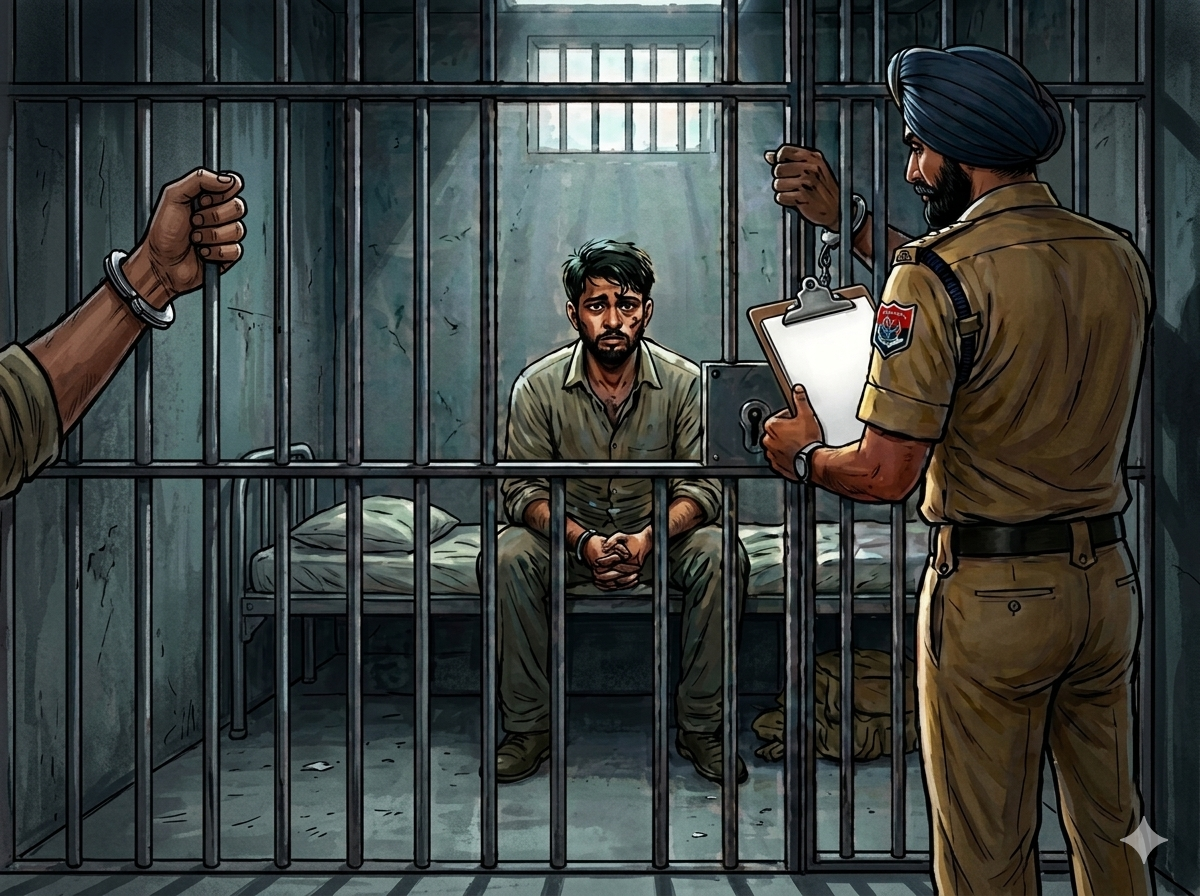
Section 64A of the NDPS Act grants immunity from prosecution to an addict who voluntarily seeks treatment at a government-recognised institution. This is explicit legislative intent: the end user must be treated as a patient, not a prisoner. In practice, this intent is systematically subverted. Law enforcement officials frequently struggle to differentiate between addicts and traffickers. A dependent user caught with a small quantity may be wrongly classified as a peddler and charged under the harsher provisions, leading to long-term imprisonment. The result is a system that incarcerates the addict — destroying whatever social fabric remains in his life — while the financier of the supply chain is either untouched or briefly detained on bail. Around 63
per cent of prisoners in India have a history of drug use. Incarceration aids drug users’ exposure to other criminal offenders, forcing them into a life of deeper crime rather than recovery.
Punjab’s enforcement machinery has improved procedurally. Conviction rates are rising. What has not changed is the fundamental equation. The kingpins largely remain untouched. The street peddler is arrested, convicted, and replaced within weeks. The police release FIR numbers and arrest tallies with commendable regularity. What they do not publish — and what every legislature session should demand — is a conviction audit by offence tier: how many kingpins convicted, how many mid-level financiers, how many couriers. Until that audit exists, the statistics are performance, not accountability. A state that arrests the foot soldier while protecting the general is not fighting a war. It is performing one.
The author is a retired IAS officer of the 1984 batch of the Punjab cadre and the founder-editor of The KBS Chronicle. This is the second article in a series on Punjab’s drug crisis.
This article was originally published on the author’s personal blog, The KBS Chronicle.


Leave a Comment