

Perspectives from inside Punjab’s security system: narco-terrorism, malkhana reform, and families that received no timely warning
A six-part reckoning with the drug crisis that is hollowing out India’s most storied martial state — and what it will actually take to stop it
The first three articles in this series were based on parliamentary panel reports, RTI data, NIA court filings, academic surveys and enforcement records. This fourth article is based on a different set of sources: conversations with serving and recently retired senior officers of Punjab Police and the police service, people who have worked within or led the very system analysed in this series. They spoke on the condition that neither their names nor their exact periods of service would be published.
Their accounts matter because they do not contradict the documentary record. Instead, they deepen it with an internal administrative and security perspective.
The Double Link: Drugs and Weapons
A serving DGP-rank officer of the Punjab cadre, speaking to The KBS Chronicle on condition of anonymity, offered an assessment that places the drone threat discussed in earlier articles within a wider security framework.
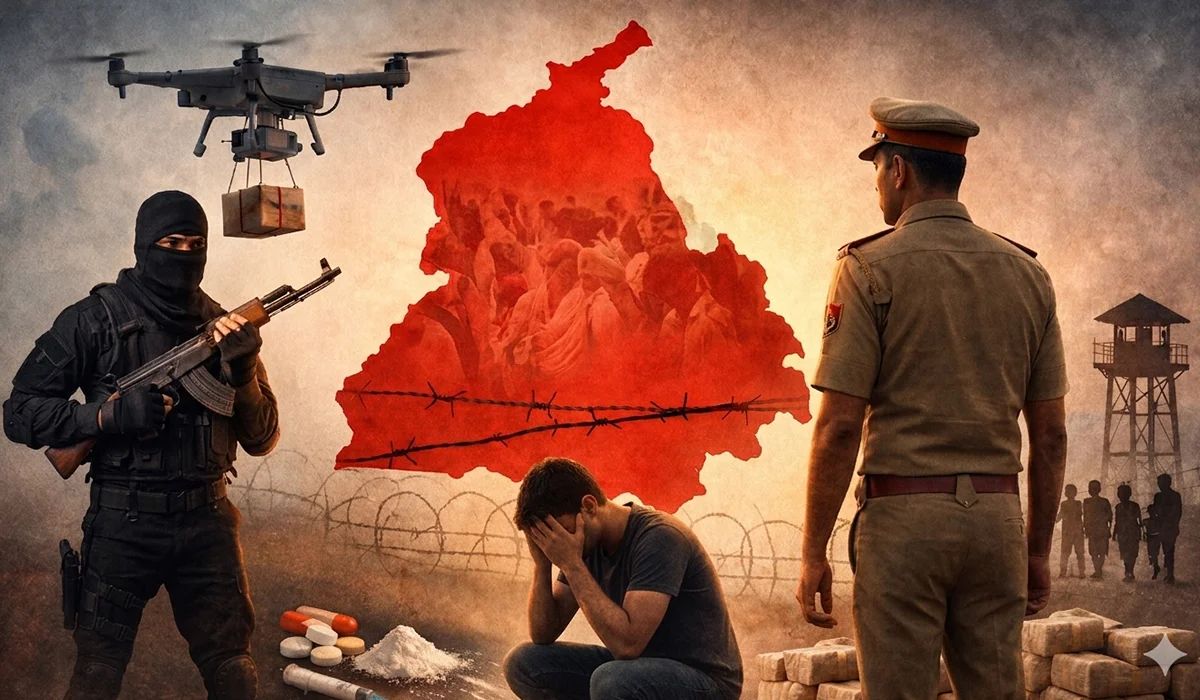
According to him, the issue is not limited to drug smuggling with security implications. It is a more serious narco-security challenge, in which drug trafficking and the movement of weapons appear as linked dimensions.
He said that in several cases, small drones crossing the 553-km-long border fence do not carry only narcotics. There are indications that arms, including pistols, ammunition and, in some documented cases, more sophisticated weapons, are also sent along with drug consignments.
According to him, such operations are neither accidental nor random. The drug consignment gives financial strength to the local network that receives it, while the weapons consignment gives it operational capability. In this way, one drone drop can serve two purposes at the same time: weakening youth through drug supply and delivering weapons to elements linked with distribution networks.
The impact of this has been visible in Punjab’s criminal landscape in different forms over the past few years. The presence of illegal weapons within drug distribution networks has strengthened local zones of influence in several areas. Some gangs view villages, urban wards or transport routes as their operational territories. These boundaries are not formally declared, but they are known locally. When these zones of influence are contested, the possibility of violence increases.
Shootouts, targeted attacks and contract killings seen among gangs in Punjab cannot be treated merely as random crimes. In the assessment of one officer, they are part of a “narco-territorial” trend strengthened by cross-border weapons and income from drugs.
The officer’s main conclusion was that what is often described at the policy level as Punjab’s “drug problem” also contains a serious security dimension. According to him, the possible role of Pakistan-backed elements and the ISI must be examined seriously in this context.
Drugs generate income, weapons increase the capacity for violence, and young people become both the market and the victims in this process. The officer believes that the state often deals with different aspects of the problem separately, but they need to be seen as one combined security and social challenge.
Malkhana Reform
A High Court direction has had significant impact in this area. A recently retired officer, who had served as ADGP and had also held additional charge as DGP for some time, explained the technical details of the “case property” problem raised in Section III and its partial solution.
According to him, the problem was multi-layered. In NDPS cases, seized narcotics have long been kept as case property in police malkhanas and government treasuries. This period often extends for several years, sometimes even more than a decade. In many places, security arrangements remained incomplete, documentation had gaps, and malkhanas were not free from the institutional weaknesses that affect other departments, including corruption, negligence and pressure.
In some cases, allegations also emerged that seized substances had illegally re-entered the supply chain.
The second aspect of the problem is forensic and legal. Narcotic and psychotropic substances can degrade over time. Heroin, opium-based substances and pharmaceutical compounds, if not stored properly for ten or fifteen years, can undergo changes in their chemical composition. In such situations, defence lawyers can question the reliability of evidence during trial. Sometimes cases become weak because the physical condition or chemical stability of the evidence has been affected over time.
In the officer’s assessment, the Punjab and Haryana High Court’s direction proved to be an important and practical judicial intervention in the field of drug prevention and evidence management.
The essence of the direction is this: as soon as a drug consignment is seized, scientific samples should be taken in the presence of independent witnesses; those samples should be preserved as sealed evidence along with a report from the appropriate central or state forensic science laboratory; and the remaining consignment should be destroyed according to prescribed procedure, in the presence of police officers and, wherever possible, a magistrate.
This has had a two-fold impact. First, large physical stocks of seized substances in malkhanas have reduced, lowering the possibility of theft or misuse. Second, the forensic reliability of evidence in the case remains intact through sealed samples and laboratory reports.
The officer also clarified that implementation is still not complete. The directions exist, but their compliance depends on the alertness of officers, the availability of magistrates and the capacity of forensic laboratories. Even so, wherever the process has been implemented properly, positive results have been seen.
No Family Is Fully Beyond Its Reach
The third testimony is of a different kind. It comes from a retired DGP-rank officer of the Punjab cadre, who saw the crisis linked to drugs and mental health not only as an administrator, but also as a father.
His son died by suicide. The circumstances were complex. The young man was struggling with mental illness and was undergoing treatment. After his death, sections of the media linked him to drugs. According to family statements and medical records, this portrayal was not correct. A young man whose mental illness was documented and who was receiving treatment was, after death, attached to a stigma that deepened the family’s grief.
The former DGP does not say this to seek sympathy. He believes this experience carries a serious warning for Punjab’s society: the drug problem, and the mental health crisis that runs alongside it, is not limited to poor, marginalised or rural families. It can also reach homes where people consider themselves socially, economically or administratively secure.
His message is especially for Punjab’s influential classes: politicians, senior officers, senior police officials, business families and civil servants. If families with power or social status believe that their children’s schooling, colony, class or family background will fully protect them from the dangers visible in Tarn Taran’s villages or Ludhiana’s urban areas, that belief does not match reality.
This crisis has already reached many homes where no one imagined that serious conversations about drugs, mental health or youth vulnerability would ever become necessary.
According to him, girls, whether in school or college, are also not completely untouched by this challenge. Availability is widespread, social pressure is often invisible, and early warning signs are frequently misunderstood or ignored because of fears about family honour.
He does not see this as a message of despair. According to him, it is the first condition for a different kind of political and social will. As long as Punjab’s influential class continues to treat this crisis as “someone else’s problem”, government action will remain incomplete. Only when it is accepted that the problem can affect every level of society will the politics and administrative priority of the issue change.
A Named Voice: Lt Gen T. S. Shergill on the GoG Drug Census
Not all testimonies in this article are anonymous. Lieutenant General T. S. Shergill (Retd.), who led the Guardians of Governance programme as senior adviser to Chief Minister Captain Amarinder Singh, agreed to be named. His contribution to the ongoing discussion on drugs is based on experience and field data, which makes it different from a general policy comment.
The Guardians of Governance programme carried out a wide village-level mapping of drug prevalence with the help of around 4,000 drug prevention officers posted across Punjab’s villages. The findings were shown through colours on the state’s district map.
These findings challenged the dominant political assumption of the time. The worst-affected rural areas were not the border districts adjoining Pakistan, such as Amritsar, Tarn Taran and Gurdaspur, but the southern districts of Mansa, Bathinda, Muktsar and Fazilka, which border Rajasthan.
His assessment of the supply route for the southern districts was that it was not linked only to the Golden Crescent route, but also to the legal trade of opium and poppy husk permitted in Rajasthan. This was an older and established route, which later began to be used for the illegal movement of stronger narcotics as well.
In the rural surveys, Hoshiarpur and Pathankot were found to be largely less affected by drugs. No major drug impact was recorded along the border with Himachal Pradesh either.
General Shergill’s View of the Pharmacological Sequence
In his assessment, traditional opium or poppy husk were not the main threat. The more serious challenge came from medicinal tablets that reached Punjab through medical and para-medical channels from Himachal Pradesh’s manufacturing belt.
He said the GoG data was available with the police and administration, and could have been used to prepare a more aggressive and geographically targeted prevention strategy. But according to him, that data was not used properly. Later, the programme was discontinued. With that, the detailed village-level drug mapping gradually disappeared from the administrative process. In itself, this can be seen as an important governance failure.
What Do These Testimonies Tell Us?
If the statements of these officers are read together, one still serving, two recently retired, and all connected with top police leadership, they strengthen the analysis made in the previous three articles through an internal administrative perspective.
The double link between drugs and weapons is not a theoretical assumption. It is an operational trend felt by several officers from inside the security system.
Malkhana reform is also not just a policy suggestion. It is a judicial direction that has shown practical impact wherever implemented properly. Similarly, the spread of the crisis into influential and privileged families is not mere rhetoric. It is rooted in the experience of people who have suffered it closely.
Punjab can find a way out of this crisis. But for that, the section of society that has the power to influence policy and administration must accept that it is not watching this crisis from a safe distance. That distance has now reduced considerably.
The writer is a retired IAS officer of the 1984 batch, Punjab cadre, and the founder-editor of The KBS Chronicle. This is the fourth article in a six-part series on Punjab’s drug crisis. Some statements in this article were provided to The KBS Chronicle on condition of anonymity. The identities of these officers are known to the editor.
This article was originally published on the author’s personal blog, The KBS Chronicle.


Leave a Comment