
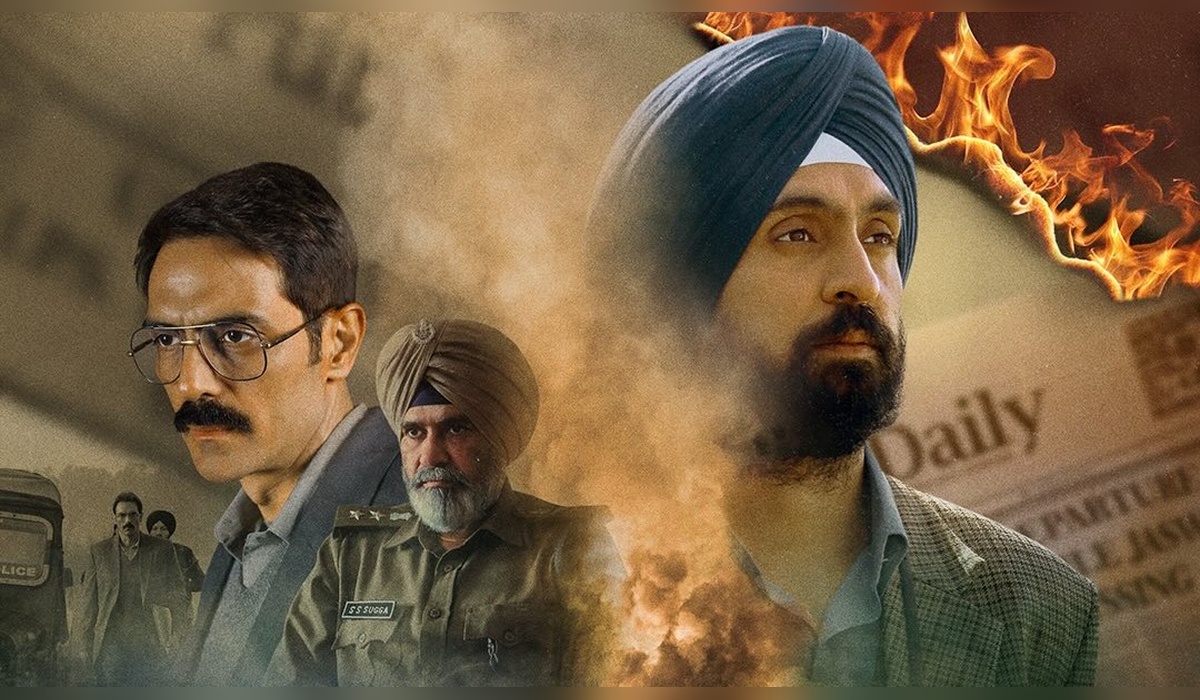

The context then and now is something that cannot be ignored.
The Context
The sudden removal of Diljit Dosanjh’s film Satluj — earlier known as Punjab ’95 — from ZEE5 within 48 hours of its digital release has reopened one of the most difficult and painful chapters in Punjab’s recent history.
The film is based on the life of Bhai Jaswant Singh Khalra, who investigated the alleged illegal cremation of unidentified bodies during the years of militancy and counter-insurgency in Punjab. Its withdrawal from the OTT platform has led to sharp reactions from political leaders, Sikh organisations, free-speech advocates and those who believe that the film presents a dangerously selective account of that period.
My Standpoint
I participated in a discussion on The Mojo Story, anchored by Barkha Dutt, on this very issue. I spoke not merely as a commentator, but as someone who had seen those years from close quarters. I was Deputy Commissioner, Amritsar, from 1992 to 1996. I was also a prosecution witness for the CBI in the Special CBI court proceedings that led to the conviction of six Punjab Police officials in the Bhai Jaswant Singh Khalra case.
My view on the issue is rooted in the constitutional, administrative and historical context.
Free Speech Is Not Absolute in India
To begin with, freedom of speech and expression in India is not absolute. It is subject to reasonable restrictions, including public order, morality and other constitutionally recognised grounds. Therefore, the issue cannot be reduced to a simplistic claim that every film, irrespective of its content or consequences, must circulate without restriction.
In this case, the Central Board of Film Certification had reportedly suggested more than 120 cuts. There had also been litigation before the Bombay High Court, which was later withdrawn. Therefore, it is not correct to say that the regulatory system had never applied its mind. The real gap appears to have arisen because theatrical release and OTT release operate under different regulatory frameworks. A film that had not cleared the theatrical route appears to have entered the public domain through OTT self-classification.
Bhai Khalra’s Research in Factual Perspective
On Bhai Jaswant Singh Khalra’s work itself, the matter needs to be placed in factual perspective.
Bhai Khalra’s research was based substantially on cremation-ground registers, which are maintained by municipal authorities and from which death certificates are issued. He identified entries marked as “unidentified”. Eventually, in proceedings before the Supreme Court and the National Human Rights Commission, the figure of about 2,096 unidentified cremations emerged. This body figure is not be conflated with fake encounters aggregated.
This is a serious issue and cannot be brushed aside. But it is equally important not to inflate or decontextualise the figure to create an impression that tens of thousands were simply disappeared by the state.
The Larger Tragedy of Punjab
During the two decades of the 1980s and 1990s, roughly 12,000 innocent civilians and about 1,800 police personnel were killed in Punjab. Senior police officers were assassinated. Civilians were pulled out of buses and shot. Families across communities suffered. The state was facing a Pakistan-sponsored proxy war.
I have no hesitation in saying that extrajudicial killings, disappearances or executions cannot be justified. They were not justified then, and they cannot be justified now. In the Bhai Khalra case itself, six persons stood convicted, with life imprisonment ultimately upheld. Legal accountability did occur.
One-Sided Storytelling Can Mislead
But that does not mean that a film should isolate one aspect of the tragedy and present it as the whole truth. If the film focuses only on one disappearance, or only on unidentified cremations, while omitting the full terror, civilian killings, police casualties, Pakistan’s role and the collapse of institutions, it risks misleading a generation that did not live through those years.
Punjab today needs healing. It does not need selective reopening of wounds.
Old Wounds Require Responsible Handling
Tomorrow, someone may make a film on tanks entering the parikrama of Sri Darbar Sahib during Operation Blue Star. Someone else may make a film glorifying those who assassinated General Vaidya. Someone may make a film on the anti-Sikh pogroms of November 1984. All these are historical subjects. But if each is told selectively, with the purpose or effect of reopening communal wounds, then the consequences for Punjab’s psyche can be serious.
The Politics of Selective Outrage
One must also examine the politics around the controversy. Once the film was taken down, the decision came to be seen as a central-government or BJP decision. Therefore, Congress, Akali Dal and AAP all criticised the takedown. But one must ask whether all this outrage is principled.
Bhai Khalra had been associated with the human-rights wing of the Shiromani Akali Dal. Yet when his widow contested the 2019 Lok Sabha election from Khadoor Sahib, the Akali Dal fielded its own candidate against her. If he is now being invoked as a martyr, why was that recognition missing then? Similarly, one must ask why his portrait does not occupy the kind of institutional space now being demanded rhetorically.
Why the Film Should Not Have Been Released in This Form
My conclusion on the release of the film is clear. In my view, the film should not have been allowed to be released in this form in the first place, especially after the CBFC had applied its mind and suggested extensive cuts. If those cuts were unreasonable, the legal remedy was to pursue the matter before the court. Having withdrawn the writ petition, the makers could not bypass the process through OTT release and then claim a pure free-speech defence.
The Ban May Still Prove Counterproductive
That said, I also recognise the practical consequence. Once released and then removed, the film will now be seen far more widely than it might otherwise have been. The takedown may have created precisely the curiosity it sought to avoid. Some damage, at least temporarily, has already been done.
Free Speech Needs a Wider Reform
On free speech, my view is not one of opposition. I am all for free speech. But if India wants a truly robust free-speech culture, then it must also confront criminal defamation, multiple FIRs over tweets, and the harassment of journalists, humourists, activists and public commentators. It cannot selectively invoke free speech for one film while maintaining a legal structure that routinely chills expression across the country.
Tell Punjab’s History — But Tell It Whole
Therefore, my position is this: tell Punjab’s history, but tell it whole. Do not justify disappearances or extrajudicial killings. But do not isolate them from the larger proxy war, the slaughter of civilians, the killing of police officers, Pakistan’s role, militant terror and the collapse of institutions. Free speech matters, but in India it exists within constitutional and legal limits.
A film that selectively glorifies Bhai Khalra, or projects only one side of the conflict, risks damaging Punjab’s healing process and giving leverage to separatist elements abroad.
Punjab’s Healing Must Not Be Selective
Punjab has suffered deeply. It has healed in many ways, and much healing is still required. That healing will not come through suppression alone, nor through selective glorification. It will come only when the full truth is told — courageously, soberly and responsibly

Leave a Comment