

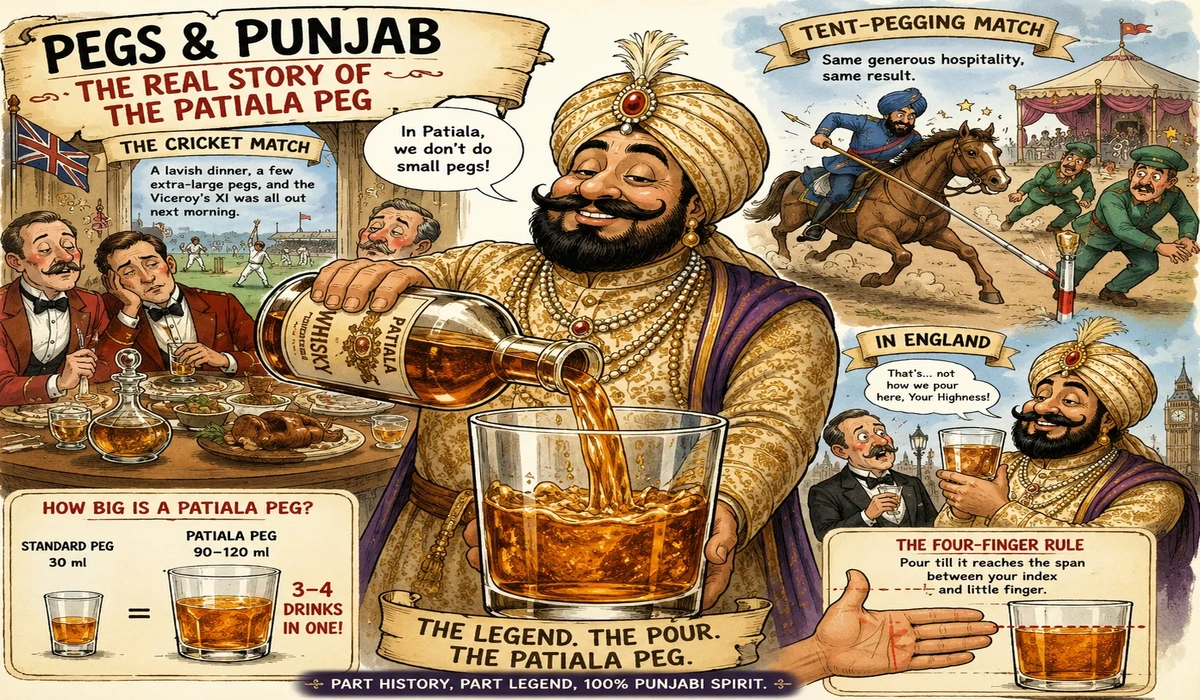

A large pour, a larger legend, and a Maharaja who may or may not have out-drunk the British Empire for the sake of a cricket trophy.
I. Myth, Measure and Maharaja
Ask for a “Patiala peg” anywhere from the exclsuive Chandigarh Golf Club to a wedding tent in rural Bathinda, and the bartender’s hand doesn’t even hesitate: not the meek 30 ml measure served in most Indian bars, but something closer to four times that — a pour generous enough to make water feel like an unnecessary imposition. The phrase escaped its royal cage decades ago and now turns up in Bollywood lyrics, election-season insults, and the ordinary vocabulary of Punjabi hospitality, usually accompanied by a look that dares you to ask for less. Few who use it could say with any confidence where it comes from, or how much of the legend is history and how much is simply a good story that refused to die quietly.
That gap is worth closing — not least because the peg’s supposed birthplace, princely Patiala under Maharaja Bhupinder Singh, sits at the intersection of two things this column enjoys equally: Punjab’s history, and the gap between what actually happened and what has simply been repeated enthusiastically enough, over enough pegs, to sound true.
II. The Man Behind the Legend
The ruler at the centre of every version of this story is Maharaja Bhupinder Singh of Patiala, who reigned from 1900 to 1938 and remains, a century on, the gold standard for princely excess — a man who appears to have never encountered a good time he didn’t immediately try to supersize. He was a familiar face in London and on the Continent, an enthusiastic patron of polo and cricket, and the architect of a durbar reputation for extravagance that Patiala has never quite been allowed to live down. He was also the grandfather of Captain Amarinder Singh, whose own writings later kept the peg story in circulation, presumably over dinner-table retellings that only grew more heroic with each generation.
It is precisely this reputation — real, well documented, and cultivated with evident relish by Bhupinder Singh himself — that lends the legend its plausibility. A ruler who entertained on that scale hardly needed embellishment to seem larger than life; the trouble for the historian is working out which specific anecdotes are event, and which are simply afterglow with excellent production values.
III. The British, the Double Peg, and the Fixed Match
The core story survives in at least three overlapping versions, and none of them rests on anything so inconvenient as a contemporaneous written record — all descend from family memoir, retelling, and the sort of embellishment that improves with age, much like the whisky itself. The best-known version is cricketing. A Viceroy’s XI is said to have toured Patiala for a friendly fixture the home side feared losing outright, so the night before the match the visitors were treated to a lavish durbar dinner at which the pegs were unusually — and repeatedly — generous. When the political agent objected to the size of the pours, Bhupinder Singh is supposed to have replied, with the dry wit that made the line immortal, that in Patiala the pegs simply ran larger than elsewhere. Britain’s finest, it seems, discovered the hard way that diplomacy and double pegs are a poor combination the night before a match; the following morning, an unsteady visiting side duly collapsed, and Patiala won.
A second, closely related version swaps cricket for tent-pegging — a 1920 contest between Bhupinder Singh’s Sikh horsemen and a visiting Irish team, with the same generous-banquet-the-night-before device doing the disabling. A third, gentler variant skips the contest altogether and relocates the entire affair to England, where the Maharaja is said to have found the local peg too mean for his taste, taken matters into his own hands, and poured himself what became, by report, a four-finger measure — presumably to the quiet alarm of his hosts.
Three contests, three casts, one recurring plot device: an oversized pour, deployed strategically to the home side’s advantage. That repetition tells its own story. It suggests less a single remembered evening than a durbar reputation that later storytellers found irresistible to dramatise in whichever setting suited the anecdote of the day. None of this makes the underlying reputation for lavish hospitality false; it simply means the specific anecdotes should be filed under legend anchored in a real personality, rather than sworn testimony.
IV. How Big Is a Patiala Peg? Fact Versus Folklore
On the measure itself, there is rather more consensus than on the mythology surrounding it. Bar practice generally treats the Patiala peg as 90 to 120 ml of spirit, against a standard peg of 30 ml — a ratio generous enough that ordering “just a small one” at a Punjabi wedding tends to be received as a charming, if doomed, ambition. Folk measurement adds its own unscientific but entirely serviceable gloss: bartenders and old hands describe pouring until the liquid reaches the span between an outstretched index finger and little finger held against the glass — the celebrated “four-finger” peg, thumb notably and mercifully excluded from the calculation.
For readers tempted to take the peg entirely literally, a brief and sobering aside: at 40 per cent alcohol by volume, a 120 ml pour contains roughly 38 grams of pure alcohol — comfortably outrunning what most public-health authorities consider a single standard drink. Set against British or American conventions, where a standard drink typically contains 8 to 14 grams, the Patiala peg is, quite unapologetically, three to four drinks masquerading as one. Water, at this point, is less a mixer than a diplomatic afterthought.
V. Is the Patiala Peg Uniquely Punjabi?
It would be unfair — and inaccurate — to treat the Patiala peg as proof that Punjab, alone among India’s regions, drinks with any particular abandon. Princely courts across the country, Baroda, Gwalior and Hyderabad among them, cultivated equally extravagant reputations for hospitality and drink; Patiala’s real distinction lies not in the scale of its indulgence but in the marketing genius of putting the state’s name on a specific measure, and making it stick.
The wider social picture, inconveniently for the stereotype, is also rather more restrained than the legend suggests. Field surveys from the 1970s found that roughly half of adult Punjabi men reported consuming alcohol at all, with genuinely heavy drinkers forming a much smaller minority — hardly the region-wide bacchanal the peg’s reputation implies. Meanwhile, reform movements within Sikh and Arya Samaj traditions have for over a century campaigned, with considerable moral force and rather less success, against drink as a matter of religious and family discipline. Punjab, in other words, hosts both a real drinking culture and an equally real counter-current of temperance — not a monolithic love affair with the bottle, however good the branding.
VI. Weddings, Screens, and How the Peg Became a Symbol
A durbar anecdote survives on charm alone; it takes something more structural to become a living tradition, and in Punjab that structure has unmistakably been the wedding. The baraat, the sangeet, the reception — each comes with its own drinks table, and the generosity of the pour poured there has long doubled as a visible marker of the host family’s means, in much the same way the spread of dishes does for food. “Chaar ungal” is requested as casually at a village wedding tent in Bathinda as at a five-star Chandigarh banquet, and pouring thin at either can be read, rightly or wrongly, as an unforgivable failure of hospitality. Somewhere in this process, the Patiala peg stopped being a durbar curiosity and became a working unit of Punjabi celebration — entirely detached from whether anyone at the table could place Bhupinder Singh in a sentence, let alone a history book.
Cinema then made the image thoroughly portable. Mira Nair’s Monsoon Wedding (2001) is the film most often credited with exporting this template internationally — its Delhi-staged Punjabi wedding, whisky flowing as generously as the marigolds, gave a global audience its enduring picture of what such a celebration looks and sounds like. The mainstream Hindi wedding-and-joint-family genre that flourished from the 1990s onward borrowed the same grammar with enthusiasm: the sangeet staged around a well-stocked bar, the oversized peg poured and toasted as visual shorthand for festivity itself. Punjabi-language cinema and music went further still, turning the peg into an outright emblem of rural plenty and Jat pride, set alongside the dhol and the tractor in song after song aimed at an audience already primed to cheer at the reference. Between the wedding tent and the screen, a princely anecdote of dubious provenance was converted into full-blown folk currency — repeated so often that its royal origin has become almost incidental to what it now means at any given Saturday-night sangeet.
VII. The Story’s Afterlife: From Royal Joke to Mass Culture
Shaky documentary footing has done remarkably little to slow the anecdote down. The phrase migrated from durbar gossip into film lyrics, the standard vocabulary of bar menus nationwide, and everyday banter entirely untroubled by any knowledge of Bhupinder Singh or interwar Patiala politics. Amarinder Singh’s own retelling of the family story gave it fresh circulation in recent decades, and the local press has periodically revived it, not least during election seasons, when “Patiala peg” becomes a convenient bit of shorthand for insinuating royal indulgence against a political rival — proof, if any were needed, that a good insult never really goes out of fashion in Punjab politics.
That trajectory — from durbar anecdote to nationally recognised unit of measure to reliable political dig — says something about how Punjab’s public image gets made, and remade. A colourful story, attached to a genuinely photogenic historical figure, can comfortably outrun the evidence behind it and still do useful cultural work for a hundred years and counting. The honest approach is not to debunk the Patiala peg out of existence — that would be no fun for anyone — but simply to keep a straight face about what is documented history, what is cherished family legend, and what is, frankly, just very good copy.
Global television even got in on the joke, whether it meant to or not. The BBC’s Yes Minister sent Jim Hacker’s delegation to a fictional, dry Middle Eastern sheikdom in its 1982 episode “The Moral Dimension,” where the British party ingeniously smuggled in whisky disguised as urgent telegrams from “Mr Haig,” “Mr Smirnoff” and “Teachers,” routed through a hastily built communications room. Some enthusiastic retellings credit the gag to the spirit, if not the letter, of the Patiala peg — no scriptwriter has ever gone on record confirming the debt, so file it as an unofficial footnote to the legend rather than a verified one. But if the cap fits, Sir Humphrey would certainly wear it.
VIII. Fact and Fiction, Side by Side
Fact: the Patiala peg is a genuine, long-standing tradition of generous measure, rooted in the court culture of Maharaja Bhupinder Singh, and kept thoroughly alive today by the wedding drinks table and the cinema screen as much as by the original durbar anecdote. Fiction: that any specific match, tournament or drawing-room encounter can be verified as its precise moment of invention — the cricket, tent-pegging and England variants cannot all be literally true, and not one of them rests on contemporaneous documentation. Fiction, too, is the broader and rather unkind inference sometimes drawn from the phrase — that it describes how all Punjabis drink, every single evening, without exception. The measure is real, and its staying power is entirely real; the universal Punjabi appetite for it, mercifully for the region’s liver health, is not. Cheers — in moderation, dear reader, in moderation.


Leave a Comment