

Akali Dal (Waris Punjab De) exists, has won, and has pledged allegiance to the Constitution. The Election Commission has yet to issue its birth certificate.
A Peg to the Poll
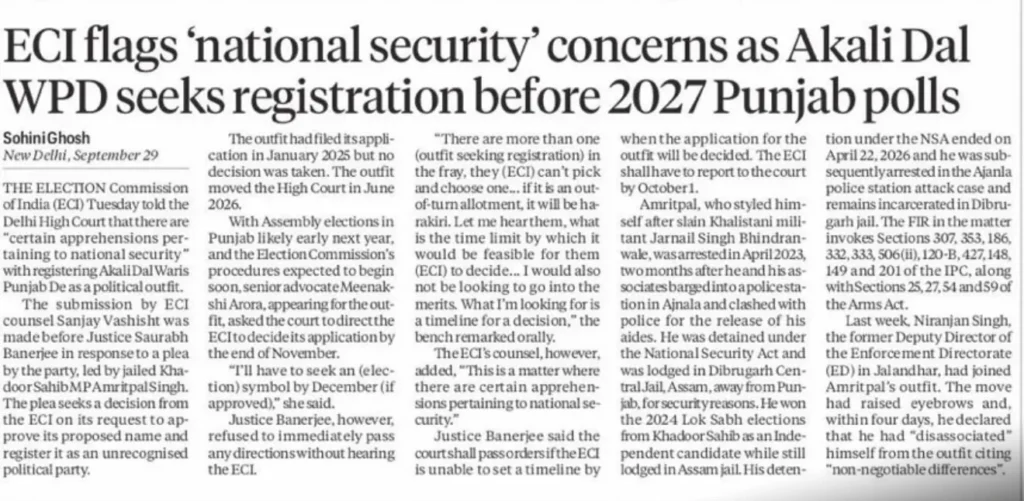
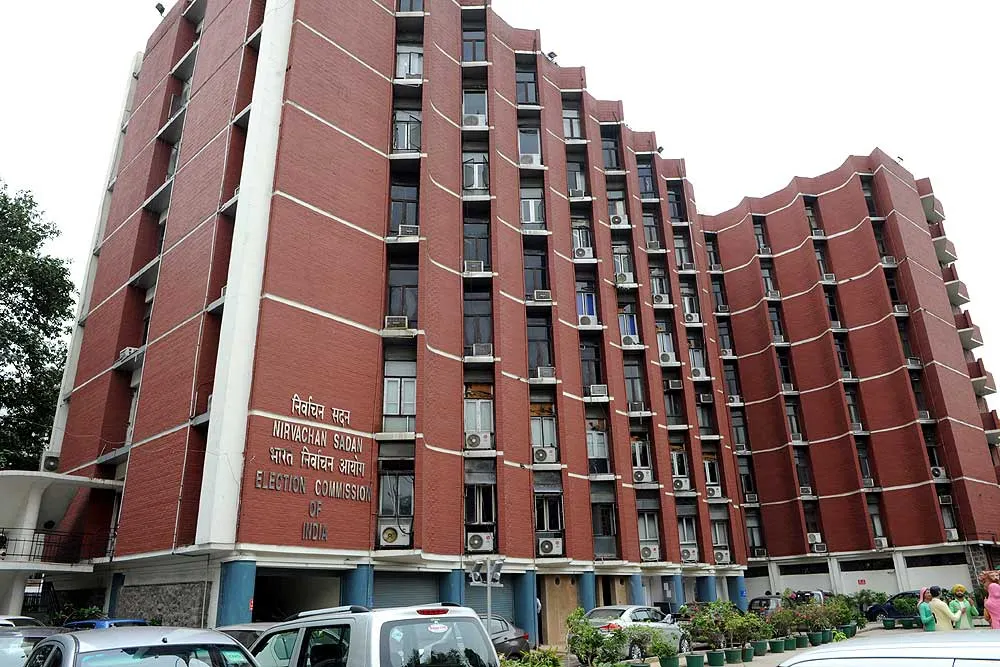
On Tuesday, 29 September 2026, counsel for the Election Commission of India told Justice Saurabh Banerjee of the Delhi High Court that there are “certain apprehensions pertaining to national security” with registering Akali Dal (Waris Punjab De) as a political party. The outfit is led by the jailed Khadoor Sahib MP, Bhai Amritpal Singh. It applied for registration in January 2025, heard nothing for seventeen months, and went to court in June 2026. Its counsel, senior advocate Meenakshi Arora, asked for a decision by the end of November so that the party can seek an election symbol by December.
The judge declined to go into merits. He wanted a timeline, and warned that with more than one outfit in the queue, an out-of-turn decision would be hara-kiri. The Commission must tell the court by 1 October, tomorrow, when it proposes to decide. Otherwise the court will pass orders.
That is the news. The context is what matters. With the Punjab Assembly’s term ending in March 2027, this is no longer an application sitting in a file. It is a pre-election question: whether the one new Panthic formation to have won a Lok Sabha seat in 2024 goes into 2027 as a party or as a crowd of independents.
What a Certificate Buys
Think of registration as a birth certificate. The child has been born; the nursing home knows it, the neighbours know it, and in 2024 Khadoor Sahib voted for it. Without the certificate, however, it cannot be enrolled in school, draw a ration or claim an inheritance. An unregistered party exists, holds rallies and may even win, but the law does not recognise it. Consider what the certificate, issued under Section 29A of the Representation of the People Act, 1951, actually confers.
A symbol, or at least a place in the queue. Under Paragraph 10B of the Election Symbols (Reservation and Allotment) Order, 1968, a registered unrecognised party may ask for a common symbol for all its candidates at a State Assembly election, provided it sets up candidates in at least five per cent of the constituencies. In Punjab’s House of 117, that means six candidates. The request may be made only in the period beginning six months before the House’s term expires. That is why Punjab’s window is already open, and why the November date is not a whim. The concession is available for two general elections, with a fresh application each time.
Even without a common symbol, registration matters constituency by constituency. Under Paragraph 12(3)(a) of the same Order, where several candidates choose the same free symbol and only one of them has been set up by a registered unrecognised party while the rest are independents, the Returning Officer must allot that symbol to the party’s candidate “and to no one else.” An unregistered outfit’s nominees are independents in law. They join the general lottery of buckets, bangles and batteries, and a voter in Tarn Taran must be taught a different symbol from a voter in Moga.
Money, lawfully raised. Section 29B of the 1951 Act allows a registered party to accept voluntary contributions from any person or company other than a Government company. Foreign sources are barred by the Foreign Contribution (Regulation) Act, 2010. Section 182 of the Companies Act, 2013 allows companies to contribute to political parties, and under the Electoral Trusts Scheme, 2013, electoral trusts may pass their funds only to registered parties.
The tax law follows the same line. Under Section 13A of the Income-tax Act, 1961, carried into Section 12 and Schedule VIII of the Income-tax Act, 2025 from 1 April 2026, a registered party’s income from house property, other sources and capital gains, and all its voluntary contributions, are excluded from its total income. The exemption depends on five conditions:
- audited books of account;
- a record of every contribution above ₹20,000 with the donor’s name and address;
- no cash donation above ₹2,000 from any one donor;
- the income-tax return filed by the due date;
- the annual contribution report filed with the Commission under Section 29C of the 1951 Act, failing which the party forfeits all tax relief.
The Congress learned how strictly these conditions are enforced when the Income Tax Appellate Tribunal, in July 2025, upheld the denial of its exemption for 2018–19 on ₹199 crore of income.
Donors, too, benefit only when they give to a registered party. A company may deduct its contribution under Section 80GGB of the 1961 Act, now Section 136 of the 2025 Act. Any other assessee may deduct it under Section 80GGC, now Section 137. In both cases, the contribution must be made otherwise than in cash, to a party registered under Section 29A or to an electoral trust. The deduction is available to individuals who remain on the old tax regime, and to companies not on the concessional rate.
A gift to an unregistered outfit earns no deduction under either regime, and nothing obliges the outfit to report it to the Commission. Its war chest stays small or goes underground. Neither outcome serves the cause of clean elections that the Commission rightly champions.
Spending that does not count against the candidate. Rule 90 of the Conduct of Election Rules, 1961 caps an Assembly candidate’s expenditure in Punjab at forty lakh rupees. Section 77 of the 1951 Act, however, counts only the expenditure a candidate or election agent incurs or authorises, so a party’s general propaganda for its programme falls outside that account. Clause (a) of Explanation 1 to Section 77(1) also excludes the travel expenses of party leaders propagating the party’s programme. Explanation 2 caps the number of such leaders, the “star campaigners” of popular usage, at forty for a recognised party and twenty for any other party. A group of independents has no such cover. Every rally, hoarding and helicopter is charged to one candidate’s forty lakh.
Discipline after the count. This is the benefit least discussed, and the most important for the stability of the next House. Under Paragraph 2(1)(b) of the Tenth Schedule to the Constitution, a legislator elected on a party ticket who votes against the party whip may be disqualified. Independents follow no whip. Paragraph 2(2) of the same Schedule also disqualifies an independent who joins any political party after the election.
So a bloc of independents cannot later become a party, even if the Commission registers that party the week after the results. It can only lend its support, one vote at a time, to whoever asks most persuasively. The Commission’s reluctance would therefore produce legislators more open to bargaining, not less. Anyone worried about Punjab’s stability should prefer a party that is visible, whipped and answerable to one that is dispersed and for hire.
The Checklist, Not the Character Certificate
What does the law ask of a new party? I have discharged statutory duties under the election law at every level, from presiding officer to District Election Officer. The requirements have always been a checklist, not a character certificate.
Under Section 29A of the 1951 Act, any association or body of individual citizens of India calling itself a political party may apply within thirty days of its formation. The application, signed by the party’s president or general secretary, must give its name, headquarters, office-bearers, membership and units, with a copy of its constitution. The Commission’s guidelines add:
- a processing fee of ₹10,000;
- at least a hundred members who are registered electors, each with an affidavit that they belong to no other registered party;
- publication of the proposed name and address in two national and two local dailies, inviting objections within thirty days;
- a party constitution that provides for periodic organisational elections, fixed terms for office-bearers, and procedures for amendment, merger and dissolution.
Only one requirement goes to allegiance, and Parliament wrote it into Section 29A(5) itself. The party’s constitution must contain a specific provision that it bears true faith and allegiance to the Constitution of India as by law established, and to the principles of socialism, secularism and democracy, and that it will uphold the sovereignty, unity and integrity of India. That declaration is the statutory test of loyalty. Akali Dal (Waris Punjab De) has given it.
Under Section 29A(7), the Commission then considers the particulars “and all other necessary or relevant factors,” hears the applicant, and decides. Its decision is final, subject only to the writ jurisdiction the Delhi High Court is now exercising. The phrase “all other necessary or relevant factors” is the only peg on which “national security” can hang. It is a slender peg.
Apprehension, Not Adjudication
In Indian National Congress v. Institute of Social Welfare (2002), the Supreme Court held that the Commission acts quasi-judicially when it registers a party, and that the statute gives it no general power to cancel a registration. It recognised only narrow exceptions:
registration obtained by fraud or forgery;
a party amending its constitution to drop the Section 29A(5) pledge;
any like ground where no inquiry is called for on the Commission’s part. A formal ban on the party by the Union Government is the obvious instance.
That last route is the key. Under Section 3 of the Unlawful Activities (Prevention) Act, 1967, the Union Government may declare an association unlawful by notification, stating its grounds. Under Sections 4 and 5, the declaration must be confirmed by a Tribunal presided over by a High Court judge. This is Parliament’s answer to an organisation that threatens the nation: a formal ban, with reasons, tested by a judge. Parliament has not given the Commission a power to leave a Section 29A file pending on the strength of an unstated apprehension.
As far as the public record shows, national security has not been raised before against a newly formed party that has given the statutory pledge. In Madhyamam Broadcasting Ltd v. Union of India (2023), the Supreme Court warned that national security cannot be invoked like a magic phrase to shut out scrutiny. If the Commission holds material, it should put it before the court.
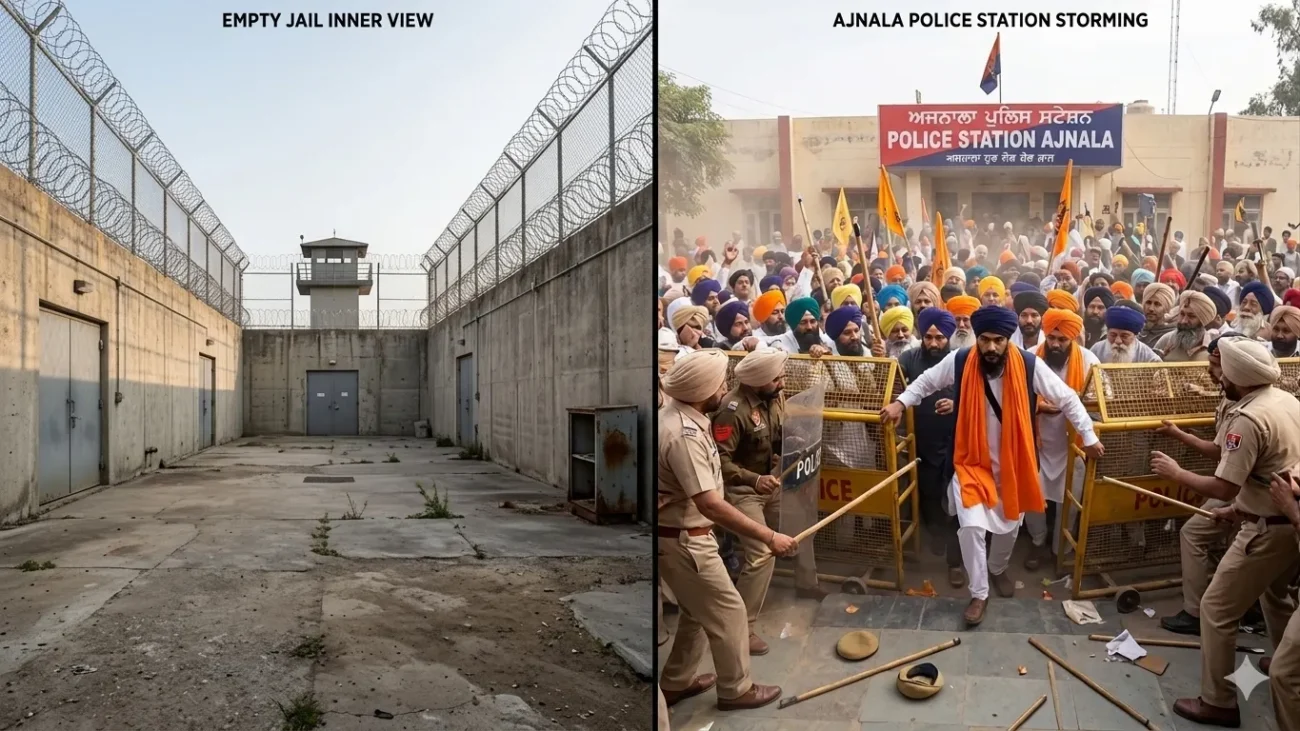
Consider also the man at the head of the party. Section 13 of the National Security Act, 1980 caps each detention at twelve months. Amritpal Singh was held under three successive orders from April 2023 until the last lapsed on 22 April 2026, and the State did not issue a fourth. He is now in custody in the Ajnala police-station case of February 2023 and connected matters: rioting, assault on public servants, criminal conspiracy and offences under the Arms Act, 1959. These are serious charges, and they will be tried. They are, however, charges of ordinary criminal law, before ordinary courts. When the State’s own preventive-detention machinery has stood down, it is hard to argue that the same man’s party is a national-security matter.
There is also a precedent in the Commission’s own register. The Shiromani Akali Dal (Amritsar) has been registered for decades, and its leader, Simranjit Singh Mann, has never hidden his advocacy of a separate Sikh homeland. He won the Sangrur Lok Sabha by-election in 2022. The republic did not collapse. It absorbed him, as mature democracies do, by giving dissent a ballot rather than a grievance.
To be fair to the Commission, the Ajnala episode was ugly: a police station stormed, policemen injured, and a saroop of Sri Guru Granth Sahib carried into a confrontation. The intelligence agencies may know things the rest of us do not, and caution in a border state with Punjab’s memories is no vice. Caution, however, must work through the law, not around it.
Two Readings, One Risk
Many, particularly in opposition parties, believe the Commission responds to the preferences of the Government of the day. Nobody has proven this, but enough people believe it that the Commission’s timing will be read politically whatever its intent.
The first reading is that the reluctance is meant to signal. Declaring a Sikh party a security concern six months before the polls could push anxious Hindu voters in urban Punjab further towards the BJP, which is working to become more than a junior partner in the state.
The second reading is kinder: the aim is simply to keep the radical fringe out of formal politics for one more cycle, on the theory that denying it a platform denies it momentum.
Both readings share a flaw. They assume that denial works.
Who Speaks for the Hinterland?
In 2024, the voters of Khadoor Sahib elected Amritpal Singh by a margin of nearly two lakh votes while he was held in Dibrugarh. Faridkot elected Sarabjeet Singh Khalsa. Both won as independents, without a symbol, a registered donor base or star campaigners. The absence of a certificate did not stop them. It merely made them less accountable.
In the villages of Majha and Malwa, the Commission’s hesitation is unlikely to look like prudence. It is more likely to confirm what many rural Sikhs already suspect: that the only regional formation to emerge from the ground in a decade is being prevented from growing. Consider the alternatives. The Shiromani Akali Dal under the Badal family is widely seen as a family concern run like a private limited company. It has never recovered from the Bargari sacrilege of 2015 and the police firings at Behbal Kalan and Kotkapura that followed, and it has since been disciplined by Sri Akal Takht Sahib and has split. The Congress and the Aam Aadmi Party take their instructions from Delhi. The BJP is, by definition, a national party.
So who speaks for Punjab as a regional voice? If the answer is left to the street, it will be given by louder and less accountable people. Registration brings a party inside the law’s disciplines: a constitution, audited accounts, internal elections, a whip and an obligation to answer to the Commission. Refusal leaves all the grievance and none of the accountability.
Hearing
A hearing was held on October 1, and while disposing of the petition, the Election Commission was directed to take an appropriate decision regarding the party’s registration within four weeks.

Leave a Comment