

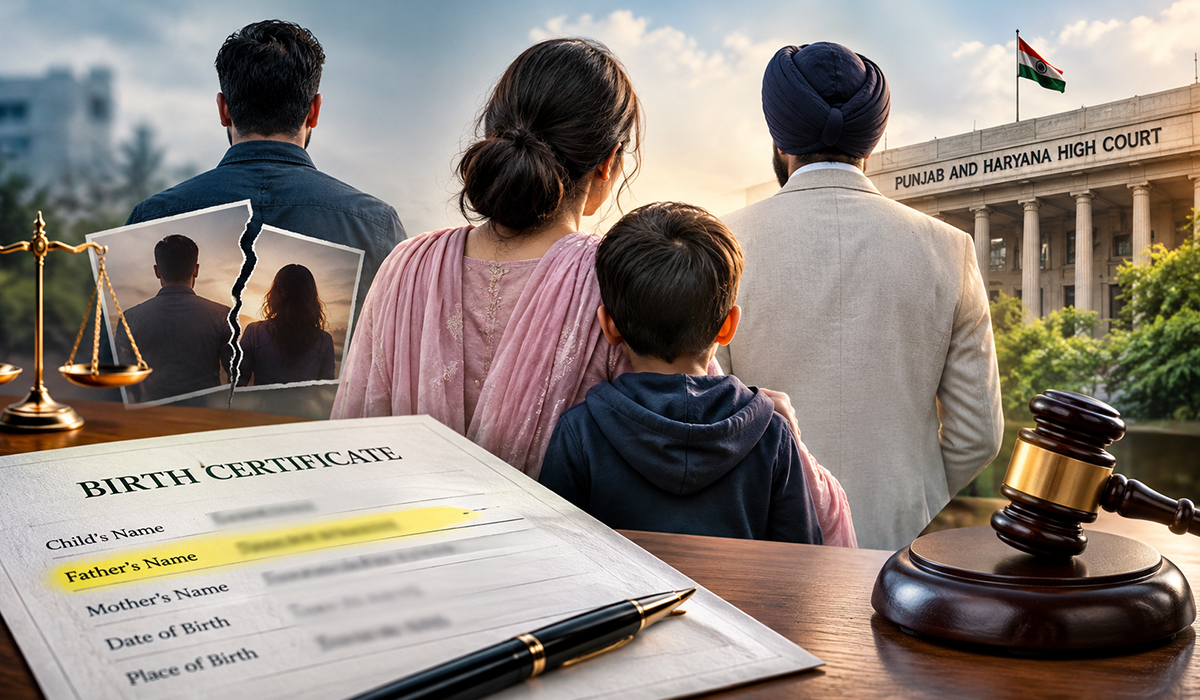

When a woman gets married, changing her surname is still considered a common practice in Indian society. But if the marriage breaks down, the woman remarries and begins a new chapter in life, what happens to the identity of her child?
Can the child adopt the surname of the mother’s second husband? Can the name of the biological father be removed from the child’s birth certificate?
A recent judgment of the Punjab and Haryana High Court has brought these questions back into discussion. The court has said that if the name of the child’s biological father has been correctly recorded in the birth certificate, it cannot be removed merely on the ground that the mother subsequently remarried.
This case is not merely about a name recorded on a government document. Behind it lies a larger question—where do biological identity, legal parenthood and changing family relationships intersect?
A New Marriage Does Not Erase an Earlier Reality
In the case before the High Court, a mother had sought the removal of the biological father’s name from the birth certificate of her minor child and the inclusion of the name of her second husband, Jagjit Singh. This request was made after her remarriage.
The court did not accept the request.
The basic principle behind this is that a birth certificate records facts relating to the birth of a child, including the information relating to the parents at that time. If this information was correctly recorded when the child’s birth was registered, a later divorce or second marriage does not automatically make that record incorrect.
In simple words, a marriage may end and a new marriage may take place, but this does not automatically change the biological reality that existed at the time of the child’s birth.
The Question of a Child’s Surname Is Not So Simple
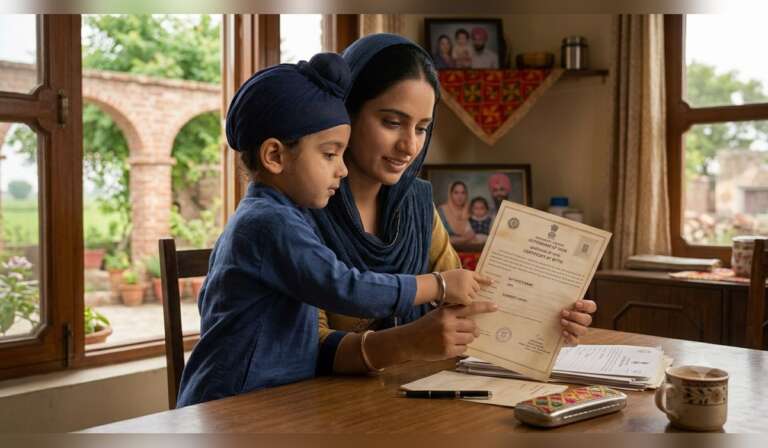
The High Court’s judgment mainly concerns the parental information recorded in a birth certificate. But for families, this issue can be much larger than that because a surname is often connected with identity, family and a sense of belonging.
In India, it is still a common practice for a woman to change her surname after marriage. Children are also traditionally expected to adopt the father’s surname.
But what happens when the marriage breaks down?
What if the mother remarries? What if the child is primarily brought up by the mother and her second husband? What if the stepfather is actually playing the role of the person whom the child knows as a father?
In an era of changing family structures, these questions are becoming more important than before.
One thing becomes clear from the High Court’s judgment—changes in family circumstances do not automatically change the biological parental information recorded at the time of birth.
However, this does not mean that every question relating to a child’s name or surname will have the same answer. Rules may differ across different government documents and different legal situations.
A Similar Matter Had Come Before the High Court in 2016 as Well
The latest matter also brings to mind an earlier judgment of the Punjab and Haryana High Court.
In Baljit Kumar v. State of Punjab & Others, on 4 May 2016, the court of Justice Rakesh Kumar Jain had considered an almost similar dispute. The case number in this matter was CWP No. 3560 of 2016 (O&M).
Baljit Kumar was born in 1993 to his biological parents. Later, his mother divorced his biological father and remarried Surjit Singh.
After growing up in the changed family circumstances, some of Baljit Kumar’s other documents, including bank records, voter identity card and Aadhaar card, carried the name of his stepfather.
After this, he approached the High Court seeking that the name of his stepfather be entered in his birth certificate as well in place of that of his biological father.
The High Court dismissed the petition.
Justice Rakesh Kumar Jain had said that the original entry recorded in the birth record had not been shown to be incorrect or wrongly entered. The subsequent divorce and remarriage were not considered sufficient grounds to change the name of the biological father in the birth certificate.
This 2016 judgment highlights an important legal distinction—the changing of family circumstances and the changing of a historical fact recorded at the time of a child’s birth are not the same thing.
But Adoption Is a Different Matter
In the 2016 judgment, the court had also drawn attention to another important distinction—adoption and remarriage are not the same legal situation.
Merely marrying the child’s mother does not automatically give the stepfather the same legal status that an adoptive parent may have. Under the law, adoption can create a recognised legal relationship between a parent and a child.
This distinction is important because the law recognises situations in which a child’s legal family relationships can change. But a second marriage by itself is not automatically equivalent to adoption.
What About Children Raised by Stepparents?
Perhaps the most human aspect of this entire issue lies here.
For a child, the person who raises him or her often matters far more than the name written on a certificate.
A stepfather may take the child to school, attend parent-teacher meetings, bear the expenses of the child’s education, stand by the child in difficult times and become a source of emotional support.
On the other hand, the name of the biological father may continue to remain in the child’s birth record.
Both these realities can exist at the same time.
But the role of the court is not always to determine who plays the more emotionally important role in a child’s life. The court must also consider the purpose of a government document and what facts are supposed to be recorded in it.
In the case of a birth certificate, the focus is on facts connected with the child’s birth.
Why Can a Birth Certificate Not Be Rewritten Merely Because Circumstances Have Changed?
A birth certificate is one of the basic documents used to establish a person’s identity.
From admission to school to passports, employment and various government services, it is used on different occasions. Therefore, the accuracy of the basic information contained in it is important.
Here, it is necessary to understand a fundamental distinction—correcting incorrect information and changing an accurate historical record because family circumstances changed later are two different things.
If the name of a mother or father was incorrectly entered when the birth was registered, the law may, depending on the circumstances, provide for correction.
But if the record was correct at the time of the child’s birth, a later divorce or remarriage does not automatically make that fact incorrect.
The Larger Question: Who Determines a Child’s Identity?
This judgment also draws attention to changing family structures in Indian society.
Divorce, remarriage, single parenting, blended families and adoption have made the definition of the “traditional family” far more complex than before.
But government documents often have to fit these complex relationships into a few limited boxes—the father’s name, mother’s name, date of birth and place of birth.
This is where questions relating to identity arise.
A child may have a biological father, may be raised by a stepfather, the mother may be the principal caregiver in the family, and the child’s surname may not fully represent all of these relationships.
The law does not view all these relationships in the same way.
A Surname May Change Socially, but the Question of Parenthood Is Different
The most important point emerging from this judgment of the Punjab and Haryana High Court is not that a child’s name or surname can never be changed.
The important point is that biological parental information correctly recorded at the time of the child’s birth cannot be erased merely because the marital circumstances of the parents changed later.
This distinction is extremely important.
A surname may be connected with social identity, family association and a sense of belonging. But the biological parental information recorded in a birth certificate serves a different legal purpose.
For women who rebuild their lives after divorce, and for children who grow up in blended families, this distinction is especially important.
The form of a family may change. A child may develop a deep relationship with a stepparent. A new surname may enter the household.
But according to the principle set out by the High Court, a new chapter in the life of a family cannot automatically erase the first chapter that was recorded at the time of the child’s birth.
Ultimately, this judgment makes it clear that a change in marital relationships does not automatically change the biological identity of the child. The mother’s remarriage may give her life a new direction, but facts connected with the child’s birth cannot be erased merely on the ground that family circumstances have changed. Although a surname may be one part of identity, the legal and biological identity of a child is much larger than that. This judgment has drawn an important boundary—families may change, relationships may change, but true birth facts cannot be altered merely for the sake of a new relationship.
I have preserved the original sequence, emphasis, legal distinctions, examples and argumentative structure without adding interpretation or correcting the substance.

Leave a Comment