



She Helped Thousands Navigate American Courts. Then the Same System Came for Her.
For more than three decades, Meenu Batra walked through the courtrooms of Texas as a certified court interpreter, soothing the fears and confusion of thousands of immigrants who had no other voice. She translated not merely words but entire worlds: the terror of a deportation hearing, the desperation of a mother unable to explain her circumstances to a judge, the quiet humiliation of a man who understood nothing being said about his own future. She was, for many, the only human bridge between two languages and two systems of justice.
In April 2026, she walked out of the El Valle Detention Centre after more than six weeks in federal custody. Her release brought enormous relief to her family. But the circumstances that placed her there in the first place have left a much deeper mark, one that will not fade when her legal case eventually closes.
Thirty-Five Years and Still No Solid Ground

Meenu Batra arrived in the United States in the early 1990s, having fled conditions of violence in India. She settled, worked, raised a family, and made herself useful to the country that had taken her in. In the year 2000, the American immigration system granted her a status known as “Withholding of Removal.” This legal designation allowed her to live and work in the United States without fear of immediate deportation, but it stopped short of permanent residency or citizenship.
That distinction, seemingly minor, turned out to be an important one in the recent immigration enforcement drive. The “Withholding of Removal” status is not a green card. It does not grant the holder the protections that come with lawful permanent residency. It is, in legal terms, a conditional tolerance rather than an accepted belonging. A person in this category can pay taxes for decades, raise children who become American soldiers, serve the court system as a certified professional, and remain, legally speaking, removable. The status offers shelter but not security. It is the immigration equivalent of renting a home for thirty years without ever being permitted to own it. Meenu Batra understood immigration law better than most. She worked within it daily. Yet that understanding offered her no protection when federal officers decided, in March 2026, that her case warranted renewed scrutiny.
The Arrest at the Airport
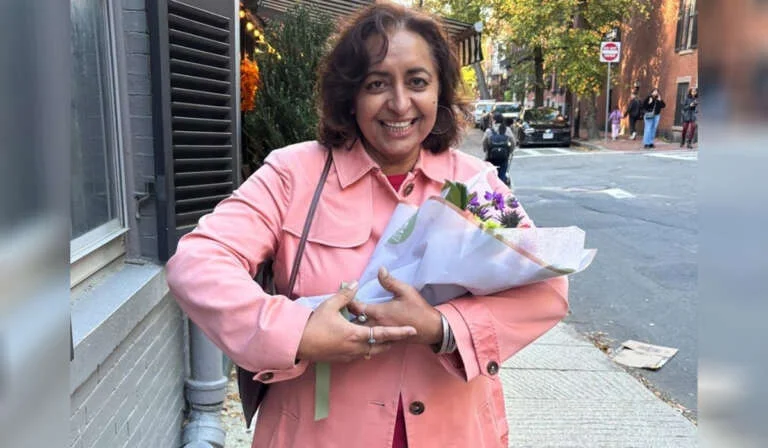
Her arrest happened while Batra was travelling for a court assignment. She was stopped at the airport, questioned about her immigration status, placed in handcuffs, and taken into federal custody. The officers raised concerns about the legality of her decades-old immigration arrangement. For a woman who had spent years helping others navigate that very arrangement, the moment carried a particular cruelty.
What followed, according to her own account, was deeply troubling. She described being held for close to twenty-four hours without food or water. Her prescription medications were not made available to her during that period. She was photographed in a manner she described as deliberately degrading. She stated afterwards that the experience had broken something in her.
“I felt as though thirty-five years of contribution and loyalty meant nothing to this country,” she said. Her legal team moved quickly, filing a habeas corpus petition, arguing that her detention lacked lawful justification and violated her fundamental rights. It was this petition, not any administrative review or routine process, that eventually secured her release. Her attorney, Deepak Ahluwalia called the outcome a partial victory at best. “These past six or seven weeks have been nothing short of a nightmare for this family,” Ahluwalia said. “We are relieved she is out, but her legal fight is far from finished.”
A Son in the Army, a Mother in Legal Limbo

The story takes on a further dimension when one considers the composition of Batra’s family. Her youngest son serves in the United States Army. He is now using the special immigration provisions available to military families to apply for a green card on his mother’s behalf. The situation is genuinely difficult to reconcile: a young man defending the country on its terms while the same country’s immigration system works to remove his mother from it.
This is not a rhetorical contradiction manufactured for effect. It is a structural one, built into an immigration system that has long distinguished between the contributions a person makes and the legal category they occupy. One can devote decades to civic life in the United States and remain legally vulnerable to removal. The category on paper takes precedence over the life lived in practice.
A Warning the Immigrant Community Cannot Afford to Ignore

Batra’s case is not an isolated one. Across the United States, large numbers of long-term residents live in comparable legal grey zones. They pay taxes. They hold professional positions. They raise children who become citizens and soldiers. Their lives are woven into the fabric of American communities. But their immigration status is fragile enough that a change in administration, a shift in enforcement priorities, or a renewed review of an old file can place everything they have built at immediate risk.
The lesson here is not abstract. For anyone currently holding a “Withholding of Removal” designation or a similarly conditional immigration status, the Batra case is a clear signal that such arrangements cannot remain unaddressed indefinitely. A work permit is not a guarantee. A long record of lawful, productive residence is not a substitute for formal legal standing.
Legal counsel is not optional in these circumstances. Community organisations that specialise in immigration matters can provide guidance that makes a genuine difference. Ahluwalia’s role in this case clearly illustrates that. Without experienced legal representation and the filing of the habeas corpus petition, Batra’s situation could have ended very differently.
The Definition of Home, Still Pending in Court

As of now, Meenu Batra is free. She has returned to her family. But the deportation proceedings against her have not been formally withdrawn. The government has not confirmed that the threat has passed. The woman who spent 35 years serving the American legal system still does not know with certainty whether the country she has called home will allow her to remain.
Her case raises a question that American immigration law has never answered satisfactorily. At what point does long residence become a form of belonging that the legal system is obligated to recognise? If thirty-five years of professional service, civic participation and paying taxes do not earn a person the right to stay, what does?
These are not new questions. They have figured in immigration debates for a generation. But the Batra case gives them a human face that is harder to set aside.
For every Indian-origin resident and every immigrant who has built a life abroad on the assumption that hard work and good conduct would be enough, this case stands as a clear and documented warning. The assumption is not safe. The grey zones of immigration law are real, they are populated, and they are not getting smaller.
Meenu Batra’s legal fight continues. Her future, like that of so many others in comparable situations, remains subject to courts, petitions, and procedural timelines. The wounds from her detention are her own. The lesson belongs to everyone.


Leave a Comment