
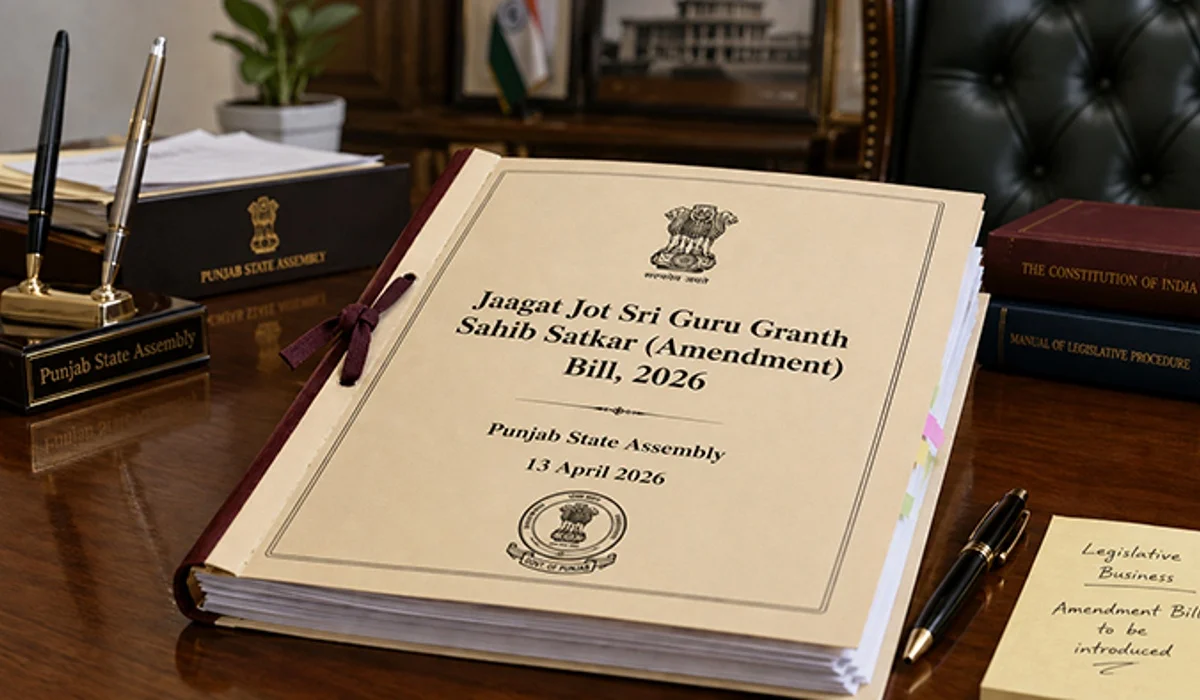

In 2026, Punjab’s politics and religious circles witnessed a major upheaval when Sri Akal Takht Sahib and the Shiromani Gurdwara Parbandhak Committee strongly objected to the “Jagat Jot Sri Guru Granth Sahib Satkar (Amendment) Act, 2026” passed by the Punjab government. The controversy reached a historic point on June 29, 2026, when all Sikh MLAs and cabinet ministers of the Punjab Vidhan Sabha appeared before the Secretariat of Sri Akal Takht Sahib.
In this article, we will examine the background of the Bill, the positions of different stakeholders, and the legal and religious aspects linked to it in detail.
In Sikhism, Sri Guru Granth Sahib Ji is not merely a sacred scripture, but the Shabad Guru and the “Jagat Jot”, the living Guru of the Sikh community. Any issue connected with the recognition, respect and maryada of Guru Sahib holds deep sensitivity and spiritual significance for the Sikh world. The “Jagat Jot Sri Guru Granth Sahib Satkar (Amendment) Act, 2026”, passed by the Punjab government in April 2026, has triggered a fresh debate in political, legal and religious circles.
Originally, the “Jagat Jot Sri Guru Granth Sahib Satkar Act” was brought in June 2008. At that time, the main objective of the law was to prevent mistakes being committed by private institutions or individuals in the printing, publication and preservation of Sri Guru Granth Sahib Ji, so that the religious sentiments of the Sikh community were not hurt. The original 2008 Act explained the responsibilities of the Shiromani Gurdwara Parbandhak Committee in detail and laid down the process for deciding the bhent for the sacred Birs.
In 2026, the current Aam Aadmi Party government in Punjab convened a special session of the Assembly and passed this Bill unanimously, arguing that the amendment was necessary to curb incidents of sacrilege, maintain communal harmony and ensure strict punishment for the guilty. But as soon as the law was passed, Sikh institutions, scholars and the sangat began raising serious concerns and objections over its draft and terminology. As a result, the matter turned into a major confrontation between the government and the Panth.
Sri Akal Takht Sahib’s Stand and the Historic Appearance
Taking note of the large number of objections and complaints received from Sikh sangat, a very important decision was taken as per the directions of Sri Akal Takht Sahib, the supreme temporal authority of the Sikh community. An official letter was issued by Bagicha Singh, in-charge of the Akal Takht Secretariat, asking all Sikh MLAs and cabinet ministers of the Punjab Vidhan Sabha to appear at the Secretariat of Sri Akal Takht Sahib on June 29, 2026.
This special gathering was led by the Panj Singh Sahibaan. Those present included Acting Jathedar of Sri Akal Takht Sahib and Jathedar of Takht Sri Kesgarh Sahib, Singh Sahib Giani Kuldeep Singh Gargaj; Granthi of Sachkhand Sri Harmandir Sahib, Singh Sahib Giani Baljit Singh; Singh Sahib Giani Kewal Singh; Jathedar of Takht Sri Damdama Sahib, Giani Tek Singh; and Giani Mangal Singh, one of the Panj Pyare of Sri Akal Takht Sahib.
The hearing began with the recitation of Mool Mantar and Gurbani in a deeply serious and spiritual atmosphere. A total of 87 Sikh MLAs and ministers marked their presence at Sri Akal Takht Sahib. Jathedar Giani Kuldeep Singh Gargaj personally conducted the proceedings and gave all sides an open environment to present their views without personal remarks or controversy.
Main Religious Objections Raised by Jathedar Giani Kuldeep Singh Gargaj
Questioning the law framed by the government, Jathedar Giani Kuldeep Singh Gargaj clearly stated that the government had, knowingly or unknowingly and in haste, interfered in the internal religious matters of the Sikhs and in the jurisdiction of Sri Akal Takht Sahib. He said that in Sikh history and maryada, the word “Bir” is the authentic term. By using the word “Saroop” instead in the legal draft, the government had violated tradition. The bureaucracy has no authority to change Panthic terminology.
“How Sri Guru Granth Sahib is to be kept, how Sikh Rehat Maryada is to be followed — this cannot be decided by the Vidhan Sabha. Only Akal Takht Sahib can decide this. No government law can come between the Guru and the Sikh.”
Objecting to the clause that stated that anyone violating the provisions of this Act, apart from sacrilege, could face imprisonment of up to five years, the Jathedar said that this “custodian” clause had created fear among ordinary members of the community and the sangat. Such a harsh law cannot be applied to natural processes or unintentional mistakes. Because of this fear, sangats had started depositing Gurbani Sainchis, Pothis and Gutka Sahibs in gurdwaras, which is worrying. Assigning unique numbers to published Birs and monitoring them is entirely the work of the SGPC; the government cannot legislate on this.
Akal Takht Sahib’s Ultimatum and New Demands
After listening to the arguments of ministers and MLAs, Jathedar Gargaj said that many leaders had admitted the truth that they had passed the Bill in haste without reading its draft. Sri Akal Takht Sahib gave the Punjab government one month, or 30 days, to convene a special session of the Vidhan Sabha and remove these flaws from the law. Along with this, it directed that the law remain suspended until the amendments are made.
The Jathedar also demanded the addition of another important provision: if a follower of an anti-Sikh dera deliberately commits sacrilege, then along with the follower, a case should also be registered against the head of the concerned dera. He also strongly criticised the government for not bringing Dera Sirsa chief Gurmeet Ram Rahim to Punjab for questioning in the 2015 Bargari sacrilege case.
What Is the Punjab Government’s Stand and Legal Argument?
According to an article published in April 2026, the Punjab government said in a press note: “In the past, several incidents of sacrilege of Sri Guru Granth Sahib Ji and other sacred scriptures have taken place, causing deep hurt to people’s sentiments and creating an atmosphere of unrest in society.” It further said, “Although Sections 298, 299 and 300 of the Bharatiya Nyaya Sanhita deal with such matters, these provisions do not provide adequate stringent punishment to deal strictly with those committing such offences.”
The Punjab government and the ruling Aam Aadmi Party maintain that their intention was completely clear and that the law was brought solely to protect the sanctity of Sri Guru Granth Sahib Ji. When the Bill was passed in the Assembly, Chief Minister Bhagwant Mann congratulated the Sikh sangat and claimed, “Now, if anyone commits an act of sacrilege in the future, several generations of that person will regret it.” According to the government, painful incidents of sacrilege in the past had deeply hurt society’s fabric and people’s sentiments, which made stricter law the need of the hour.
Punjab Finance Minister Harpal Singh Cheema explained the provisions of the Bill, saying that the new amendment provides enhanced punishments, including life imprisonment for those guilty of sacrilege, and heavy fines ranging from Rs 5 lakh to Rs 25 lakh. It also proposes strict punishment for masterminds who use mentally ill persons to carry out sacrilege. Investigations into sacrilege incidents will now be conducted at a higher level by an officer of DSP rank. Harpal Cheema clarified that the Bill is linked only to the sacrilege of Sri Guru Granth Sahib Ji. Responding to allegations by the SGPC, he said the committee had enough time to present its suggestions before the Select Committee, but it did not do so.
The Government’s Softer Tone After the Appearance
After appearing before Sri Akal Takht Sahib, the government’s tone appeared considerably softer. Vidhan Sabha Speaker Kultar Singh Sandhwan said outside, “All of us have immense respect for Akal Takht Sahib and the Jathedar. We bowed barefoot. There was a very constructive discussion with Jathedar Sahib, and whatever directions have been given will be placed before the government for consideration.”
Sandhwan also revealed that when Akal Takht had sent some objections in May, he, as Speaker, had forwarded the copy to the Chief Minister’s Office because the authority to amend lies with the House. Harpal Cheema also admitted that based on the list of suggestions given by Jathedar Sahib, the government is ready to make the necessary amendments within one month.
Reactions From the Opposition
Opposition parties in the Punjab Vidhan Sabha, including the Congress and the Shiromani Akali Dal, supported the spirit of the Bill and the idea of punishing the guilty, but sharply questioned the government’s intention, haste and failure to deliver justice in earlier cases. Leader of Opposition Partap Singh Bajwa accused the government of trying to gain political mileage and said that if the government had not crossed the “Lakshman Rekha” between the Panth and the Vidhan Sabha, this situation would not have arisen. He said, “We support the Bill, but the Chief Minister’s arrogant attitude and legal negligence have made it controversial. Despite 48 months having passed, the government has done nothing in old sacrilege cases, because of which five major cases have gone out of the state.”
Congress MLA Sukhpal Singh Khaira said that making a law for the future is good, but when will justice be delivered in the 597 past sacrilege cases? He said, “The AAP government had made Kunwar Vijay Pratap Singh its poster boy during elections and promised justice, but justice remains incomplete even today. The government did not show the courage even once to bring the main conspirator, Ram Rahim, on production warrant for questioning.”
Congress MLA Pargat Singh stated, “The law was made in great haste. In religious matters, we politicians do not have that level of understanding, so religious experts and those who understand Rehat Maryada should have been involved. The truth is that many MLAs and ministers did not even know what was actually written in the draft of this law.”
Senior Akali Dal leader Bikram Singh Majithia targeted the government and said, “A law made without the approval of Sri Akal Takht Sahib, without taking the SGPC and the Guru Nanak Naam Leva sangat into confidence, is nothing but a stunt brought to polish politics. Governments come and go, but one must speak the truth in the court of the Guru.”
Akali MLA Manpreet Singh Ayali demanded that trials in sacrilege cases should be time-bound and charges should be framed within one year. He also expressed fears of misuse of the law and said that if required, the government should always keep the path open for amendments.
The SGPC, the premier Sikh institution, has objected strongly to the process of this law from the very beginning. SGPC president Advocate Harjinder Singh Dhami described Harpal Cheema’s statements after the Punjab Cabinet decision as unclear and misleading. He clarified, “The reality is that the high-level committee formed by the Shiromani Committee tried several times to approach the government and its Select Committee, but the arrogant government gave no response.”
Advocate Dhami said that the matter of Sri Guru Granth Sahib Ji is linked to the internal spiritual sentiments of the Sikhs. By bypassing Sikh institutions and directly making a law, the government has shown that its purpose is not justice, but vote-bank politics.
Legal and Constitutional Position and the Opinion of Sikh Scholars
A large group of Sikh scholars, retired judges and legal experts held a meeting on the technical and constitutional aspects of this law and advocated rejecting the Act completely. Those present included Justice Nirmal Singh, retired; senior advocate Puran Singh Hundal; Ashok Singh Bagrian; former IAS officer Gurtej Singh; Paramjit Singh Gazi; Jaspal Singh Sidhu; Prof. Davinder Singh; and Gurpreet Singh.
Justice Nirmal Singh opposed both the 2008 and 2026 laws and raised serious practical questions about the judicial process. He asked, “When such matters come before a court, how will sacrilege be proved? Will torn Angs be matched inside the court? Will the sacred Bir be kept in the court’s malkhana? And under what maryada will it be presented before the judge?” Questioning the government’s morality, he said that a government that has failed to deliver justice in old sacrilege cases has no right to bring such a complicated law.
According to a media report, senior advocate Puran Singh Hundal described the law as illegal, unethical and unconstitutional. He said that instead of merely amending “some clauses” as suggested by Jathedar Sahib, the entire law should be withdrawn unconditionally and repealed because it goes against the principles of a secular state, where the government cannot define the private rules of any religion.
Religious expert Ashok Singh Bagrian said that the care and preservation of Sri Guru Granth Sahib Ji falls solely within the internal sphere of the Sikh Panth. No civil government can enforce religious rules or sacred practices through parliamentary law. Speakers also expressed fears that the amendments were motivated by elections.
In the end, the many-hour-long historic hearing at the Secretariat of Sri Akal Takht Sahib concluded with a major political and religious understanding. When the Panj Singh Sahibaan announced that the government would have to amend the law within one month and that it would remain suspended until then, Sikh leaders from all political parties present in the hall — AAP, Congress and Akali Dal — accepted the decision with one voice by raising the sky-shaking jaikara of “Bole So Nihal, Sat Sri Akal.” All MLAs raised their hands in support. After the hearing concluded, Jathedar Sahib, the Singh Sahibaan and all ministers and MLAs sat together and recited Gurbani, turning the political tension of the past several days into a peaceful atmosphere.
At the very end of the gathering, Jathedar Giani Kuldeep Singh Gargaj issued a strict religious instruction to leaders of all political parties, saying, “Now that this matter is moving towards resolution under the guidance of Sri Akal Takht Sahib, no leader or party will go outside and indulge in political blame-game against one another on this sensitive issue. This is a common issue of respect for Guru Sahib, not a matter of victory or defeat for any party. No statement should be made in the media or on social media that creates confusion, fear or mutual hatred in people’s minds again. All parties must unite and perform their duty to uphold the honour of Guru Sahib.”
This entire sequence of events around the “Jagat Jot Sri Guru Granth Sahib Satkar (Amendment) Bill, 2026” has proved that the authority and sovereignty of Sri Akal Takht Sahib remain supreme in the Sikh Panth. In a democracy, governments may pass laws with any majority, but when the matter concerns Sikh Rehat Maryada and respect for Guru Sahib, all political parties must bow before Panthic traditions.
In the words of Jathedar Giani Kuldeep Singh Gargaj, our Punjab is “united against terrorism, separatism, fear and sacrilege.” It is now the responsibility of the Punjab government to coordinate with Sikh institutions such as Sri Akal Takht Sahib and the SGPC within the one-month period given, remove the flaws in the law, and ensure that the fear of government interference in the relationship between Guru and Sikh is permanently ended, while peace and communal harmony in the state are preserved.


Leave a Comment