

Reading the Lawrence Bishnoi-Goldy Brar Indictments Against the Longer Arc of Indian Foreign Policy
US Crackdown on Bishnoi-Brar Gangster Network
For the better part of a decade, Indian security planners have made a single, recurring complaint in private and, increasingly, in public: that North America – the United States and Canada in particular – has functioned as a permissive, even hospitable, base of operations for a loose but lethal ecosystem of Punjabi gangsters, drug syndicates, and Khalistan-aligned operatives working to India’s detriment, and specifically to Punjab’s. The recent coordinated action by American and Canadian law enforcement, styled “Operation Hard Ball,” is the first genuinely large-scale rebuttal of that complaint that Washington has offered in kind rather than in diplomatic language alone.
I. What Actually Happened
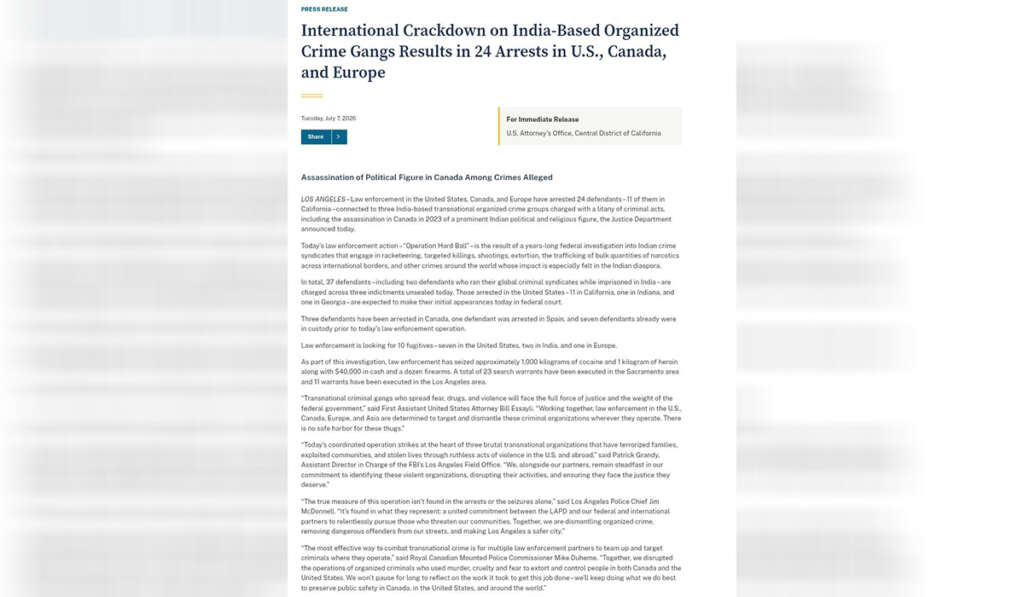
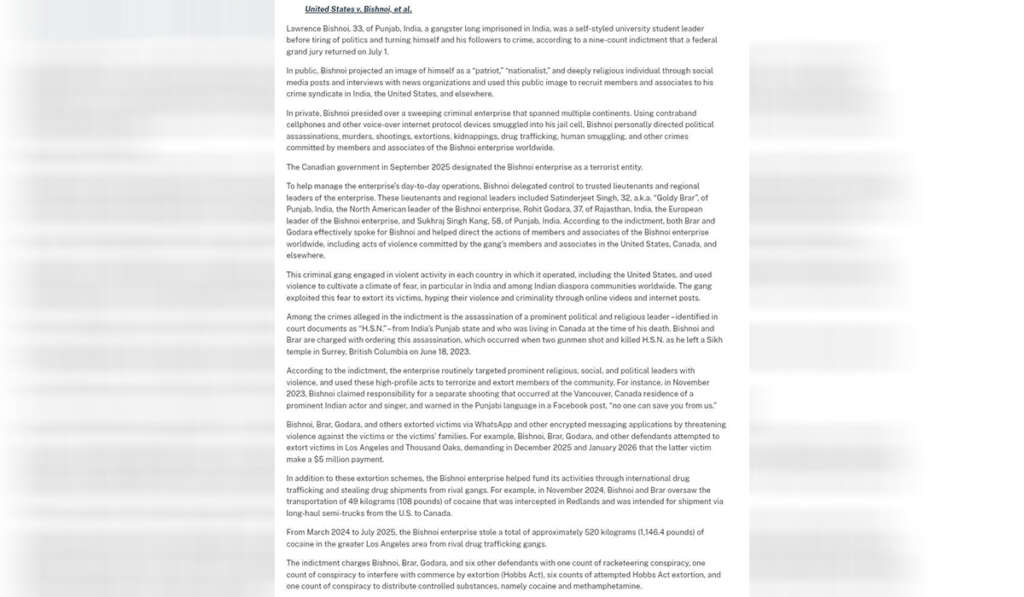
The US Department of Justice, working with the FBI, the Los Angeles Police Department, the Royal Canadian Mounted Police, and European counterparts, unsealed three federal indictments naming 37 defendants across more than 50 raid locations in the United States, Canada, and Europe. Twenty-four defendants are in custody; the rest remain fugitives. The most consequential of the three indictments, United States v. Bishnoi et al., charges Lawrence Bishnoi – currently lodged in Sabarmati Jail, Gujarat – with directing a transnational criminal enterprise from behind bars, using contraband phones and encrypted channels to coordinate murders, extortion, kidnapping, arms trafficking, and large-scale narcotics movement across continents. Named alongside him is his alleged North American lieutenant, Satinderjeet Singh, known publicly as Goldy Brar, believed to be operating out of the United States. Crucially, this indictment marks the first time American prosecutors have formally charged the Bishnoi network with ordering the June 2023 assassination of Hardeep Singh Nijjar outside a Surrey gurdwara – the killing that triggered the most serious rupture in India-Canada relations in living memory.
II. The Safe-Haven Complaint, and Why It Had Teeth
New Delhi’s grievance was never entirely without foundation. Bishnoi cultivated, quite deliberately, a public persona as a nationalist and a man of faith, using social media and sympathetic interviews to recruit across India, North America, and Europe even as prosecutors now allege he ran shootings, extortion rackets, and the movement of hundreds of kilograms of cocaine and methamphetamine from Southern California into Canada. Two of the three networks charged under Operation Hard Ball – the Bishnoi enterprise and its rival, the Jaggu Bhagwanpuria syndicate – are Punjab-rooted organisations that have, for years, operated with what looked from New Delhi like relative impunity once their operatives crossed the Atlantic or the Pacific. Nearly 1,000 kilograms of cocaine, a kilogram of heroin, firearms, and cash were seized in this operation alone – a scale that gives some measure of how deeply embedded these networks had become in North American criminal economies, well beyond anything that could be dismissed as a Punjab-specific nuisance.
III. The Foreign Policy Reading
It would be naïve to read the timing and scale of this operation as coincidental. India’s diplomatic establishment has spent the past three years pressing Washington, in increasingly direct terms, to treat organisations like Sikhs for Justice and the Bishnoi-Brar network not as diaspora political activity or ordinary gang crime respectively, but as a security threat with cross-border implications. The Modi government has repeatedly urged the United States to designate SFJ a terrorist organisation, with limited success, even as it has separately pushed for action against the Punjab-based gangster networks it blames for financing and enabling Khalistan-linked violence. Operation Hard Ball, arriving as it does with explicit, formal reference to the Nijjar assassination, reads as the clearest sign yet that some part of that pressure has landed – whether framed publicly as an FBI-RCMP organised-crime initiative or understood privately as a calibrated response to sustained Indian representations at the highest levels, including, one may reasonably infer, conversations that reached the White House. If this is indeed a “beginning of the end” of the perception that North America is a safe rear base for anti-India, pro-Khalistan gangsterism and narco-trafficking, it would mark a genuine strategic inflection point – not the end of the ecosystem, but the first serious dent in its operating assumptions.
IV. The Uncomfortable Domestic Half of the Story
New Delhi’s demand that Washington and Ottawa stop treating this network as someone else’s problem sits awkwardly alongside an unresolved question closer to home: how much soft accommodation Bishnoi has himself enjoyed from parts of the Indian state apparatus even while formally incarcerated. In March 2023, while in Punjab Police custody at the CIA facility in Kharar, Bishnoi gave a television interview – broadcast on national media by a well-regarded journalist – in which he all but confessed to his role in the Sidhu Moosewala killing, calmly walking the country through his rivalry with the slain singer. A second interview followed days later purportedly from a Rajasthan jail. The scale of access on display – a CIA lock-up turned, in effect, into a studio, with police Wi-Fi placed at a gangster’s disposal – could not plausibly have occurred without institutional connivance, and the Punjab and Haryana High Court said as much when it took suo motu cognisance and ordered a Special Investigation Team to find out how. The SIT’s findings were unambiguous: a Punjab Police Gazetted Officer, then posted at CIA Kharar, had facilitated the interview through his personal presence and complicity. He was eventually dismissed from service in early 2025, and a separate Prevention of Corruption Act case was registered against him and his mother over disproportionate assets. Seven officers in total were suspended, including a second DSP; the then SSP of the district, was controversially exonerated by a retired High Court judge in 2026, a decision the Akali Dal’s Bikram Singh Majithia publicly denounced as an insult to Moosewala’s grieving parents. More troublingly still, a Tribune investigation this May revealed that the said indicted Gazetted Officer had continued sending Bishnoi birthday gifts — sweets and caps — via a gang courier to Sabarmati Jail in Ahmedabad, months after his own suspension and while the SIT probe was actively underway. What remains conspicuously absent from this record is any criminal prosecution, as opposed to service dismissal and a standalone corruption case, for the substantive act of facilitating a wanted gangster’s national broadcast from state custody. If Washington and Ottawa are now expected to treat this network as a serious cross-border security threat, Punjab’s own institutions owe the same seriousness to the question of who inside the department made Bishnoi’s custody porous enough to turn into a media platform, and why accountability for that specific breach has stalled at administrative censure.
V. The Sidhu Moosewala Thread, and the Wider Pattern of Intimidation
The Operation Hard Ball indictment against Bishnoi and Brar arrives loaded with a domestic Punjab context that gives it particular resonance: this is the same duo whose names became inseparable, in the Indian public mind, from the May 2022 killing of Punjabi singer Sidhu Moosewala. Goldy Brar, then already operating out of Canada, claimed responsibility within hours in a social media post that named Bishnoi alongside him, framing the killing as retaliation over the earlier murder of Akali leader Vicky Middukhera. Punjab Police’s own charge sheet subsequently identified Brar as the mastermind behind the assassination, and both men were formally designated terrorists by the Government of India under the Unlawful Activities (Prevention) Act. But Moosewala’s killing was never an isolated act of score-settling; it sat atop a far broader extortion economy that the Bishnoi-Brar network had built around Punjab’s music and entertainment industry – targeting singers, promoters, and public figures with threats calibrated to extract money or compliance, and treating a well-publicised killing as effective advertising for the racket’s credibility. That the same network which openly claimed a Punjabi singer’s assassination, ran extortion rackets against the state’s cultural economy, and facilitated its own leader’s custodial media appearances is now separately indicted in the United States for ordering Hardeep Singh Nijjar’s killing underscores how thoroughly diaspora organised crime, Khalistan-linked violence, and Punjab’s domestic gangster economy have become a single interlocking system rather than three distinct problems.
VI. The Complication New Delhi Cannot Ignore
Here, however, the story acquires a genuine twist, and an honest column cannot elide it. RCMP Deputy Commissioner Lisa Moreland stated explicitly, in the course of announcing these charges, that the investigation had found no evidence that Indian government officials were involved in the crimes alleged in this particular announcement – and noted, pointedly, that the Indian government had cooperated with the probe. That is a markedly different narrative from the one Ottawa advanced in September 2023, when Justin Trudeau told Parliament that Canadian intelligence held “credible allegations” tying agents of the Indian state directly to Nijjar’s killing, and from the parallel American case against Vikash Yadav and Nikhil Gupta over the foiled plot to kill Gurpatwant Singh Pannun in New York, in which US prosecutors have alleged the involvement of a serving Indian intelligence official. Operation Hard Ball, by contrast, frames the Nijjar killing as an operation ordered by a criminal enterprise, not a state one. For New Delhi, that is diplomatically convenient – it allows the Nijjar case to be recast as gangsterism rather than state assassination – but it does not retire the Pannun-Yadav track, which remains open, unresolved, and considerably more damaging if it is ever fully litigated.
VII. The Wider Task Ahead
It bears repeating, as US officials themselves were careful to say, that an indictment is merely an allegation, and every defendant is presumed innocent until proven guilty beyond reasonable doubt. But taken together with the CIA Kharar interview scandal and the still-unresolved question of accountability for the officers who made a gangster’s custody porous, the wider picture that emerges is not simply of foreign safe havens finally being shut down, but of a single ecosystem — Punjab-based gangsterism, diaspora extortion and contract killing, Khalistan-linked violence, and, by credible allegation if not yet proof, ISI-facilitated small-arms supply — that has thrived precisely because no single jurisdiction, Indian or Western, has been willing to pursue it end to end. This is where the real opportunity in this moment lies. If the Punjab Police, Gujarat Police, and central agencies — the Intelligence Bureau, the NIA, and India’s external intelligence apparatus — can now coordinate seamlessly with their American and Canadian counterparts to identify and apprehend the local shooters, financiers, and logistical facilitators who give this network its reach inside Indian soil, while simultaneously cleaning out whatever residue of departmental complicity allowed a jailed don to run a television studio from a police lock-up, Operation Hard Ball could mark something more consequential than a single set of indictments: a genuine chance to break the back of an integrated criminal architecture spanning gangsterism, narcotics, and cross-border arms supply that has bled Punjab for the better part of two decades.
VIII. Punjab’s Moment: Two Debates, Two Registers
There is also a timelier reason to seize this moment rather than let it dissipate into the usual news cycle. Public discourse across the country has, in recent days, been consumed by the banned film Satluj, Diljit Dosanjh’s dramatisation of the alleged fake encounters and mysterious disappearances of Punjab’s dark years of terrorism and insurgency. That controversy has its own legitimate claims on public attention, and Punjab’s approaching Vidhan Sabha election in February 2027 will ensure that every party extracts whatever political mileage it can from both the film’s banning and, doubtless, from Operation Hard Ball itself – that political contest is coming regardless, and no columnist’s preference will forestall it. But precisely because the Satluj debate risks pulling public attention backward into the unresolved arguments of three decades ago, this is also the ideal moment to redirect at least part of the national conversation toward the narco-terror and gangster ecosystem operating in the present. The two subjects are not unconnected – both concern the machinery of violence and impunity that has repeatedly attached itself to Punjab – but they call for different registers: the first for historical honesty, the second for present-tense law enforcement. What is needed now, whatever the electoral calendar eventually does with the politics of it, is a single-minded focus by Indian law enforcement agencies on securing due process strictly in accordance with law – no shortcuts, no extra-judicial reflexes of the kind Punjab has already paid too dearly for once – while taking every operational cue on offer from the American and Canadian intelligence and prosecutorial work that has, for the first time, named this network in a court of law. Whether that chance is taken, or allowed to recede once the headlines fade, will say a great deal about how seriously India’s stated foreign policy priorities are actually being absorbed into enforcement practice at home, not merely abroad.

Leave a Comment