
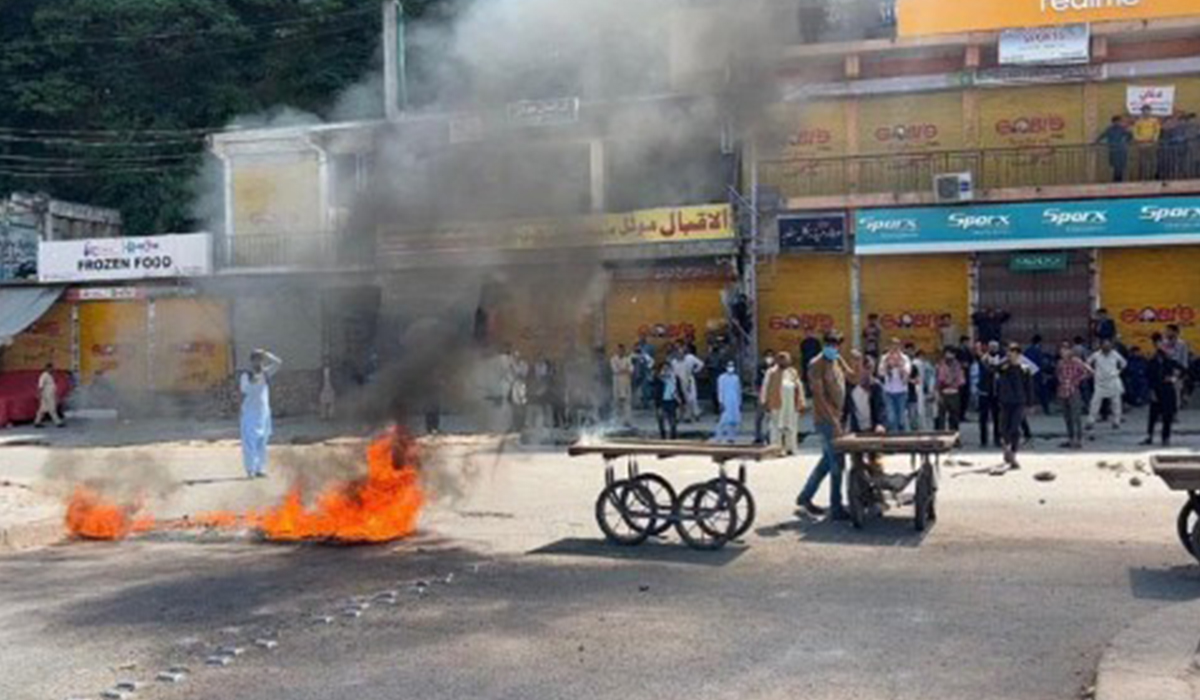

The latest unrest in Pakistan-occupied Jammu and Kashmir (PoJK) marks a turning point in a protest movement that has steadily evolved from an economic agitation into a wider political challenge to Pakistan’s governance of the region. What began as demonstrations over electricity prices and inflation has now become a broader confrontation over political representation, civil liberties and state accountability.
At the centre of the movement is the Joint Awami Action Committee (JAAC), a coalition of traders, civil society groups and political activists that has emerged as one of the most organised voices of dissent in PoJK in recent years. The violent clashes that reportedly left at least 20 people dead underline not only the intensity of public anger but also the increasingly fragile relationship between the Pakistani state and the people in the region.
Evolution of the movement
The immediate trigger for the latest protests was the ban and listing of JAAC as a terrorist organisation under the POJK Anti-Terrorism Act, 2014. The ban came days before a territory-wide shutdown the JAAC had called for June 9. However, the roots of the crisis run much deeper. PoJK has long suffered from economic distress, weak infrastructure, unemployment and limited political autonomy. Rising inflation and soaring electricity costs became the catalyst that transformed these underlying grievances into a mass movement.
In 2024, large-scale protests forced authorities to announce subsidies on electricity and flour, suggesting that sustained public mobilisation could extract concessions from the government. Yet protest leaders argue that many promises were either only partially implemented or failed to address structural issues. This sense of betrayal has intensified distrust toward the authorities and strengthened the perception that the region lacks meaningful political representation.
The movement’s evolution is particularly significant. Economic protests are often easier for governments to contain through subsidies or temporary relief measures. But when such movements begin framing their demands in terms of rights, accountability and democratic participation, they acquire a more enduring political character. The JAAC appears to have crossed precisely that threshold.
The allegations emerging from the latest crackdown have further sharpened the political dimension of the crisis. Claims of excessive police force, internet shutdowns and restrictions on journalists and activists suggest an attempt to control not only the protests themselves but also the narrative surrounding them. In modern conflicts and protest movements, communication blackouts often become symbolic of deeper anxieties within the state apparatus. Even when governments justify such measures as necessary for maintaining order, they frequently reinforce public perceptions of repression.
Pakistan’s crackdown exposes contradiction
Pakistan’s handling of the unrest also exposes a broader contradiction in its Kashmir narrative. Islamabad has historically positioned itself as a defender of Kashmiri rights, particularly in relation to the Indian state of Jammu and Kashmir. However, the current protests in PoJK create an uncomfortable situation where Pakistan itself faces accusations of suppressing dissent in territory under its control. India has moved quickly to point at this contradiction, accusing Pakistan of “brutality” and urging the international community to hold Islamabad accountable for alleged human rights abuses. The violence in PoJK provides India with an opportunity to challenge Pakistan’s moral positioning on Kashmir-related issues.
India has consistently accused Pakistan of fomenting unrest and supporting cross-border militancy in border states such as Jammu and Kashmir and Punjab, alleging that Islamabad has backed separatist networks, infiltration attempts and extremist elements as part of a long-running strategy to destabilise the region. Pakistan denies these allegations, maintaining that it only provides diplomatic and moral support to Kashmiris.
The chief of the Balochistan Liberation Front (BLF), Allah Nazar Baloch has challenged Pakistan’s portrayal of PoJK as “Azad Kashmir” claiming the region enjoys freedom only in name while remaining under the firm control of Islamabad. He alleged that major decisions regarding the territory were taken by federal officials and bureaucrats rather than elected representatives of the Kashmiri people.
In contrast to the situation in PoJK, Jammu and Kashmir has witnessed a different trajectory in recent years, particularly after the abrogation of Article 370 in 2019. While the move was accompanied by heavy security restrictions, communication blackouts and criticism from human rights groups, New Delhi has since sought to project the region as moving toward greater political stability and economic integration. Elections at the local level, increased infrastructure spending and tourism growth have been highlighted by the Indian government as signs of normalisation.
Diaspora protests bring international attention
The international reaction to the situation in PoJK suggests that the unrest is beginning to attract wider attention beyond South Asia. Concerns raised by more than 50 British parliamentarians indicate the growing role of the Kashmiri diaspora in internationalising the issue. Diaspora activism has become increasingly influential in shaping Western political discourse on Kashmir, particularly in the United Kingdom, where large British Kashmiri communities maintain strong emotional and political connections to the region.
The protests outside Pakistani diplomatic missions in the UK demonstrate how domestic unrest in PoJK is now spilling onto the international stage. This international dimension could increase pressure on Islamabad, especially if allegations of communication blackouts and civilian casualties continue to gain visibility abroad.
Another important aspect of the current unrest is the emergence of a broader anti-establishment sentiment. Protesters are no longer focusing solely on utility bills or inflation. Their demands increasingly reflect frustration with governance structures that many believe provide limited local agency and insufficient accountability. Such movements can become especially difficult to contain because they are driven not only by material hardship but also by questions of dignity, participation and political voice.
The Pakistani state now faces a delicate challenge. A purely security-driven response risks deepening resentment and expanding the movement further. Yet meaningful political concessions could encourage additional demands for autonomy and democratic reform. Islamabad’s approach in the coming months will likely determine whether the crisis remains a regional protest movement or develops into a more sustained political confrontation.
Leave a Comment