

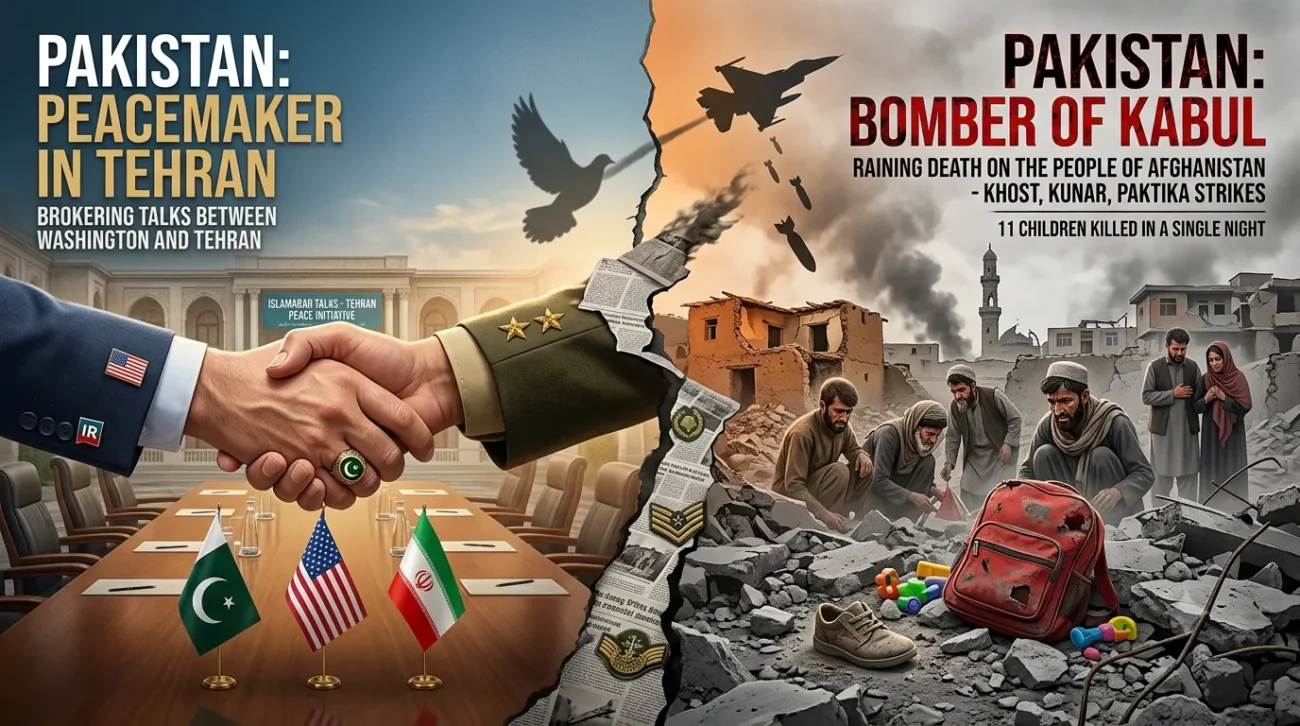

Pakistan’s towering hypocrisy — brokering peace in Tehran while raining death on Kabul
There is a particular species of hypocrisy that does not merely offend the moral sense — it insults the intelligence. Pakistan has, over the past several months, cultivated for itself a carefully burnished image as the indispensable peacemaker of West Asia. Islamabad hosted the talks between the United States and Iran. Pakistan’s Army Chief, General Asim Munir, flew to Tehran on a shuttle diplomacy mission. Pakistani mediators shuttled between Washington and the Iranian leadership, carrying messages, building trust, nursing a fragile ceasefire. The world watched, and the world applauded. Here, it seemed, was a nuclear-armed Muslim state deploying its unique geography and its web of relationships — with Washington, with Riyadh, with Tehran — in the service of a larger peace.
And yet, on the very same nights that Pakistani diplomats were pressing Iranian and American negotiators to lower their weapons, Pakistani Air Force jets were taking off and bombing a landlocked, impoverished, air-force-less neighbour into the rubble.
On the 9th of June 2026, Taliban spokesman Zabihullah Mujahid announced that Pakistani airstrikes had hit the Afghan provinces of Khost, Kunar, and Paktika, killing at least thirteen people and wounding fourteen more. Eleven of the thirteen dead were children. One was a woman. One was an elderly man. Pakistan offered no acknowledgement, no statement, no expression of regret. The bombs fell; the children died; Islamabad said nothing.
This is not an isolated incident. It is a pattern — relentless, brutal, and now months old.
The Arc of a One-Sided War
The current round of violence began in earnest on the 22nd of February 2026, when Pakistan launched what it described as “intelligence-based, selective operations” against camps and hideouts of the Tehreek-e-Taliban Pakistan (TTP) and the Islamic State – Khorasan Province (ISKP) across the Afghan provinces of Nangarhar and Paktika. Pakistan insisted it was hitting terrorists. Afghanistan said Pakistan was hitting homes, madrasas, and families. The United Nations Assistance Mission in Afghanistan (UNAMA), not given to taking sides, confirmed that thirteen people were killed in those strikes — women and children among them.
Afghanistan retaliated with cross-border fire. Pakistan launched Operation Ghazab Lil Haqq — “Wrath for the Truth” — an exercise in nomenclature that tells you everything about how Rawalpindi sees this conflict: as a moral crusade, not as the aerial pounding of a defenceless country. By mid-March, UNAMA had confirmed that since the 26th of February alone, seventy-five people had been killed and a hundred and ninety-three others injured on the Afghan side. Then came the strike on a hospital in Kabul — the Omar Addiction Treatment Centre — with Afghanistan claiming four hundred killed, and Pakistan dismissing the figure as fabricated.
One need not accept every Taliban casualty count at face value. The Afghan Taliban have their own information warfare imperatives. But the accumulation of evidence — UN confirmations, AP photographs of children’s bodies, independent reporting from the border provinces — makes the broad picture undeniable. Pakistan is repeatedly and systematically bombing civilian areas in Afghanistan, killing children with a frequency that has ceased to shock only because the world has grown numb to it.
The Peacemaker Pretence
Against this backdrop, consider what Pakistan has been simultaneously doing on the diplomatic stage.
When the United States and Israel struck Iran in late February 2026, it was Pakistan that stepped forward as the mediator. Islamabad offered its territory for negotiations. It hosted the Islamabad Talks in April. General Munir flew to Tehran. Pakistani officials conveyed American proposals to Iranian leadership and Iranian red lines back to Washington. When Trump paused US naval escorts through the Strait of Hormuz, he cited, on Truth Social, the “request of Pakistan and other Countries” — a remarkable acknowledgement of Islamabad’s diplomatic heft. Al Jazeera reported Pakistani officials expecting a “major breakthrough on the nuclear front,” their optimism barely concealed.
The contrast is not merely jarring — it is philosophically incoherent. Pakistan presents itself to the world as a state that believes in dialogue, in the de-escalation of conflicts, in the preservation of civilian life, and in the architecture of peace. It tells Washington and Tehran: put down your weapons, let us talk, let reason prevail. And then it turns around, crosses into the airspace of a country that has no air force, no surface-to-air missile batteries worth the name, no capacity whatsoever to contest Pakistani air dominance — and it kills children in their sleep.
This is the essence of the hypocrisy: Pakistan lectures the world on peace while waging a war it knows its opponent cannot fight back on equal terms.
The Asymmetry of Power and the Moral Depravity It Enables
Afghanistan is landlocked. It has no coast, no blue-water navy, no strategic depth in the conventional military sense. Under the Taliban, it has no functional air force — certainly nothing that can challenge Pakistan’s F-16s, JF-17 Thunder jets, and precision-guided munitions. When Pakistan bombs Afghanistan, it does so in the knowledge that there will be no retaliatory airstrike over Lahore, no Pakistani city that will wake to the sound of incoming ordnance. The skies over Islamabad are perfectly safe. The skies over Khost and Kunar are not.
There is a word for the use of overwhelming, uncontestable military force against a neighbour that cannot retaliate in kind — against civilians who cannot flee fast enough, against children who are simply in the wrong house in the wrong province. That word is not “counter-terrorism.” It is not “intelligence-based selective operations.” It is not “wrath for the truth.” It is bullying — systematic, lethal, and conducted under the cover of a security rationale that no independent observer has been able to verify.
Pakistan’s argument is, at its core, this: Afghan soil is being used by the TTP and the ISKP to plan and execute attacks on Pakistan. This is not an implausible claim. The TTP has indeed carried out devastating attacks on Pakistani soil — the February 2026 Islamabad mosque bombing that killed thirty-one Shia worshippers being the most recent before this current escalation. Pakistan has a legitimate security interest in preventing its territory from being bled by cross-border terrorism.
But the method Pakistan has chosen — aerial bombardment of civilian areas, strikes on residential homes and religious seminaries, the killing of eleven children in a single night — is not a counter-terrorism strategy. It is collective punishment. It is the application of air power against a population that the Pakistani military has decided is collectively culpable. And collective punishment, under international humanitarian law, is a war crime — regardless of the provocation that preceded it.
A Question of Credibility
Pakistan’s diplomatic credibility as a peacemaker rests on a simple premise: that Islamabad is a responsible state, animated by principle, capable of restraining the impulses of belligerence in the interest of a larger good. That is the premise on which the United States trusted Pakistan to carry its messages to Tehran. That is the premise on which Iran accepted Pakistani hospitality for the Islamabad Talks. That is the premise on which the international community is willing to treat Islamabad as a constructive actor rather than as a destabilising one.
Every bomb dropped on Afghan children corrodes that premise. Every night that Pakistani jets range over Khost and Paktika, the credibility that Pakistani diplomats are building in Tehran and Washington is being simultaneously demolished on the other frontier. A state cannot be a peacemaker in one theatre and a war criminal in another and expect the world to maintain a convenient partition between the two roles. Sooner or later — and on present evidence, sooner — the contradictions collapse inward.
The children of Khost have no lobby in Washington. They have no powerful patrons at the UN Security Council. They are citizens of a pariah state, governed by a regime that the world has largely chosen to ignore. But their deaths are real. Their deaths are documented. And their deaths are the direct consequence of decisions made by an air force operating under the authority of a state that, last week, was being praised for its role in bringing peace to West Asia.
What Must Be Said
Pakistan must be called out — clearly, firmly, and without the diplomatic equivocation that has thus far allowed this double standard to persist. The international community cannot simultaneously applaud Islamabad for brokering the US-Iran ceasefire and look the other way while Pakistani jets kill children in Afghanistan. The two things are not separable. They are expressions of the same foreign policy, conducted by the same military establishment, authorised by the same government.
India, which has its own complex and often fraught relationship with both Pakistan and the Afghan Taliban, has every reason to raise this issue at international forums — not for opportunistic reasons, but because the principle at stake is one that matters to the entire subcontinent: that no state may claim the mantle of peacemaker while simultaneously exercising the impunity of the bomber.
Pakistan wants the world’s respect. It wants a seat at the high table of global diplomacy. It wants to be seen as the indispensable bridge between East and West, between the Muslim world and the American hegemon. Fine. But respect is not a garment that can be worn selectively. You cannot drape yourself in the robes of the peacemaker on Monday and send your jets to kill eleven children on Tuesday.
The children of Afghanistan deserve better. So does the concept of peace itself.

Leave a Comment