


VIII. The Namdhari (Kuka) Sect: Historic Legitimacy, Symbolic Weight
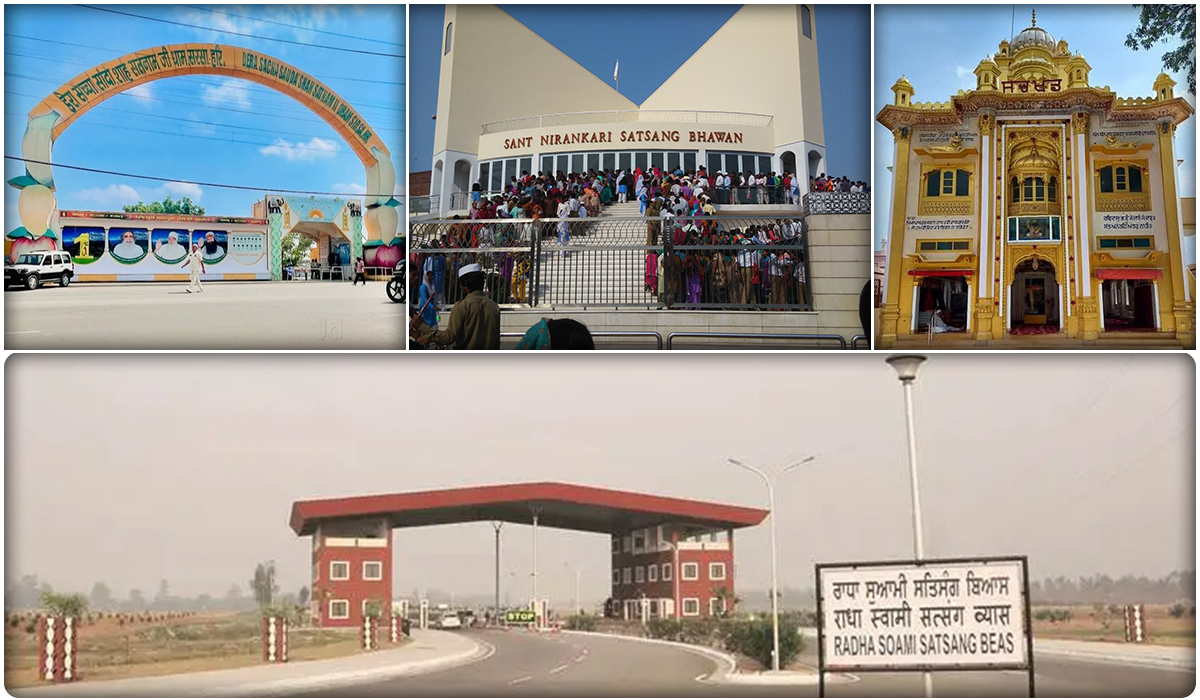
The Namdharis, or Kukas, occupy a category of their own. Founded in the mid-nineteenth century as a reformist movement within Sikhism with a pronounced anti-colonial character — the Kuka rebellion of 1872 remains one of the earliest organised armed challenges to British rule in Punjab, commemorated annually at Malerkotla — the sect, headquartered at Bhaini Sahib near Ludhiana, carries a historical legitimacy none of the newer deras can match.
Its contemporary political footprint is modest — perhaps one or two constituencies directly — but its symbolic value to a party seeking to project itself as rooted in authentic Sikh historical memory remains disproportionate to its numerical weight. A photograph with the Namdhari head signals continuity with reform and resistance rather than vote arithmetic, even though the underlying calculation is rarely different in kind.
IX. Dera Baba Nanaksar: The Ascetic Model
Dera Baba Nanaksar, with its principal seat at Kaleran near Ludhiana and a wider network of affiliated branches, traces its lineage to Baba Nand Singh Ji and his successor Baba Ishar Singh Ji, and carries a reputation, distinct from most establishments on this list, for austere personal conduct and an emphasis on simplicity and seva over institutional visibility.
Politically, Nanaksar has kept the lowest profile discussed here, its influence exercised almost entirely through the quiet weight of its ascetic reputation rather than any organised political outreach. It is included here less because it rivals Sacha Sauda or Beas in seat-moving capacity, and more because no honest account of Punjab’s religio-political landscape ahead of 2027 can omit an establishment whose moral authority, however lightly exercised, still shapes sentiment in pockets of Malwa and Doaba.
X. Dera Baba Bhaniarwala: The Cautionary Case
Dera Baba Bhaniarwala, at Dhamana village near Ropar, is the cautionary entry on this list. Its founder, Piara Singh Bhaniara — a Dalit religious leader who rose from a peon’s post in the state Horticulture Department — built a following estimated at several lakh, mostly Mazhabi Sikh and other Dalit communities. That trajectory took a sharply different turn from the rest: excommunicated by the Akal Takht in 1998, Bhaniara’s followers published the Bhavsagar Granth in 2001, a text alleged to encroach on the Guru Granth Sahib’s unique status, triggering communal violence, a state ban on the text, and Bhaniara’s arrest under the National Security Act. He survived a stabbing in 2003 and a bomb attack in 2005, living under security cover until his death in December 2019; the dera continues under his successors.
Politically, Bhaniarwala’s following is noted more for consistent antipathy to the Akali Dal, the party most associated in the dera’s institutional memory with the events of 2001, than for open embrace of a rival — a reminder that not all dera influence in Punjab is transactional; some of it is grievance carried forward across two decades.
XI. The Common Architecture of Influence
Set side by side, these eight establishments — different in theology, founding moment, and scale — share a common structural logic that explains their durability as political actors regardless of which party is in power in Chandigarh or New Delhi.
First, mass, disciplined congregations. A single directive, or even a studied silence read as tacit signal, from the gaddi can move a following that no party’s own cadre machinery could organise from scratch — an outsourced whip system that parties did not build and cannot fully control, but have learned to solicit.
Second, a concentration of Dalit and other historically marginalised communities for whom the dera offers dignity and material support that mainstream religious and political institutions have failed to fully provide. This is not incidental to dera politics; it is close to its foundation. Parties courting Ballan or Sacha Sauda are, in substantial part, courting the reserved-seat electorate that mainstream Sikh and Hindu institutional structures have historically underserved.
Third, welfare infrastructure — hospitals, schools, de-addiction centres, langars — functioning as a parallel, in places more responsive, service-delivery system than the state’s own. Political patronage of deras is, in this sense, also an implicit acknowledgment of governance gaps the formal state has not closed.
Fourth, an absence of any obligation — legal, financial or otherwise — to disclose how, why or with what internal deliberation a dera arrives at its political posture, tacit or explicit.
Fifth, and perhaps the least appreciated: silence itself as strategy. Barring Sacha Sauda’s recurring exception, dera heads generally decline to say publicly whom their followers should vote for — and it is precisely this discretion that sustains their bargaining power across cycles. An explicit directive would burn the bridge to whichever party is not chosen; a quiet cue about who best serves “the mission’s interest” keeps every door open, and every dera head a permanent fixture on the pre-poll circuit rather than a spent card played once. It is this absence of disclosure, paired with this discipline of silence, that raises the constitutional question to which this analysis now turns.
XII. The Demographic Counter-Current: Punjab’s New Voter
Before turning to that constitutional question, one qualifier deserves candid mention, since it cuts against much of what is argued above. Punjab’s electorate is changing shape. The Special Intensive Revision of electoral rolls now under way is adding a substantial fresh cohort of eighteen-year-olds — many enrolled within months of clearing their Class XII boards — to the voter list, one of the more consequential demographic shifts in the state’s electoral profile this decade, which this publication has tracked closely alongside the Election Commission representations accompanying the SIR exercise.
These young voters are, by most informal accounts, considerably less anchored in generational dera loyalty than their parents and grandparents. Educated, more exposed to information outside the sangat, and often more digitally literate than the elders in their households, many are not simply passive inheritors of a family’s dera affiliation — in a number of documented instances, the direction of influence has visibly reversed, with young first-time voters steering how their elders vote. The command-and-control grip a gaddi’s quiet cue once carried through three generations of a household cannot be assumed to hold through a fourth.
The consequence, still under-appreciated in Punjab’s political strategy, is that the relative weight of dera influence is quietly declining even as the choreography of courtship grows more visible. A section of the state’s older political leadership — formed in an era when the dera visit was non-negotiable — continues to accord these establishments a strategic importance the changing arithmetic of the electorate may no longer fully justify. This is not an argument that deras are becoming irrelevant; the estimates in this piece suggest otherwise for the present cycle. It is an argument that the trend line points one way, and that any leader still treating the gaddi as the last word on a constituency may be reading yesterday’s Punjab rather than today’s.
XIII. The Constitutional Question: Parties Without Registration
Here I bring, as this publication has consistently sought to do, a lens beyond sociology and horse-race political reportage.
India’s Representation of the People Act, and the Election Commission’s Model Code of Conduct, impose disclosure and conduct obligations on registered parties and candidates — expenditure ceilings, source-of-funds disclosure, restrictions on the misuse of religious appeal under Section 123(3) of the RP Act, 1951. None of these attach to a dera issuing an “appeal” to its following, however consequential in a closely contested constituency. A dera’s Political Affairs Wing, however institutionalised, is not a political party; its deliberations are undisclosed, its funding unaudited for electoral purposes; and its “advisory” to lakhs of followers sits in a regulatory blind spot the drafters of India’s electoral law did not anticipate.
This is not an argument for banning or delegitimising deras, whose welfare contribution in many cases is genuine and considerable. It is an argument for candour about what is actually occurring: a parallel representational structure, operating with none of the transparency obligations imposed on the formal party system, exercising influence over outcomes in perhaps fifty to sixty of Punjab’s 117 Assembly seats — large enough that no serious government formation in the state can any longer be built without accounting for it.
A second, related concern deserves candid treatment: the caste contradiction visible within some of these establishments, most documented at Radha Soami Satsang Beas, where critics have long pointed to a gap between the tradition’s stated ideal of spiritual equality and observed practices of social distance in seating, dining and institutional office. A dera that draws part of its electoral weight from marginalised-community loyalty, while reproducing hierarchy internally, presents precisely the kind of tension that deserves more scrutiny than either hagiographic coverage or purely transactional political reportage typically affords it.
XIV. Conclusion: The Anatomy of the Photo-Op
Return, finally, to the fortnight with which this piece began. A Prime Minister flags off a train named for a Dalit saint-reformer, meets a Padma Shri-decorated dera head aboard it, and inaugurates several thousand crores of infrastructure across three states in a single sweep. A Chief Minister, absent from that event, had five months earlier converted a rival dera head’s jail visit into a public rupture his own alliance partners publicly questioned. Neither gesture is spontaneous; both are choreographed, aimed less at the dera head personally than at the lakhs of followers watching for a signal.
This is the essential grammar of pre-election Punjab, repeated with only cosmetic variation across cycles: Rahul Gandhi at Beas followed within a day by Sukhbir and Harsimrat Badal; Channi at Ballan followed within a day by Kejriwal, Mann and Cheema; Modi at Ballan in February followed by Modi at Ballan again in July. The deras have not seized this power through any single dramatic act. They have accumulated it, congregation by congregation, langar by langar, hospital bed by hospital bed, across a century in which the formal state has periodically found it easier to seek a blessing than to close the welfare gap that made the blessing valuable in the first place.
Whether that gap is closed by 2027, or merely papered over by one more season of competitive pilgrimage, is a question this publication will continue to track — as is the quieter question of whether Punjab’s newest voters, less bound to the gaddi, will still be listening by the time the next photo-op is arranged.


Leave a Comment