

Who They Are, How Many Remain in Prison, and for What Offences
While Independence Day across Punjab was celebrated with zeal and fervour — flag-hoisting ceremonies, school functions, the customary civic pageantry of the 80th anniversary of India’s freedom — one corner of that same morning told a rather different story. At YPS Chowk on the Mohali–Chandigarh border, the Quami Insaaf Morcha’s march toward the Governor’s House was broken up with drone-fired tear gas and water cannon, and Simranjit Singh Mann was detained en route. The demand, as it has been for over a decade now, was the release of the “Bandi Singhs” — Sikh prisoners whom campaigners describe, often without distinction, as men who have completed their sentences and remain unconstitutionally jailed. That framing is not accurate for every name it is applied to, and a movement’s credibility is better served by precision than by a slogan. This piece sets out, briefly, only the cases that remain genuinely alive today — not the men already released, but those still on the file.
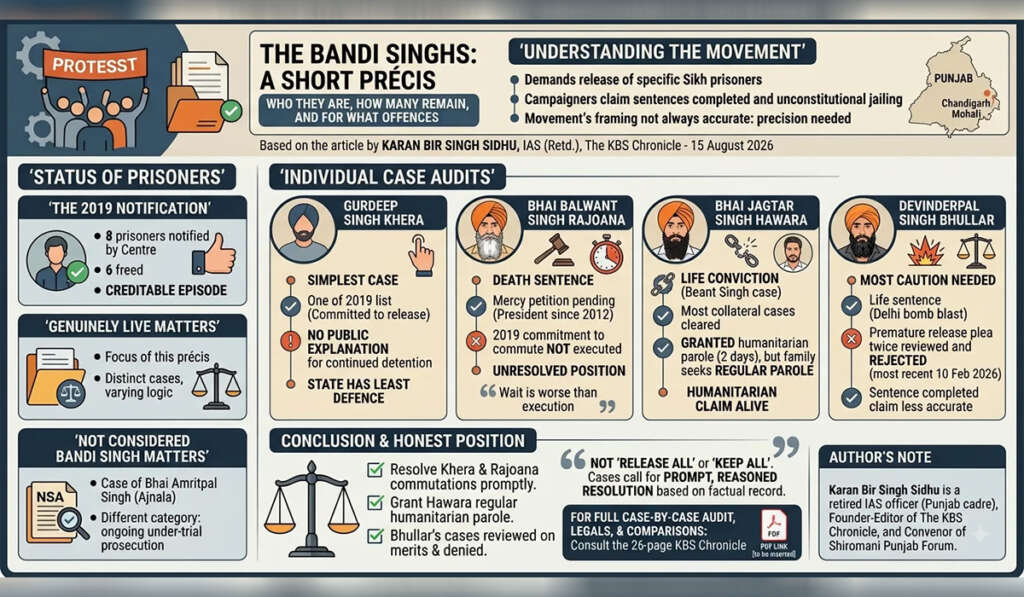
Some context first. In 2019, on the 550th Prakash Purb of Guru Nanak Dev Ji, the Centre notified the release of eight prisoners; six were duly freed. That was a creditable episode, and it is not what remains in dispute. What remains in dispute are four distinct, live matters, each governed by a different logic, which is precisely why lumping them together under one banner has done the cause more harm than good.
Gurdeep Singh Khera is the simplest and, in a sense, the most damning entry. He was one of the 2019 eight; his case was “committed to be processed” and never was. Six years on, there is no public explanation for the non-release, no jurisdictional complication to point to, nothing but silence. Of every file discussed here, this is the one where the State has the least defence.
Bhai Balwant Singh Rajoana stands apart because he alone remains under sentence of death. The SGPC’s mercy petition on his behalf has been pending before the President since March 2012 — over fourteen years — and the Supreme Court, in 2023, effectively let the matter rest on the Home Ministry’s submission that a decision “could compromise national security,” without ever pronouncing on the merits. The 2019 commitment to seek commutation of his sentence to life imprisonment remains, seven years later, formally unexecuted, notwithstanding sharp Court language in April 2026 that “no further time will be granted.” Bhai Rajoana himself has since written more than once to the Akal Takht asking that the mercy petition simply be withdrawn, calling the wait “worse than the execution itself.” Whatever view one takes of his original crime, a formal executive commitment left unexecuted for seven years, compounding a fourteen-year-old unresolved mercy plea, is not a position any government should be comfortable defending.
Bhai Jagtar Singh Hawara‘s file has moved furthest in the past year, though not in the direction the slogans suggest. The roughly three dozen collateral cases that had long barred him from parole consideration were substantially cleared through 2025 by ordinary acquittal and discharge — his underlying life conviction for the Beant Singh assassination stands untouched. Chief Minister Bhagwant Mann then sought humanitarian parole so Bhai Hawara could see his ailing, octogenarian mother after three decades apart, a request the Governor received favourably. What the Delhi Prison Department actually granted on 13 August, however, was a two-day custody parole — and Bhai Hawara declined it, holding out for the regular parole his family has actually asked for. That refusal is worth noting on its own terms: it is not the posture of a man grasping at any relief on offer, and it leaves the real humanitarian question sitting, still unresolved, on the Chief Minister’s desk. Notably, Ravneet Singh Bittu, Beant Singh’s own grandson and a sitting BJP MP, has publicly backed the parole request — a reminder that humanitarian relief and the far larger question of remission are not the same instrument, however easily they are conflated in public argument.
Devinderpal Singh Bhullar‘s case, arising from the 1993 Delhi bomb blast that killed nine people, deserves the most caution of all four. His death sentence was long ago commuted to life; the Delhi Sentence Review Board considered and rejected his premature-release plea as recently as 10 February 2026, one among twenty-five such applications considered together and found “not tenable.” Maninderjit Singh Bitta, the attack’s surviving target, continues publicly to oppose his release. Of the four live files, this is the one where the “completed sentence” claim sits least comfortably against the actual record.
A fifth, more recent thread deserves a line: Punjab Congress broke its own relative silence on the issue this week, with Gurkirat Singh Kotli — himself Beant Singh’s grandson — and former Chief Minister Charanjit Singh Channi, joined at a rally by Lakhvir Singh Lakha, calling for the prisoners’ release. Kotli’s position marks a genuine reversal from 2019, when he was the family’s most vocal opponent of Bhai Rajoana’s commutation. It illustrates, better than anything else in this file, how these positions shift as the years accumulate.
Separately, and deliberately: this piece does not treat Bhai Amritpal Singh’s continued custody as a Bandi Singh matter. His NSA detention has concluded; what continues is a pending undertrial prosecution in the Ajnala case, a different category of grievance entirely, and conflating the two only weakens the stronger claims above.
The honest position, on this record, is neither “release them all” nor “keep them all in.” It is that Khera’s file and Bhai Rajoana’s unexecuted commutation both call for prompt, reasoned resolution; that Bhai Hawara’s humanitarian parole should be granted in the form actually sought rather than in a lesser substitute; and that Bhullar’s case, twice reviewed on the merits and twice declined, does not currently meet that bar.

Leave a Comment