

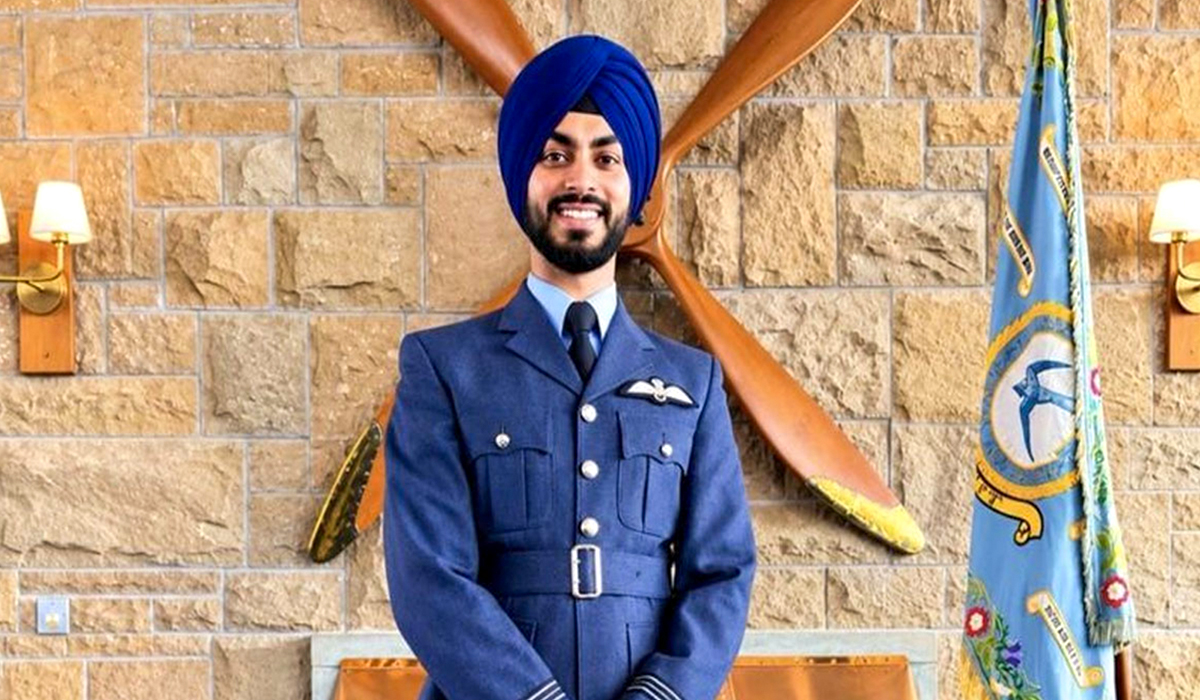

Arshdeep Singh Dang becomes the first Sikh officer to qualify as a fighter pilot in Britain’s Royal Air Force after World War II
The history of the Sikh community is full of countless examples of bravery, sacrifice, hard work, discipline and dedication. Be it at home or abroad, Sikhs have made a distinct identity with their ability and determination. Continuing this glorious tradition, 28-year-old Flight Lieutenant Arshdeep Singh Dang, born in Chandigarh, the capital of Punjab, has set a historic milestone in the British Royal Air Force (RAF).
Arshdeep Singh Dang has become the first Sikh officer to qualify as a fighter pilot in Britain’s Royal Air Force after World War II. His achievement is not just a personal achievement but also another strong example of Sikh identity, capability and dedication on a global scale.
After successfully completing his high-level flying training, Arshdeep Singh Dang obtained his official qualification at the Fast Jet Pilot Graduation Ceremony held at the famous RAF Valley in North Wales. On this occasion, he was awarded the fighter pilot’s wings. As important as this moment was for him personally, it was also a proud moment for the Sikh community around the world. Becoming a Fast Jet Pilot is considered one of the most difficult and challenging professions in the Air Force. It requires physical fitness as well as mental agility, quick decision-making ability, technical knowledge and extraordinary concentration. Arshdeep Singh proved his mettle by continuously facing all these challenges and ultimately created history.
Arshdeep Dang’s journey from Chandigarh to UK
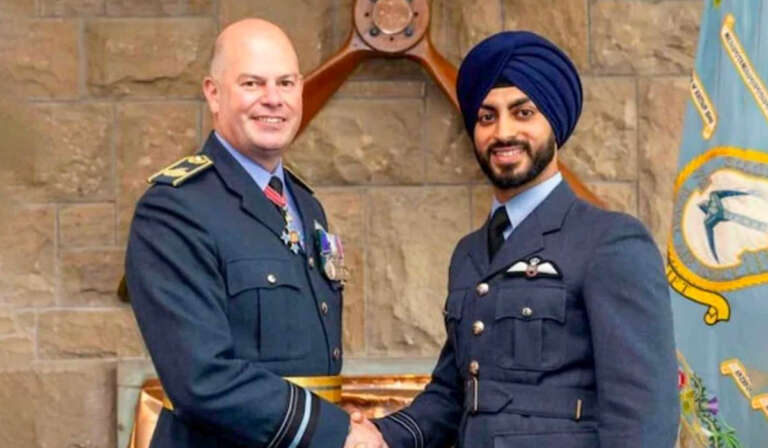
Arshdeep Singh Dang was born in Chandigarh. In 1998, when he was just six years old, his family moved to the United Kingdom. Despite growing up in a new country and a different cultural environment, his family kept him connected to his Sikh roots, traditions and heritage. After completing his schooling, Arshdeep Singh enrolled at the renowned Bristol University in the UK. Here he obtained a bachelor’s degree in mathematics and philosophy. The logical thinking of mathematics and the analytical approach of philosophy further enhanced his personality. This educational background later proved to be extremely useful during his pilot training. While technical understanding is required to operate modern fighter jets, the ability to make the right decision in the blink of an eye is also very important.
Let us tell you that the process of becoming a fast jet pilot in the Royal Air Force is long, difficult and highly disciplined. Arshdeep Singh also went through many stages during this. He began his initial military training as an officer in the Royal Air Force in February 2022. During this phase, he was trained in military discipline, leadership, physical fitness and service regulations.
He completed his initial flying training in the year 2023. During this, he mastered the fundamental principles of flying, aircraft maintenance and various techniques related to flying. Based on his excellent performance, he was selected for the Fast Jet stream in the year 2024. This was a very important stage in his career, as training in this stream in the British Royal Air Force requires a high level of skills and consistent excellent performance.
High-level training in Texas

A significant part of Arshdeep Singh’s flying training also took place in Texas, USA. Here he received high-level jet training and understood the technical nuances associated with modern fighter aircraft. This international-level training prepared him to make quick decisions in different situations and handle high-speed flights. Throughout this process, he made hard work, discipline and constant practice the basis of his success. Finally, in July 2026, he successfully passed the final wing test. With this, he created history by becoming the first Sikh officer to qualify as a fighter pilot in the RAF after World War II.
Grandfather’s dream became an inspiration and the historical relationship between Sikhs and the RAF
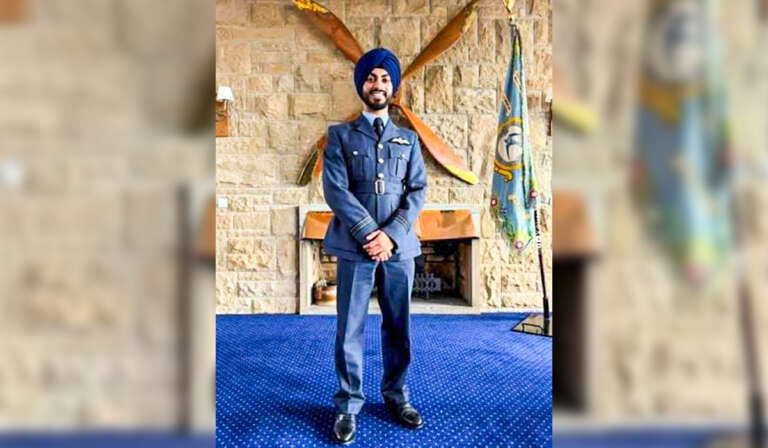
Arshdeep Singh’s family has also played a major role in this historic achievement. According to him, his grandfather Sardar Santokh Singh Dang had a dream that a child from the family would grow up to become a pilot in the Air Force. Arshdeep Singh made this dream of his grandfather his life’s goal. The love, encouragement and guidance he received from his family motivated him to move forward in this difficult journey. His Sikh values also played an important role in strengthening his personality. Principles like discipline, service, fearlessness, and hard work gave them the strength to face difficult situations with courage.
The Sikhs’ association with the Royal Air Force is not new. Many Sikhs served in the British Air Services during the First and Second World Wars. Among them, Hardit Singh Malik is particularly remembered. He served in the Royal Flying Corps during the First World War and made a unique mark as a turbaned pilot. Many Sikh officers and soldiers played important roles in the RAF during the Second World War as well. In view of this historical backdrop, the achievement of Arshdeep Singh Dang becomes even more significant.

After a long gap, a Sikh officer qualifying as an RAF fighter pilot is not only a matter of pride for the Sikh community, but it is also an important example of diversity and participation of minority communities in the British Army. Arshdeep Singh Dang’s story is an inspiration for the youth who dream of achieving big goals in their lives. His journey shows that just dreaming is not enough for any great achievement, but hard work, discipline, dedication and patience are required to fulfill that dream.
He has also left a strong message for the Punjabi and Sikh youth living abroad that by being proud of one’s heritage and identity, one can achieve success in any field of the world. His achievement also proves that Sikh youth are not limited to traditional fields. They can also prove their capabilities on a global scale in fields like defense, science, technology, aviation and entrepreneurship. Arshdeep Singh Dang has proven that while remaining connected to one’s roots, heritage and traditions, one can achieve top success in the most difficult and competitive fields of the world.

Leave a Comment