


A study of Indian history after the composition of the Vedas reveals the emergence of social stratification within society. According to Vedic thought, society was divided into four classes based on occupation: Brahmins, Kshatriyas, Vaishyas, and Shudras. Since the Vedas were authored by human beings, historians argue that the authors placed themselves within the Brahmin category. The Brahmins were described as originating from the mouth of Brahma, responsible for imparting knowledge and guidance. Those who were physically strong and warrior-like were categorized as Kshatriyas, said to have emerged from Brahma’s arms. Agricultural and trading communities were placed in the Vaishya class, believed to have originated from Brahma’s stomach, while those engaged in servile work were classified as Shudras, supposedly born from Brahma’s feet.
Over time, this social hierarchy deeply affected Indian society. During the medieval period, another major religious community entered the Indian social landscape—Islam. Muslims differed significantly from Hindus in their religious, social, and spiritual beliefs. They believed in one God and strongly opposed idol worship, whereas Hindu society had faith in multiple deities and considered idol worship an integral part of religious practice. Muslim communities were also largely free from many ritualistic traditions prevalent among Hindus.
The renowned Arab scholar Abu Rayhan Al-Biruni, who came to India alongside Mahmud of Ghazni, studied Indian religion, culture, and society extensively. He observed that Hindus and Muslims differed from one another in almost every aspect of life. Before the rise of Sikhism, saints such as Baba Farid attempted to bridge social divisions and reduce caste-based discrimination, but they could not completely eliminate these inequalities.
It was in this context that Guru Nanak Dev Ji emerged. Through his extensive travels, known as Udasis, he laid the foundation of Sikhism. By Guru Nanak’s time, Indian society was largely divided between Hindu and Muslim communities. The Delhi Sultanate had already established deep roots of Islamic influence across the subcontinent, while both Hindu and Muslim societies were burdened by various social and religious distortions.
Guru Nanak Dev Ji travelled across the four directions of India and beyond to challenge these social evils. Through his teachings and divine hymns, he introduced a new spiritual and social movement that emphasized equality, justice, and devotion to one God. His message prevented society from becoming further polarized and offered a path that transcended rigid religious divisions.
Guru Nanak welcomed people from all sections of society into the Sikh fold. He established the institutions of Sangat (congregation) and Pangat (community dining), where people of all castes and backgrounds sat together as equals. He instructed that anyone wishing to join his congregation should first share a meal in the community kitchen, thereby breaking barriers of caste and social status. Through these institutions, Guru Nanak gave Indian society a new social, religious, political, and economic direction.
Guru Angad Dev Ji further strengthened this movement by standardizing the Gurmukhi script, making spiritual knowledge more accessible to ordinary people. He preserved the hymns of Guru Nanak Dev Ji and added his own compositions. Guru Amar Das Ji expanded Sikh teachings across northern India through the establishment of twenty-two Manjis (preaching centres), while Guru Ram Das Ji gifted the Sikhs the sacred city of Amritsar.
By the time of Guru Arjan Dev Ji, the Mughal Empire had grown powerful under Emperor Jahangir. Guru Arjan Dev Ji’s martyrdom became a defining moment in Indian history. While many believed that the execution of the Guru would weaken Sikhism, his sacrifice instead strengthened the resolve of the Sikh community and safeguarded the spiritual traditions of the land.
His son, Guru Hargobind Sahib Ji, transformed Sikhism into a community capable of defending justice. By introducing the concept of Miri-Piri, symbolizing temporal and spiritual authority, he organized the Sikh military tradition. Under his leadership, the Sikhs fought several battles against Mughal forces and emerged victorious. Guru Hargobind Sahib taught Sikhs to stand firmly against oppression, laying the foundation of a courageous and self-respecting community.
The ninth Sikh Guru, Guru Tegh Bahadur Ji, played an equally significant role in preserving India’s spiritual and cultural diversity. Unlike many religious leaders of his era, he travelled extensively across Punjab, northern India, and eastern India, spreading the message of righteousness and divine remembrance.
During his time, Mughal Emperor Aurangzeb pursued policies that many viewed as religiously coercive. In Kashmir, Governor Iftikhar Khan reportedly forced many Kashmiri Pandits to convert to Islam. Distressed by persecution, a delegation of Kashmiri Brahmins led by Pandit Kirpa Ram approached Guru Tegh Bahadur Ji at Anandpur Sahib and sought his protection.
Guru Tegh Bahadur Ji offered them courage and guidance. He reportedly declared that if the Mughal authorities could convert him, the Kashmiri Pandits would willingly accept conversion as well. This bold challenge brought him into direct conflict with the Mughal administration.
Eventually arrested and taken to Delhi, Guru Tegh Bahadur Ji, along with his devoted companions Bhai Mati Das Ji, Bhai Sati Das Ji, and Bhai Dayala Ji, chose martyrdom rather than abandoning the principle of religious freedom. His sacrifice is widely remembered as one made not only for the protection of Sikhs but also for the right of all people to practice their faith freely.
The martyrdom of Guru Tegh Bahadur Ji stands as one of the most remarkable examples of defending human rights and freedom of conscience in world history. His sacrifice preserved religious plurality and protected vulnerable communities from forced conversion.
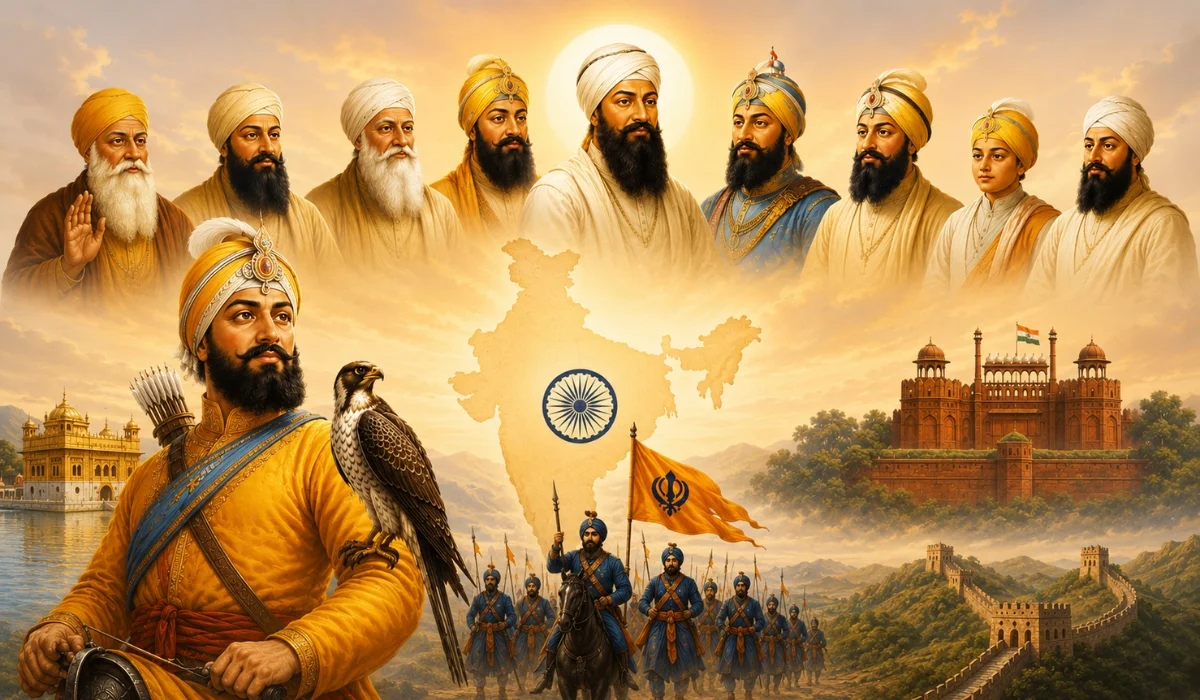
The Sikh Gurus collectively worked to eliminate caste discrimination, promote equality, defend human dignity, and challenge injustice. Through their teachings, institutions, and sacrifices, they strengthened the social fabric of India and helped preserve its diverse cultural identity.
Punjab, often called the land of Gurus and saints, continues to reflect the legacy of these teachings. The spirit of communal harmony, social equality, and mutual respect that characterizes Punjabi society today owes much to the vision and sacrifices of the Sikh Gurus. Their contribution remains a cornerstone in the story of India’s unity, diversity, and enduring integrity.


Leave a Comment