
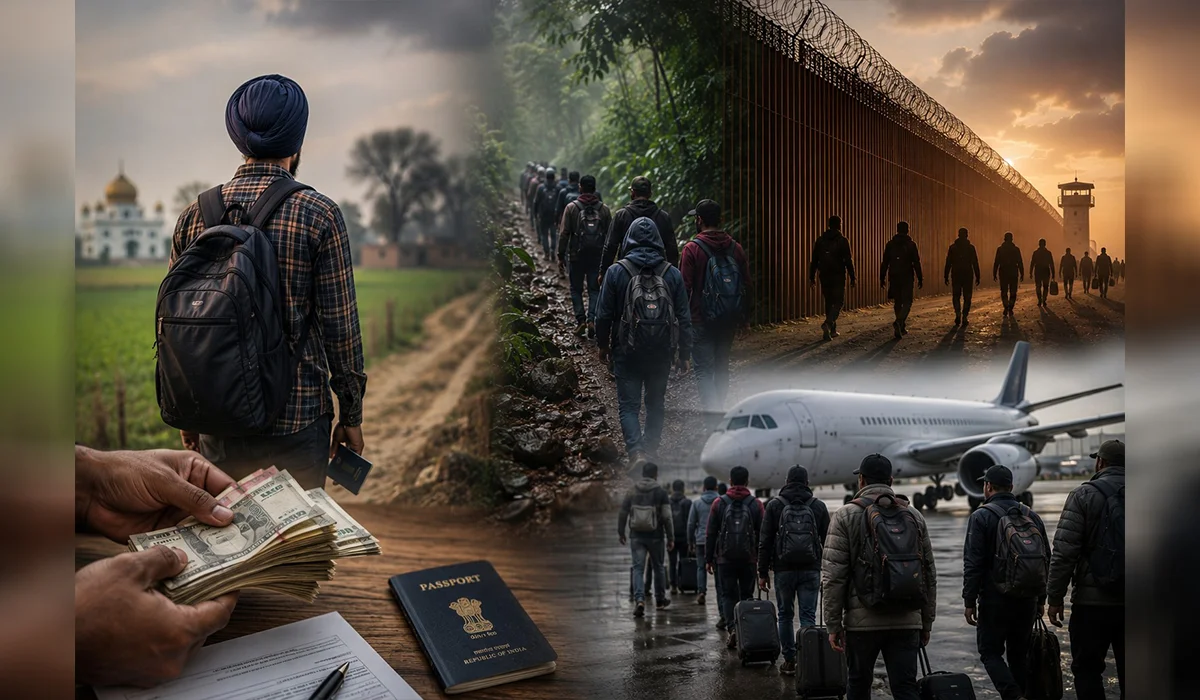

An attempt to go abroad by paying lakhs and crores of rupees, the risk of getting stranded on the way, and deportation: the ‘Dunki Route’ is still a big question for the youth of Punjab
A 33-second video that surfaced from Mexico has once again sparked discussion in Punjab about attempts to go to America through the ‘Dunki Route’. In the video, a young man can be seen lying on a bed. With folded hands, he is appealing to people not to undertake the kind of journey through which he himself claims to have reached Mexico. In this video, which surfaced on social media on August 13, the young man claims that when he tried to get out of there, he was beaten up and now he is unable to walk properly. In the video, pointing towards the person operating the camera, he says that this is the person who brought him there.
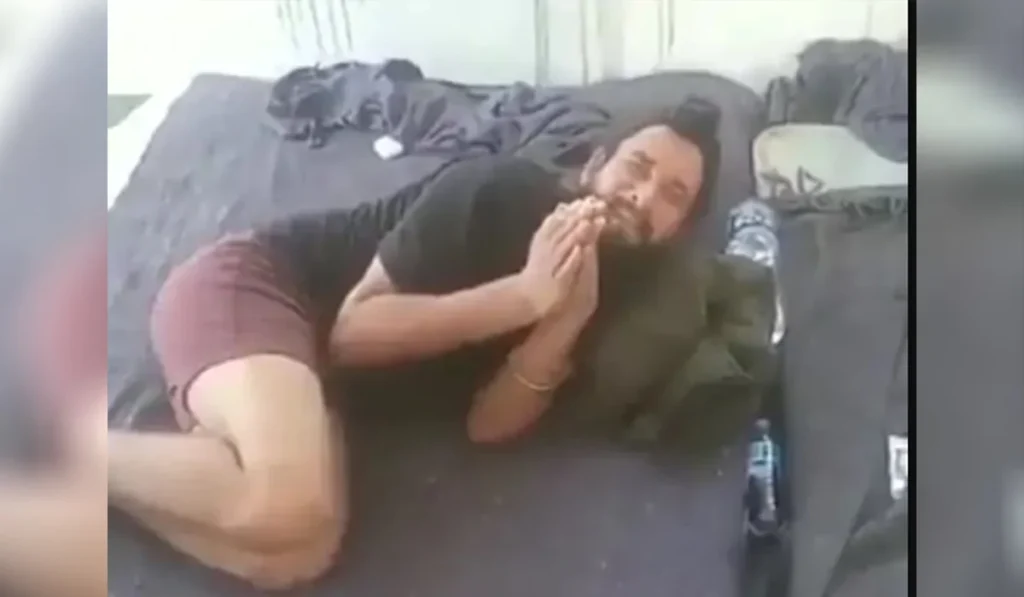
The identity of the young man, his exact location in Mexico, and the allegations made by him could not be independently verified. Therefore, at this stage, the claims made in the video should be treated only as claims. But this short video has certainly drawn attention to an issue with which thousands of families in Punjab are directly or indirectly connected: the desire to go abroad and the risks of the routes being chosen for it. In Punjab, going abroad is no longer just the decision of one young person. Many families invest their savings for this, take loans, mortgage land and, at times, pay large sums of money to agents. When legal routes begin to seem difficult or expensive, the network of agents claiming to take people to America quickly becomes more attractive. This is where the story of the ‘Dunki Route’ begins.
‘Dunki Route’ Is Not One Single Route
‘Dunki Route’ is not the name of any one fixed road or border. It is a term used for changing routes used to reach America or another Western country by crossing the borders of several countries through irregular or illegal means. Indians attempting to go to America sometimes travel towards Mexico through different countries in Latin America and from there try to reach the American border. The routes keep changing according to agents, visa availability and the border surveillance of different countries.
These routes have also included the Darién Gap, located between Colombia and Panama. It is a roadless, densely forested area, through which migrants face difficult geographical conditions as well as robbery, violence and other dangers. In many cases, gangs associated with human trafficking have also been active on these routes. This is why the video that surfaced from Mexico needs to be seen not merely as a social media clip, but in the larger context in which young people from Punjab spend lakhs of rupees trying to reach America.
How Big Is the Trend of Going Abroad From Punjab?
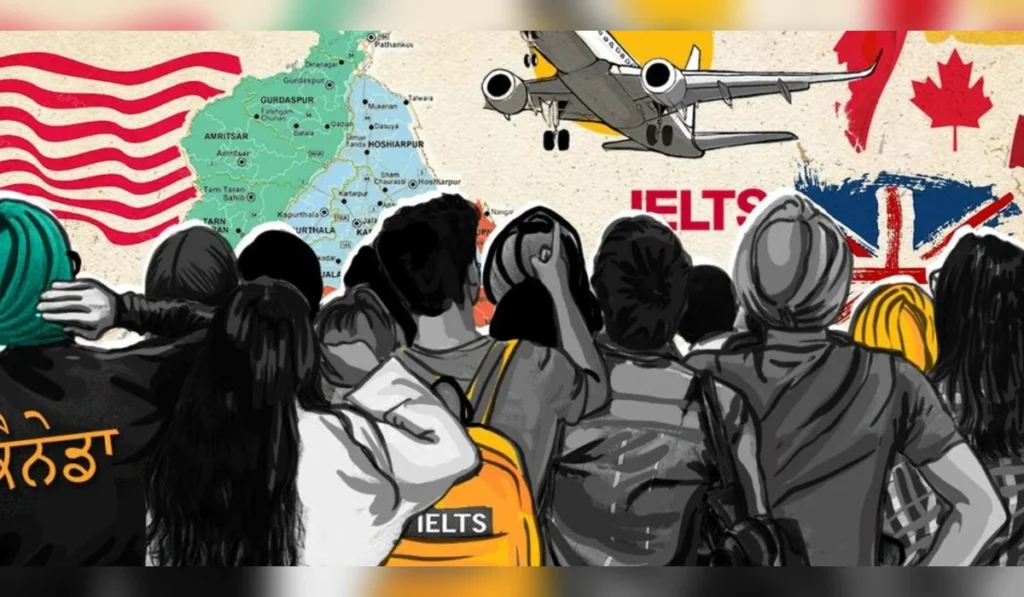
The answer to this question cannot be found only in cases connected with the Dunki Route. The trend of going abroad in Punjab is quite large, and studies also confirm this. A study conducted by economists of Punjab Agricultural University, covering 9,492 families in 44 villages across 22 districts, examined the situation of migration from Punjab between 1990 and 2022. It found that around 74 per cent of the total migration during the period under study had taken place after 2016. According to the same study, 13.34 per cent of families in rural Punjab had at least one member living abroad. Canada was the biggest destination country for this migration, followed by countries such as Dubai, Australia and Italy. These figures make one thing clear: going abroad has now become a major economic and social reality in rural Punjab. For this reason, when a young person succeeds in going abroad through a legal route, his or her story often becomes an inspiration for other young people as well. On the other hand, the cost of failure can sometimes be very heavy.
When the Dream of Reaching America Costs One Crore Rupees
The amount demanded for going to America through the Dunki Route varies according to the route and the agent. In many cases, this amount has been reported to range from Rs 30-40 lakh to Rs 1 crore or even more. In a case that came to light in February 2025, Lovepreet Kaur of Punjab had left to go to America with her 10-year-old son. According to reports, she had paid around Rs 1 crore to an agent. Her journey passed through several countries before reaching Mexico, and eventually, after entering America, she was deported.
This is not merely a matter of losing money. When a family arranges such a large amount, behind it there are often years of savings, debt or a decision involving property. That is why, when a young person ends up in a detention centre or on a return flight instead of America, another burden comes back home with them: debt.
The Colombia Case Showed Another Side of the Danger
Some cases connected with the Dunki Route have been even more serious. In a case involving five young men from Punjab and Haryana, they found themselves in danger after being held hostage in Colombia. According to reports, three of the young men died in this case, while two escaped. Such cases show that in irregular migration, the danger is not limited only to the American border. After beginning the journey, a person may reach a situation in several countries where they have neither legal documents nor easy access to the local system. It is this situation that can make them even more vulnerable to human trafficking and exploitation.
The Agent Takes the Money, the Debt Remains on the Family
The demand for going abroad in Punjab has also created a large market of immigration and travel agents. There are agents who are registered and work legally, but on the other hand, complaints have also continuously surfaced against people who take large sums of money and send young people through illegal routes.
The problem becomes even more serious because a family seeking to send someone abroad often invests far more money than it can afford. Fields are mortgaged, loans are taken and, at times, money is collected from relatives. If the young person is deported and returns, the journey ends but the debt does not. There is no guarantee that the amount paid to the agent will be returned, and it may take years for the family to restore its financial position. Even then, why do young people choose this route?
This is perhaps the most difficult question in this entire matter.
Simply saying that young people should not choose the Dunki Route is not the complete answer to the problem. It is also necessary to understand what makes a young person ready for such a dangerous journey. Employment opportunities in Punjab, local income, the condition of agriculture, opportunities for skills, and the image of success associated with going abroad in society: all these factors influence this decision.
In many villages, stories of young people who have already gone abroad are common. Someone’s brother is in Canada, someone’s son is studying in Australia, and someone’s relative is doing business in America. In such an environment, going abroad sometimes does not remain merely a search for better income, but also becomes a social expectation. It is this demand that is exploited by agents who make promises such as “definitely getting you to America” instead of offering a legal route.
Government’s Advice: Check the Agent First
The Union Ministry of External Affairs also continuously advises people to remain cautious of unregistered agents. People going abroad for employment are advised to use the government’s eMigrate portal to check the agent’s registration and the authenticity of the job. There is also a limit on the fee that can be charged by agents legally recruiting people for overseas employment. According to the Ministry of External Affairs, the fee charged by a registered recruiting agent can be equivalent to 45 days’ salary, up to a maximum of Rs 20,000. In comparison, the demand for lakhs of rupees for the Dunki Route is in itself a major indication that the matter is completely different from the normal legal employment or immigration process.
The Story Beyond the 33-Second Video From Mexico
Who is the young man seen in the video from Mexico, how did he reach there, and how much truth is there in the allegations made by him: answers to these questions can be found only after an investigation. But the larger question raised by this video is not limited to this one individual. Every year, many young people in Punjab make plans to go abroad. Many go through legal routes and build their lives. The problem arises when the desire to reach abroad is exploited and a young person is sent on a route where his safety, money and, sometimes, even his life pass into the hands of others.
Therefore, the discussion on the Dunki Route should not remain limited only to crossing borders or deportation. It also includes the families who collect money for this journey, the young people who take this risk for their future, and the system in which, because of a lack of legal opportunities or a lack of information, the promises made by agents begin to appear bigger than reality. The dream of going abroad is not wrong. The desire for a better life is not wrong either. But before making a decision about a route that begins by paying lakhs of rupees and has no legal guarantee, it is important to know what the agent is actually selling: a legal opportunity, or a journey in which there is no guarantee of coming back.

Leave a Comment