
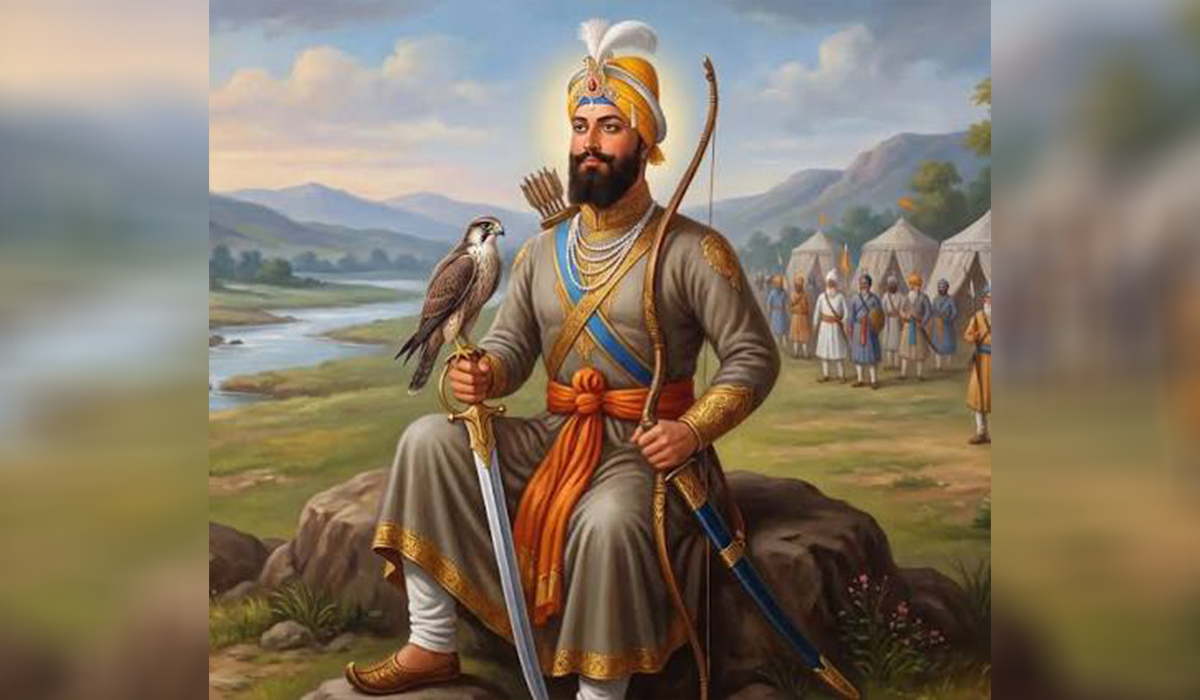

It was during the cold nights of Poh in December 1704 CE that Guru Gobind Singh Ji, who once had a large family and commanded immense prestige and respect, was now walking alone on foot.
He had left Anandpur Sahib riding his blue horse, crossed the Sarsa and reached the Garhi of Chamkaur. After leaving the Garhi, he also left behind his horse and proceeded on foot. Guru Ji slung a gun over his shoulder and, fully armed like a warrior, clapped his hands and walked out of the Garhi. He knew that if confronted, it was better to fight and die than to be captured helpless and unarmed.
Guru Ji also carried some special weapons that were treasured heirlooms of his ancestors. He always preserved these weapons carefully, and when he left the Garhi, they were secured around his waist. These weapons were relics from the time of Guru Hargobind Sahib Ji. Guru Hargobind Sahib Ji had entrusted them to Guru Tegh Bahadur Ji, and before leaving for Delhi, Guru Tegh Bahadur Ji had handed them over to the young Gobind Rai.
Now, walking westward from Chamkaur in the darkness of night, Guru Ji passed near the village of Rahimpur and reached the vicinity of Kiri Gujran Wali, about three miles from Chamkaur. Here he encountered two Gujjars from the village, Alfu and Gamu, who were searching for their missing buffaloes. Guru Ji gave them some gold mohurs and persuaded them to remain silent before moving ahead. As he walked rapidly onward, Guru Sahib’s footwear became stuck in the mud because of the wet conditions, leaving him barefoot.
Walking barefoot, Guru Ji stopped beneath a jand tree, wiped his feet and continued his journey. Today, a gurdwara known as Jand Sahib stands at this place. Continuing barefoot, Guru Ji reached Bahlol and called for Nagina Mal, a man acquainted with the Guru’s household.
Seeing Guru Ji arrive at night in such difficult circumstances, Nagina Mal became frightened. Nevertheless, he accompanied Guru Ji through thick growths of jand and karir bushes and left him at a place about three miles from Machhiwara before returning.
Today, the famous Gurdwara Jhar Sahib stands at this location. Guru Ji continued walking until he reached the outskirts of Machhiwara. Machhiwara was a prominent town at the time. A channel of the Sutlej River flowed north of the settlement.
Outside Machhiwara, Guru Ji entered a dense garden in complete darkness and sat beside a well near the orchard. He opened the well bucket and drank water. Finding a flat patch of ground nearby, Guru Ji placed the empty bucket under his head as a pillow and lay down on the bare earth to sleep. The place was about 12 miles from Chamkaur Sahib.
He had been deprived of proper sleep for several nights and was exhausted from walking. He therefore fell asleep quickly. Historians write that on this particular night, deep and carefree sleep was perhaps necessary. He had just witnessed his sons receive the ultimate certificate of bravery:
“Soora so pehchaniye jo larhe deen ke het,
Purja purja katt mare, kabhoo na chhade khet.”
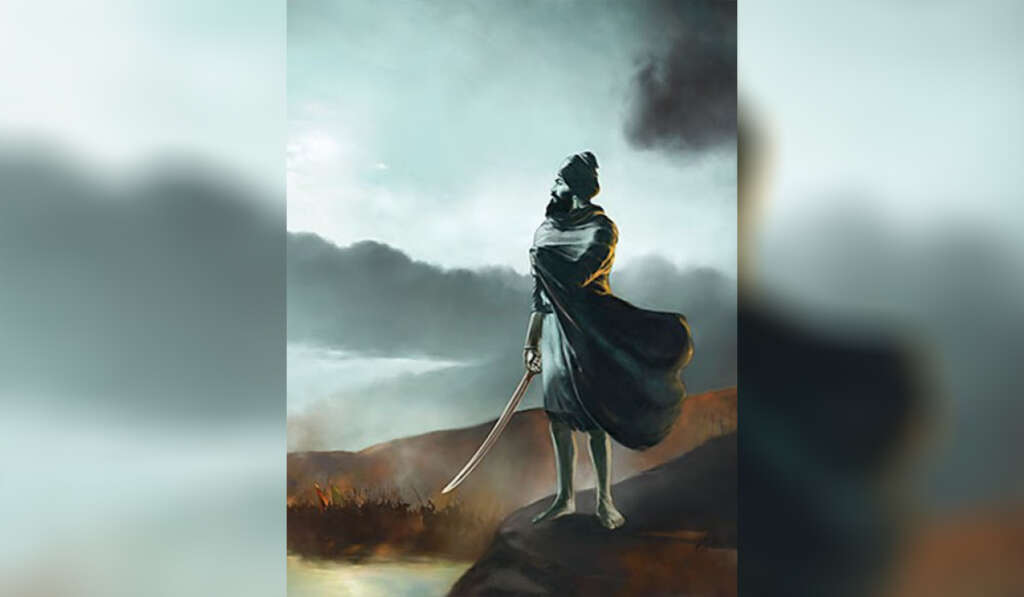
Only the previous day, both elder Sahibzadas had attained martyrdom, their bodies cut down piece by piece in battle. It was the triumph of Guru Ji’s own principle. Both elder Sahibzadas had won the great trial of Chamkaur and embraced death as their bride. The sun was about to rise when Guru Ji awoke. The cold winds of Poh and the damp ground had not allowed him to sleep for very long.
As soon as he opened his eyes, a thought arose in his mind that his beloved Bhai Sangat Singh and Bhai Sant Singh must also have attained martyrdom by now. Their radiant souls, he reflected, would be travelling towards the land of the Beloved. In a voice filled with separation and longing, Guru Ji sang:
“Mitar pyare nu haal muridan da kehna,
Tudh bin rog rajaiyan da, odhan naag nivasan da rehna.
Sool surahi, khanjar pyala, bing kasaiyan da sehna.
Yaarare da sanu sathar changa, bhatth kherian da rehna.”
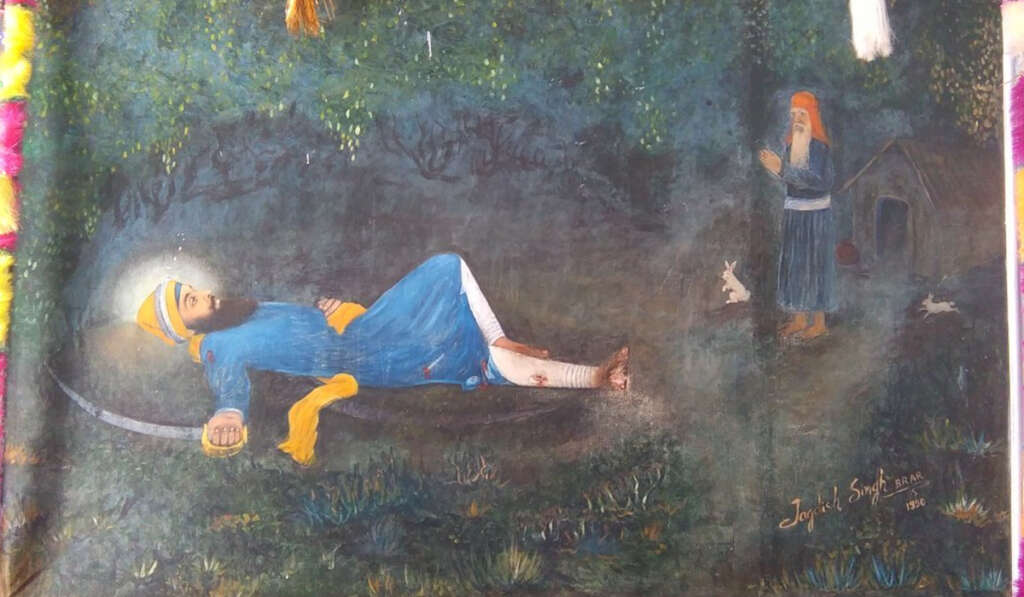
The Singhs who had left the Garhi of Chamkaur with Guru Ji, Bhai Daya Singh, Bhai Dharam Singh and Bhai Man Singh, had become separated from him. While searching for Guru Ji, they heard his voice and began moving in that direction. As they came closer, they saw a flash of light from a jewel fixed on the thumb of the glove worn on Guru Sahib’s right hand.
Expert archers wore such protective gloves and could shoot arrows continuously for hours during battle. Guru Ji had a precious stone set into his glove. The glimmer of that jewel guided the Singhs towards him.
When they reached him, they saw Guru Ji lying on the ground. The soles of his feet were badly torn, and the blood on them had already dried.
Before Guru Ji could ask anything, the Sikhs pleaded, “O tenth light of the carefree Nanak, this is not the time to remain here unconcerned. Patshah, the sun is about to rise and it is not safe to remain outside the village. If people from the village see you, word will quickly spread.”
The Sikhs told Guru Ji that the house of Gulaba, a Sikh masand, was nearby and that they should go there. When Gulaba learned that Guru Ji was nearby, he came personally, bowed before him and requested that he accompany him home.
Meanwhile, when the Mughal and hill forces discovered that the person they had killed inside the Garhi was not Guru Gobind Singh Ji, the force of around 10,000 soldiers was divided into detachments and sent in all directions with orders to capture the Guru, dead or alive.
Guru Sahib reached the upper room of Gulaba Masand’s house at night. Gulaba and his brother Punjaba together served Guru Ji with great devotion. They offered him food and prepared a comfortable bed so that he could rest.
Gulaba and Punjaba also had a sister named Har Dai, who lived nearby in Machhiwara. She was a deeply devoted follower of the Guru’s household and travelled every year to Anandpur Sahib for Guru Ji’s darshan.
She traditionally offered Guru Ji clothes made from khaddar that she had spun with her own hands. However, for several years she had been unable to visit Anandpur Sahib and longed intensely to see Guru Ji.
When Har Dai learned that Guru Ji had come to Machhiwara, she was overwhelmed with joy. She brought with her the clothes she had been unable to offer during the previous two or three years and went to her brothers Gulaba and Punjaba’s house to have Guru Ji’s darshan.
Guru Ji had spent only one night at Gulaba’s house. The brothers served him wholeheartedly, but when they learned that Mughal troops searching for Guru Ji had reached Machhiwara, they became frightened.
They informed Guru Ji of the situation and placed before him a piece of khaddar cloth and some money as an offering. Guru Gobind Singh Ji smiled. He understood that Gulaba had become afraid and was now effectively bidding him farewell.
A short distance from Machhiwara, towards the south, lived two Pathan brothers, Nabi Khan and Ghani Khan, who were among the close devotees of the Guru’s household. Both were very dear to Guru Ji and had earlier served for some time at Anandpur Sahib.
They were now horse traders, bringing fine horses from distant regions, selling them and earning substantial rewards. Guru Gobind Singh Ji summoned them to Gulaba’s upper room. Both brothers reached Gulaba’s house to meet Guru Ji.
When Guru Ji learned that Nabi Khan and Ghani Khan had arrived, he called them inside. The brothers had Guru Ji’s darshan and bowed respectfully before him. In Suraj Prakash, Bhai Santokh Singh Ji writes:
“Sadan Gulabe ke tab aae, suni Sri Prabh ne leen hakaar,
Darshan te abhivandan karke, baith gaye dhig keen uchaar.”
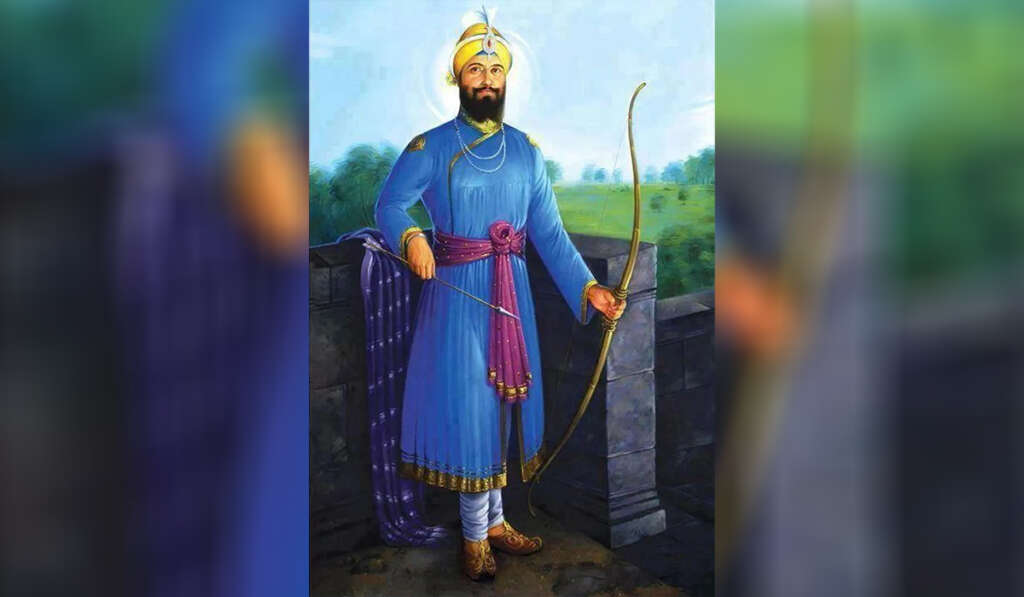
When the two Pathan brothers came before Guru Ji, they wore full beards and blue Pathani dress. Guru Ji lovingly asked them to sit beside him. Their throats were choked with emotion. They informed Guru Ji that detachments of Mughal soldiers were roaming throughout Machhiwara and that it was no longer safe for him to remain at Gulaba’s house.
They pleaded with him to come to their humble home, where they could plan a way to protect him. Guru Ji initially remained silent after hearing them and then smiled. Bhai Daya Singh Ji asked the reason for his silence and smile.
Guru Ji replied, “How long shall we continue hiding? Earlier, obeying the command of the Khalsa represented by the Five, we left the Garhi of Chamkaur. But now I would rather fight here and attain martyrdom.” Hearing this, everyone grasped Guru Ji’s feet and pleaded with him.
“Maharaj, guardian of the Panth, Satguru Ji, the purpose for which we persuaded you to leave Chamkaur has still not been fulfilled. Therefore, we should now plan to reach whatever safe place is available. For the moment, please accept the request of these Pathan brothers and go to their home.” Guru Ji then agreed to accompany Nabi Khan and Ghani Khan and took shelter in their haveli.
After spending one night at the home of Gulaba and Punjaba, Guru Ji spent two nights at the home of Nabi Khan and Ghani Khan. From there, Guru Ji sent for Sayyid Inayat Ali, his Persian teacher who had taught him the Persian language during his childhood.
Inayat Ali lived about two miles away at his home in Nurpur Bet. When he heard that his former student had arrived in such circumstances, he could not restrain himself and came to meet Guru Ji the following morning. The moment he saw Guru Ji, his heart trembled.
He remembered the royal child whom he had once taught Persian at Anandpur Sahib as the son of Guru Tegh Bahadur Ji. Now that same disciple was wandering from door to door like a displaced traveller, with wounded feet and dusty clothes.
Guru Ji narrated the entire sequence of events to his former Persian teacher. Together, Guru Ji and Inayat Ali devised a plan to take him safely out of the area.
Bhai Santokh Singh Ji also writes that Guru Ji and Inayat Ali first seated Bhai Daya Singh on a palanquin and presented him as the Pir of Uch. When Mughal soldiers became suspicious, they surrounded the palanquin, detained it and kept it under watch for one night.
Sayyid Inayat Ali testified on their behalf, saying that this was the Pir of Uch, who had returned from Hajj, was a man of great spiritual powers and was now travelling on pilgrimage. He told them, “This is not the person you are searching for.”
Later, when an opportunity arose, Bhai Daya Singh was replaced on the palanquin by Guru Gobind Singh Ji, who was then taken onward from Machhiwara. From this episode, it appears that neither Sayyid Inayat Ali had to speak a direct falsehood nor did Guru Ji violate any principle of his life.
Guru Gobind Singh Ji was now seated on the palanquin in the guise of the Uch Da Pir. Sayyid Inayat Khan and Guru Ji’s Sikhs took him to Ghulal, situated about five or six miles south of Machhiwara.
At Ghulal, Guru Ji gave Sayyid Inayat Khan a letter of appreciation, or hukamnama, and bade him farewell. Ghulal was an old and well-populated village. There Guru Ji said that an entrusted offering had to be collected from a blacksmith named Jhanda.
When Jhanda was summoned, he initially failed to recognise Guru Ji. Guru Ji then mentioned two swords, 21 arrows and two bows. Jhanda immediately remembered the vow he had made before God to offer these weapons to the Guru’s household. Overjoyed, Jhanda brought the weapons and placed them at Guru Ji’s feet, receiving his blessings.
Today, Gurdwara Shastar Bhet Sahib stands at this place in Ghulal and holds considerable historical significance. After receiving the weapons at Ghulal, Guru Ji proceeded towards Lallan.

Leave a Comment