

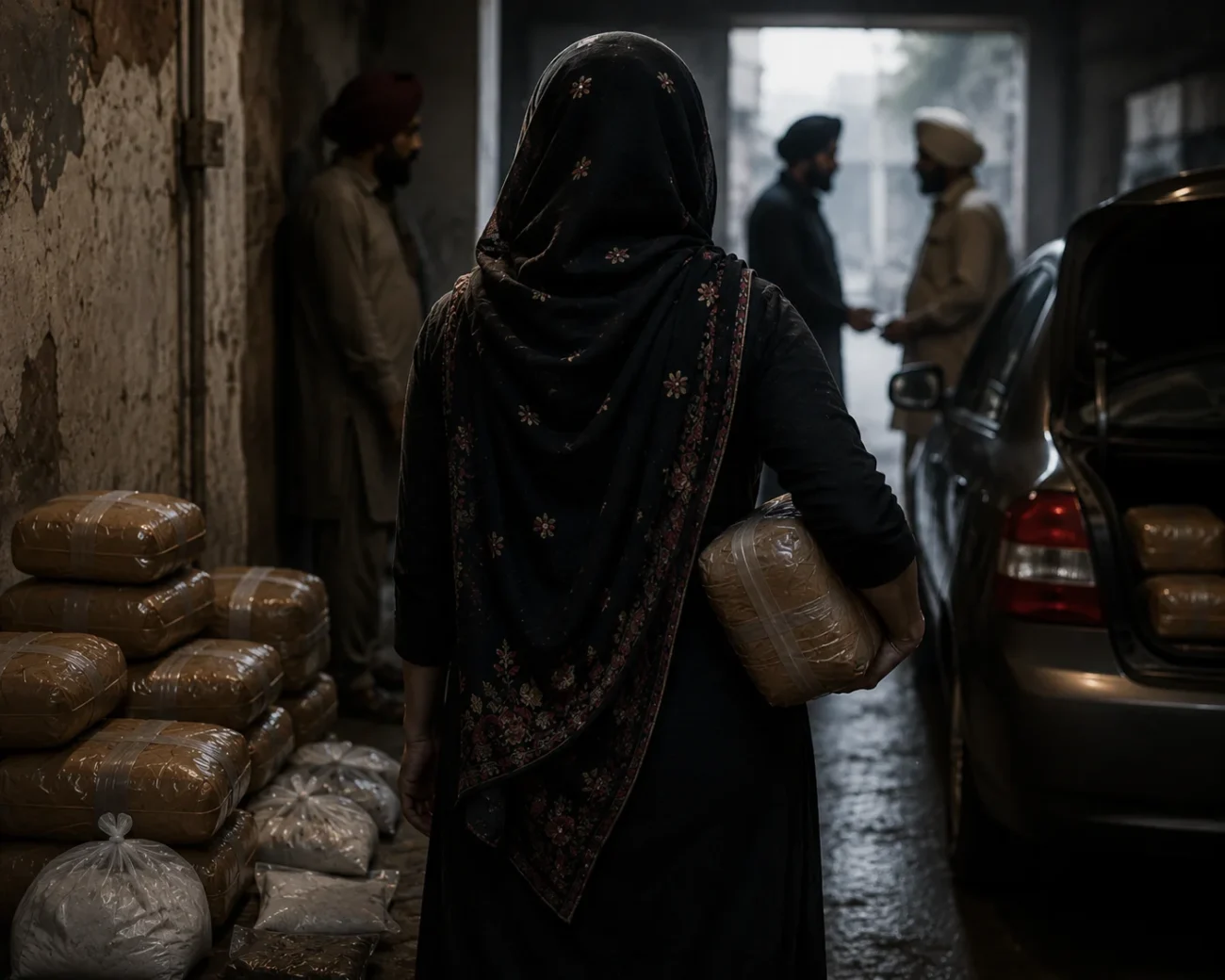

These days, reports in the media suggest that women in Punjab are increasingly being found involved in drug trafficking. Based on reports that have appeared in the media over the past two months, let us discuss this issue.
In April, Shimla Police arrested a woman from Chandigarh with 40 grams of heroin. She was allegedly involved in the drug trade. Shimla SSP Gaurav Singh told the media that the 40-year-old woman was on her way to sell narcotics. Last month, information shared with the media by a young woman from the Malwa region also became a matter of discussion. Her account punctured the Punjab government’s claims regarding its anti-drug campaign. The girl said that she herself consumes dangerous drugs and also supplies them to other girls.
The border district of Ferozepur has also been in the headlines recently because police arrested 20 women drug traffickers from this district alone. Newspaper reports indicate that a large number of women have been arrested in Punjab over the past three years. Women account for 10 percent of all NDPS FIRs registered in the state.
On 31 March, police arrested a woman named Rajbir Kaur from Shah Wala Road near Zira and recovered 3.115 kg of heroin and ₹11.50 lakh in drug money from her. On 12 January, two drug traffickers, including a woman from a village near Fazilka, were arrested and 512 grams of ice drug was recovered from them. On 16 January, police recovered 420 intoxicating tablets from a woman from Ameer Khas village in Guru Har Sahai and another female associate. Similar reports keep emerging from Punjab’s border districts of Amritsar, Gurdaspur and Tarn Taran, where women have also been found among drug traffickers arrested by police or the BSF. The Punjab State Women Commission has also expressed concern over women’s involvement in drug trafficking.
Senior journalist Rajeev Khanna, who has worked in Punjab for many years, comments on this trend: “The drug menace has brought Punjab to the brink of complete destruction, and successive central and state governments are fully responsible for this. The involvement of women in this business is even more worrying. There are many reasons why women enter this illegal trade. One reason is poverty, especially visible in the border areas. Another reason is that domestic and foreign agencies involved in smuggling consider women to be the safest couriers, because compared to men, women are less likely to be searched. Women are available in this trade at lower rates. They are considered more reliable and loyal than men. Many women enter this trade through their husbands or lovers. Because of this, they are more likely to remain involved in the business for a long time and operate with loyalty.”
Psychologist Mridula Sharma says, “The involvement of women in the drug trade is truly a matter of grave concern for our society. Women from economically weaker sections must have enough employment opportunities so that they do not get trapped in the drug trade.”
Explaining why women in border areas get caught in the drug trade, Professor Jagrup Sekhon, a noted political scientist from Punjab who has done extensive research on life in border areas, says, “Before Independence and Partition, Punjab’s border areas were prosperous and developed. Even after Partition, things remained stable for some time. But later, terrorist attacks and wars between India and Pakistan devastated this region. Due to constant tension on the border, people were displaced many times. The government also did not pay adequate attention to this region. In terms of education, employment and development, the border area remained far behind. Gradually, local people got caught in the network of drug traders. This certainly happened from across the border, but Indian officials and police were also involved in collusion. Without their help, it would be difficult for drugs to enter and spread here only from across the border. Once this became a big business, drug trafficking also began receiving political patronage. Several villages in the border belt became notorious for drug smuggling. In many families, all members became involved in this work. For many people in the border region, this became a source of livelihood. The police have their own share in this trade. Several police stations and police officers in the border region have remained infamous for direct or indirect links with the drug trade. Gharinda police post has been especially notorious in this regard.”
He further says, “A major reason for women’s involvement is that when male members of the family are caught smuggling drugs, the women of the household are forced to take up this work in order to feed themselves and their children. In some cases, it has also been seen that police personnel involved in the drug trade force these women to do this work. If they refuse, they are harassed and troubled. In reality, the drug problem and women’s participation in this business cannot be viewed separately from our polluted political system.”



Leave a Comment