
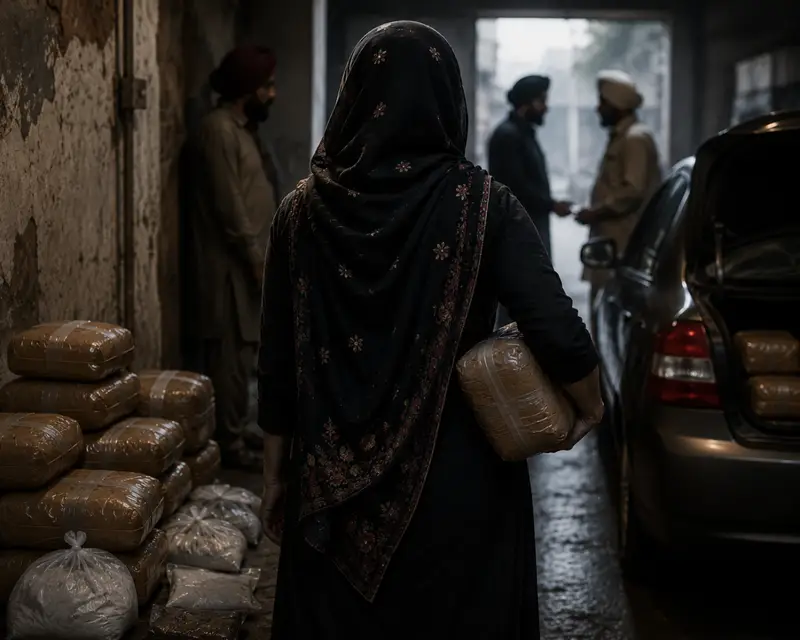

Recent media reports from Punjab indicate a troubling trend: women are increasingly becoming involved in drug trafficking. While Punjab’s drug crisis has long been discussed in terms of addiction, cross-border smuggling, and the role of criminal networks, the growing participation of women in the narcotics trade points toward a deeper social and economic crisis unfolding within the state.
Over the past few months, several incidents have brought this issue into sharp focus. In April, Shimla Police arrested a 40-year-old woman from Chandigarh with 40 grams of heroin. According to Shimla SSP Gaurav Singh, the woman was allegedly on her way to sell the narcotics. Around the same time, a young woman from Punjab’s Malwa region drew widespread attention after openly speaking to the media about her own involvement with drugs. She admitted not only to consuming synthetic drugs herself but also to supplying them to other girls, thereby exposing the stark gap between official anti-drug claims and ground realities.
The border district of Ferozepur has also remained in the news because police reportedly arrested around 20 female drug traffickers from the district alone in recent months. Newspaper reports further suggest that women now account for nearly 10 percent of all NDPS-related FIRs registered in Punjab. These figures indicate that women’s involvement in the narcotics trade is no longer isolated or incidental.
Several recent arrests underline the seriousness of the situation. On March 31, police arrested Rajbir Kaur near Zira on Shah Wala Road and allegedly recovered 3.115 kilograms of heroin along with drug money worth ₹11.5 lakh from her possession. Earlier, on January 12, police arrested two traffickers, including a woman from a village near Fazilka, and recovered 512 grams of “ice” drug. On January 16, police recovered 420 intoxicating tablets from a woman from Amir Khas village in Guru Har Sahai and one of her associates. Similar reports have repeatedly emerged from border districts such as Amritsar, Gurdaspur, and Tarn Taran, where women have figured among those arrested by Punjab Police or the BSF for alleged involvement in drug smuggling. The Punjab State Women Commission has also expressed concern regarding this growing trend.
The increasing involvement of women in the narcotics trade raises an important question: why are more women entering this dangerous and illegal network?
Senior journalist Rajiv Khanna, who has closely observed Punjab’s social and political landscape over the years, believes that the answer lies partly in the devastating impact drugs have already had on the state. He points to poverty as one of the major factors driving women toward drug trafficking, especially in border areas where economic opportunities remain scarce. According to him, trafficking networks prefer women because they are perceived as safer couriers:
“Domestic and foreign agencies involved in smuggling consider women to be safer couriers because women are less likely to be searched compared to men. Women are available at lower rates for this work. They are also considered more trustworthy and loyal than men.”
Khanna notes further that many women enter the narcotics trade through family or intimate relationships: “Many women enter this trade through their husbands or lovers. Therefore, they tend to remain associated with it for a longer time and with greater commitment.”
These observations suggest that women’s participation in the drug trade cannot be viewed simply as individual criminality. In many cases, it emerges from economic vulnerability, family dependence, and exploitation by organized networks.
Psychologist Mridula Sharma also views the trend as a serious social concern. She says: “The involvement of women in the drug trade is truly a matter of serious concern for our society. Economically weaker women should have ample employment opportunities so that they do not get trapped in the web of drug trafficking.”
Her remarks highlight the absence of stable livelihood opportunities for women from economically marginalized backgrounds. In regions where unemployment, debt, and insecurity dominate everyday life, illegal economies often become survival mechanisms.
To understand the issue more deeply, one must also examine the condition of Punjab’s border regions. Political scientist and researcher Prof. Jagroop Sekhon argues that the roots of the problem lie in decades of economic neglect and instability. He says: “Punjab’s border regions were once prosperous and developed before Independence and Partition. Even after Partition, things remained stable for some time. But later, terrorist attacks and wars between India and Pakistan devastated these areas. Continuous tension along the border repeatedly displaced people.”
According to Prof. Sekhon, border areas gradually fell behind in education, employment, and development: “The government also neglected these regions. In matters of education, employment, and development, border areas lagged far behind. Gradually, local people came under the influence of drug traffickers.”
He points toward institutional complicity in sustaining the narcotics trade: “While drugs do come from across the border, Indian officials and police are also complicit in this trade. Without their involvement, it would be difficult for drugs to enter solely from across the border.”
As the illegal trade expanded, it increasingly acquired political protection, according to Sekhon. “As the business expanded, politicians also began patronizing the drug trade. Several villages in border areas became notorious for drug trafficking. In many families, every member became involved in this work. For many people in border regions, it turned into a source of livelihood.”
This normalization of the drug economy has deeply affected family and community structures. In many cases, women become involved after male family members are arrested or incapacitated.
Prof. Sekhon says: “A major reason for women’s involvement is that when male family members are arrested for smuggling drugs, the women are forced to continue the trade to feed themselves and their children.”
He says coercion also plays a role in some cases: “In some cases, police personnel involved in the drug trade also pressure women into doing this work. If they refuse, they are harassed.”
Ultimately, the growing involvement of women in drug trafficking reflects a much wider breakdown – one rooted in poverty, unemployment, institutional corruption, political patronage, and the normalization of the narcotics economy in vulnerable regions.
As Prof. Sekhon bluntly observes: “You cannot separate the drug problem and women’s participation in this business from our corrupt political system.”
The issue, therefore, cannot be addressed solely through arrests and policing. Unless Punjab tackles the deeper structural problems affecting its border regions – including economic deprivation, lack of opportunities for women, addiction, and institutional corruption – the cycle is likely to continue.
Thus, the increasing participation of women in drug trafficking is not merely a law-and-order issue. It is a reflection of a larger social crisis that has entered homes, families, and communities across Punjab.



Leave a Comment