

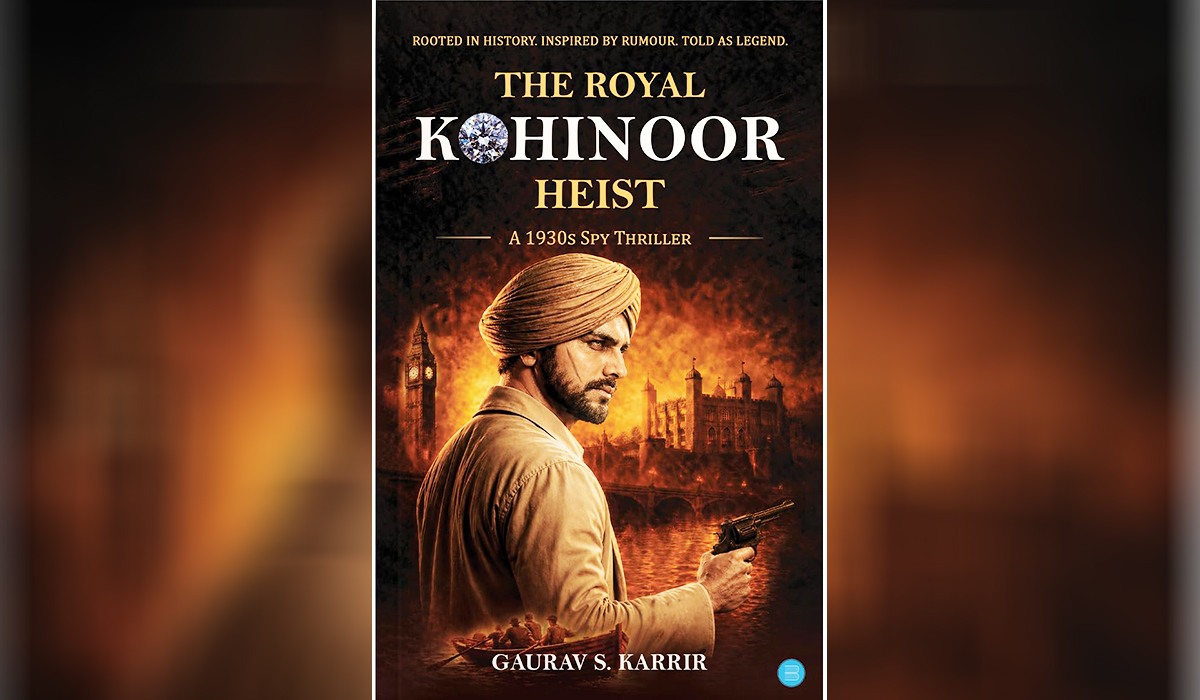

Few objects evoke as much emotion among Punjabis as the Kohinoor. Once the prized possession of Maharaja Ranjit Singh and the Sikh Empire, the legendary diamond passed into British hands after the annexation of Punjab in 1849. The young Maharaja Dalip Singh, barely a child, was separated from his kingdom, his people, his mother, and eventually from the Kohinoor itself. More than a diamond, the Kohinoor became a symbol of a lost chapter in Sikh history.
I wrote this novel because I have always felt that a part of our history lives in silence — in the stories never told, the courage never recorded, and the dreams our forefathers carried quietly in their hearts. So much of India’s struggle for freedom was shaped by ordinary men and women who dared extraordinary things, often at great personal risk. Their desperation for dignity, their hunger for respect, and their yearning for a free India form the emotional pulse of this book.
Though ‘The Royal Kohinoor Heist’ is written as a thriller, for me, it is also an act of remembrance. It is a tribute to the lakhs of freedom fighters — the unsung, the forgotten, the young who never grew old — who gave everything so that we could inherit a nation with its head held high. Their sacrifices beat beneath every chapter of this story.
In writing this book, I hope to carry their memory forward — and to remind readers that courage, even when unrecorded, changes the destiny of nations.
When I was writing the story, I was looking at one spectacular act that could rattle the empire. And in history, there have been many such acts in the course of India’s independence struggle. This novel inspires the present generation to explore history and appreciate the individuals who secured India’s independence from British rule. It is a tribute to the forgotten names and small acts of bravery that made the freedom movement unstoppable.
The novel features the protagonist, Kehar Singh, who resolves to challenge the British Empire by the spectacular act of stealing the Kohinoor from London. Having heard about the Jallianwala Bagh massacre and witnessed the daily acts of abuse by the British colonial masters, Kehar makes it his life’s mission. Using the cover of a hockey player, Kehar makes a daring escape from Lahore and travels across Central Asia, the Soviet Union and finally, Germany. The twists and turns are many, risks were at every step, but destiny rewards him with one final chance. And Kehar finally lands in London, where the heist is planned and executed.
There were two instances when tears welled up while writing for the first time, and even when I reviewed my 15th draft. The part when Kehar is in jail, thinking about what he did and what impact it had on the independence movement. Secondly, when he writes a letter to his mother before the night of the heist. The questions swirl in his mind. Do his parents know where he is? Did his friend Balbir get any information about the heist? Was Verma able to deliver the letter to his mother? Questions to which he never found answers.
What makes the book especially relevant today is that it does not end with the final page. I am inviting readers to read the petition to the Government of India on page 242 and scan the code next to it. The mail will go directly to the Ministry of External Affairs. We know the Kohinoor is still in London, but the only way to bring it back is through Government-to-Government negotiations. I urge you to do your part and petition the Government of India so that what once belonged to us can be restored to the place of its origin.
This book is now available on Amazon, click here.

Leave a Comment