

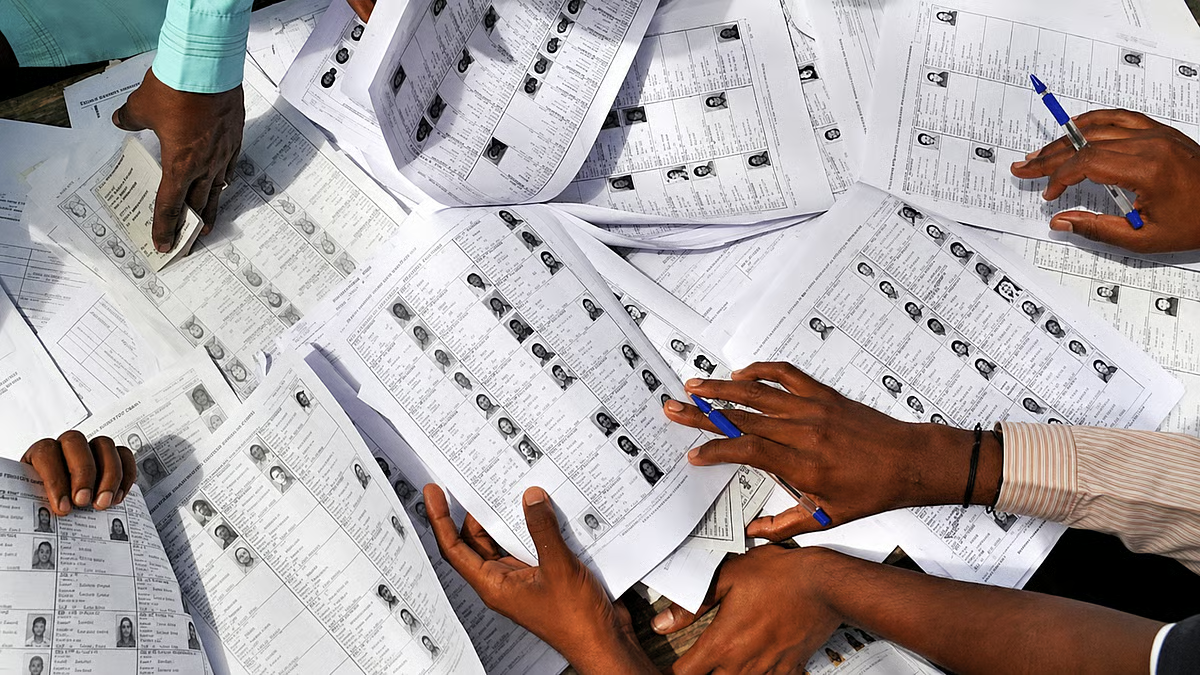

As Punjab’s SIR 2026 enumeration ends, 6.6% of the draft roll stands unmapped — here is the legal remedy every affected elector must use before 12 September, 2026.
Buried in the otherwise celebratory press note issued by the Office of the Chief Electoral Officer, Punjab, on 4 August 2026, marking the completion of the House-to-House Enumeration phase of the Special Intensive Revision (SIR) 2026, is a single sentence that deserves far more public attention than it has received. Ms Anindita Mitra, IAS, the Chief Electoral Officer, stated that 93.40% of electors included in the draft roll have been successfully mapped to the 2003 electoral rolls or to the rolls of a previous SIR. The arithmetic that follows is inescapable: roughly 6.60% — on a draft base of 1,93,94,408 collected Enumeration Forms, a figure in the region of 12.8 lakh Punjabi electors — currently stand unmapped. Notices to this cohort are to commence from 13 August 2026, “in compliance with instructions of the ECI.”
For a State with 2.14 crore registered electors, 12.8 lakh is not a rounding error. It is larger than the electorate of several Assembly Constituencies put together. The question that every affected citizen, and indeed every conscientious observer of Punjab’s democratic process, is entitled to ask is simple: what happens next, and what remedy exists?
The categories behind the numbers
Before turning to remedy, it is worth setting out, precisely as the press note frames them, the distinct categories into which Punjab’s 2.14 crore-strong electorate has now been sorted. These are not interchangeable terms, and conflating them is the surest way to misread the scale of the problem.
Of the 2,14,61,043 electors on the rolls as of 9 June 2026, 20,66,635 — 9.63% of the total — fall into the uncollectable, or ASDD, category, broken down as:
- Dead — 5,74,568 electors (2.68%)
- Untraceable/Absent — 4,12,715 electors (1.92%)
- Permanently Shifted — 9,44,131 electors (4.40%)
- Already Enrolled elsewhere — 1,19,145 electors (0.56%)
These four categories together account for the gap between the total 2.14 crore electorate and the 1,93,94,408 Enumeration Forms actually collected and digitised. They represent electors who, for one identifiable reason or another, will not carry forward onto the draft roll at all.
Unmapped is a separate and additional category, layered on top of the 1,93,94,408 forms that were collected. It is not a subset of ASDD, and it is this fifth, distinct category — affecting an estimated 6.60%, or roughly 12.8 lakh electors — that carries the most consequential and least understood remedy process.
What “unmapped” actually means
Mapping, in SIR parlance, is the exercise of tracing an elector’s current entry back to a lineage — either the 2003 roll (treated by the Election Commission of India as the last authenticated baseline) or the roll prepared during a prior SIR. An elector who cannot be so traced is not thereby declared ineligible. He or she may simply be a first-time voter, a migrant who has genuinely relocated within Punjab, someone whose earlier entry contained a clerical or transliteration error, or a person whose 2003-era household records were never properly digitised. Unmapped is not synonymous with disqualified. But it does place the elector in a category requiring further scrutiny, and therefore further paperwork, before his or her name can be confirmed on the final roll.
The constitutional foundation: why the presumption must favour the elector
It is worth stating, in terms, the constitutional principle that ought to govern how this entire exercise is approached. Article 326 of the Constitution of India establishes universal adult suffrage as the basis of elections to the House of the People and to the Legislative Assemblies of the States. Every citizen of India who is not less than eighteen years of age — a threshold itself constitutionally fixed, lowered from twenty-one by the Constitution (Sixty-first Amendment) Act, 1988 — and who is not otherwise disqualified under the Constitution or a law made by Parliament on the ground of non-residence, unsoundness of mind, crime, or corrupt or illegal practice, is entitled to be registered as an elector. This is not a statutory concession that Parliament or the Election Commission may curtail by executive instruction; it is one of the few individual entitlements the Constitution confers directly.
The companion condition — ordinary residence in the constituency — is governed by Sections 19 and 20 of the Representation of the People Act, 1950, which together define ordinary residence and, along with citizenship and age, constitute the complete and exhaustive test for registration. Nothing more is required in law.
It follows that once these three elements — citizenship, attainment of eighteen years, and ordinary residence — are established, even on the ordinary civil standard of preponderance of probability rather than the criminal standard of proof beyond reasonable doubt, an elector cannot lawfully be left off the roll. The Supreme Court’s own observation, in its 27 May 2026 judgment, that the Election Commission possesses no “exclusive or unfettered power” to adjudicate citizenship, reinforces precisely this point: an administrative exercise such as SIR is not licensed to impose an evidentiary threshold higher than the Constitution itself contemplates.
This is not a technical quibble, and it matters well beyond the ballot box. An elector wrongly struck off the rolls loses not merely the franchise for one election cycle, but very often the single most widely accepted proof of ordinary residence and identity that citizens rely upon for bank accounts, welfare entitlements, passport verification, and a range of everyday transactions in which the electoral roll entry functions as a de facto documentary anchor. Wrongful deletion is therefore rarely a solitary injury confined to one polling day; it carries consequential harm to a citizen’s broader civil standing. This is precisely why the burden of establishing eligibility must remain light, and why, once the constitutional threshold is met even on a preponderance of probability, the presumption must operate in the elector’s favour and not against him.
The legal architecture of the remedy
It is important that citizens understand this is not uncharted or arbitrary territory. On 27 May 2026, a Supreme Court bench headed by Chief Justice Surya Kant, while upholding the ECI’s constitutional authority under Article 324 to conduct the SIR, was equally emphatic that the exercise must remain “fair, inclusive, and non-arbitrary,” and that adequate safeguards and appellate mechanisms must exist for electors whose names are omitted or disputed. The Court, drawing on its earlier interim directions in the Bihar SIR litigation, had already required the Commission to accept Aadhaar as valid supporting documentation, to publish lists of excluded electors along with the reasons for exclusion, and to render active assistance to such electors — not leave them to fend for themselves against a bureaucratic wall.
Translated into the Punjab timeline, the remedy runs as follows. The draft electoral roll is to be published on 13 August 2026. From that date, notices will go out to unmapped electors, and the window for filing Claims and Objections opens simultaneously, running through 12 September 2026. An elector who finds himself unmapped, or indeed any citizen who discovers that a genuine, eligible voter has been left off the draft roll altogether, must file Form 6 — either online through the ECI’s portal or physically before the Booth Level Officer, the Electoral Registration Officer, or at the designated Help Desks that were operational through the enumeration phase and ought, as a matter of administrative discipline, to remain open through this claims window. The disposal of these claims and objections is to continue until 8 October 2026, with the final electoral roll scheduled for publication on 12 October 2026.
Where the real difficulty lies
The law, on paper, is reasonably protective. The difficulty is administrative and informational, not statutory. A 1984-batch IAS officer who has spent a career watching how paper processes translate — or fail to translate — into ground reality would flag three concerns.
First, the burden of proof. An unmapped elector is, in effect, being asked to establish a negative or an absence: to prove that his or her earlier entry existed, or that his or her current claim is genuine, often decades after the paper trail has gone cold. The onus should not fall disproportionately on citizens who may lack ready access to 2003-era documents; the presumption of eligibility, once basic residence and identity are established through Aadhaar or an equivalent document, must operate in the elector’s favour, precisely as the Supreme Court intended.
Second, awareness. The SVEEP outreach that accompanied the enumeration phase — the human chains, the radio jingles, the e-rickshaw announcements — was substantial and commendable. But awareness campaigns tend to taper off once the headline phase concludes. The Claims and Objections window is arguably the more consequential phase for the 12.8 lakh unmapped electors, and it deserves at least equal, if not greater, publicity intensity, particularly in districts such as SAS Nagar, Ludhiana, and Kapurthala, which recorded the lowest form-collection percentages and are therefore likely to carry a disproportionate share of unmapped cases.
Third, access. A five-week claims window, spanning 13 August to 12 September, is workable in principle, but only if Help Desks, BLOs, and EROs remain genuinely accessible — not merely on paper — through the harvest season and the accompanying rural workforce migrations that are a seasonal feature of Punjab’s agrarian calendar.
The remedy that citizens must actually use
For the ordinary elector reading this, the practical course is as follows: verify your name and mapping status on the draft roll from 13 August 2026; if unmapped or omitted, file Form 6 without delay, supported by Aadhaar or any other document establishing residence and identity; retain an acknowledgement of filing; and if the claim is not disposed of satisfactorily, escalate in writing to the ERO and, if necessary, the DEO, citing the Supreme Court’s 27 May 2026 directions on assistance and non-arbitrariness. Political parties and their Booth Level Agents — nearly 88,000 of them were deployed during the enumeration phase — have an equal responsibility to assist constituents through this window rather than treat it merely as a numbers contest ahead of the next election.
The Chief Electoral Officer and her team deserve genuine credit for the scale and discipline of the enumeration exercise. But the true test of SIR 2026’s inclusiveness in Punjab will not be measured by the impressive 90.37% form-collection figure. It will be measured by how many of the 12.8 lakh unmapped electors are restored to the rolls, with dignity and without needless obstruction, by 12 October 2026.

Leave a Comment