



From Congress to AAP, governments have changed, slogans have changed and enforcement drives have intensified. Yet Punjab continues to grapple with one of India’s deepest drug crises. The question is no longer whether the problem exists, rather it is why decades of political promises have failed to produce lasting results.
Punjab has spent nearly three decades fighting the drug menace. Successive governments have announced “wars on drugs,” launched special task forces, expanded de-addiction facilities and promised to dismantle trafficking networks. Yet official data, parliamentary findings and judicial observations suggest the challenge remains deeply entrenched.
The available evidence does not point to a single administration or a single policy failure. Instead, it reveals a crisis that has persisted across governments, adapted to changing enforcement strategies and evolved into a complex law-and-order, public health and socio-economic challenge.
A Crisis Measured in Millions
One of the most striking official assessments came through a Parliamentary Standing Committee on Social Justice and Empowerment, which cited survey findings estimating that nearly 66 lakh people in Punjab use drugs in a state of around three crore people.
The committee referred to an estimated 21.36 lakh opioid users and nearly 6.97 lakh children affected by drug use. It also highlighted another troubling statistic: reported cure rates at government de-addiction centres were around 1.5%, suggesting that treatment infrastructure has struggled to deliver sustained recovery.
If these estimates reflect the ground reality, Punjab’s narcotics challenge extends far beyond policing. It represents a long-term public health, social welfare and economic issue affecting households across both rural and urban communities.
Even the Supreme Court Has Raised Alarm
The seriousness of the issue has also drawn attention from India’s highest court. During proceedings relating to narcotics enforcement, the Supreme Court observed that Punjab’s drug abuse crisis had reached “alarming levels”, emphasizing the need for effective intervention to address its impact on society.
The observation is significant because it frames the issue not merely as a criminal justice problem but as one with far-reaching consequences for public health, social stability and governance.
More Enforcement – Intent Vs Political Noise
Punjab Police have substantially intensified anti-drug operations in recent years. According to official data, between 5 July 2022 and 7 July 2023, Punjab Police registered 12,218 FIRs under the Narcotic Drugs and Psychotropic Substances (NDPS) Act, indicating sustained enforcement activity during the first year of the current government.
A broader comparison of official seizure and enforcement figures between 2017-2021 and 2022 to April 2026 also illustrates the scale of policing efforts.
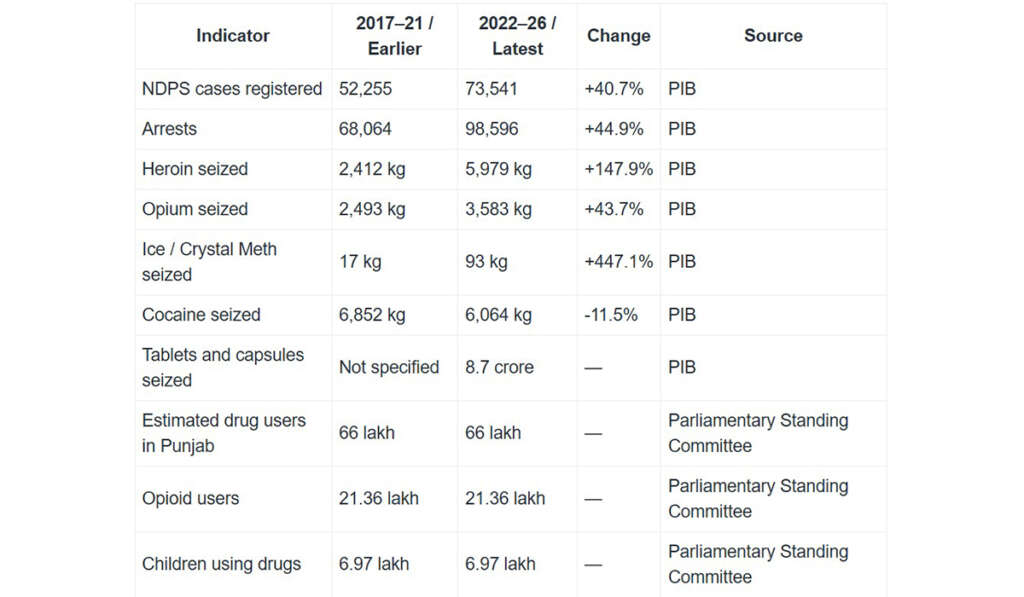
The figures show a substantial increase in registered NDPS cases, arrests and drug seizures over the past few years, reflecting intensified enforcement efforts across the country.
Higher seizures can indicate more effective policing and better intelligence. Equally, sustained or increasing seizure volumes may suggest that trafficking networks continue to move significant quantities of narcotics through the state. However, the question here arises how the drugs travel through the state, why government machinery fails to control despite seizures and arrests. One doesn’t need to crack ‘Da Vinci code’ to answer, It is low intent that revolves around the theatrics and political mileage than honest correction.
The available data alone cannot determine which explanation predominates. What it does demonstrate is that the narcotics ecosystem remains active despite intensified enforcement.
The Network Has Changed Faster Than Policy
Drug trafficking in Punjab has evolved considerably over time. Earlier concerns centred largely on heroin smuggled across the international border. Recent enforcement data indicates increasing recoveries of synthetic narcotics, including crystal methamphetamine (ICE), suggesting that trafficking patterns may be changing.
Security agencies have repeatedly reported attempts to move narcotics through cross-border routes, including the use of drones and organised smuggling networks.
Experts increasingly argue that dismantling such networks requires more than seizures. Financial investigations, asset forfeiture, intelligence sharing and inter-agency coordination have become equally important.
What the Courts Have Been Saying
Judicial proceedings in Punjab repeatedly highlight another dimension of the challenge. High Court decisions in NDPS matters frequently examine issues such as:
● proper recovery procedures;
● sealing and sampling of seized narcotics;
● maintenance of the chain of custody;
● forensic compliance;
● delays in investigation and trial.
Legal experts have long argued that arrests alone cannot ensure successful prosecution. Cases weakened by procedural lapses may reduce the deterrent effect of enforcement and allow organised trafficking networks to adapt.
In one recent observation while considering an NDPS matter, the Punjab and Haryana High Court, referring to the wider crisis, noted that Punjab was “reeling under the grip of drug menace” and that the problem posed a serious threat to the state’s social fabric.
In another case, the Court remarked that organised drug peddling was “destroying the social fabric” and consuming the youth of Punjab, underlining the gravity with which the judiciary views the issue.
Lack of Rehabs Grows Repeat Offenders
The Parliamentary Standing Committee’s reported treatment outcomes point to another structural weakness. If government de-addiction centres are reporting cure rates of around 1.5%, then reducing supply alone is unlikely to produce lasting reductions in addiction.
Medical professionals generally view substance dependence as a chronic health condition requiring detoxification, counselling, behavioural therapy, family support and sustained follow-up care. Without adequate rehabilitation and post-treatment support, relapse risks remain high.
Several experts have argued that Punjab’s anti-drug strategy must place rehabilitation and recovery alongside policing rather than treating them as secondary priorities.
The Economic and Social Cost
The drug crisis extends well beyond crime statistics. Substance abuse affects workforce participation, educational outcomes, healthcare expenditure and household finances. Families often bear significant emotional and financial burdens arising from treatment costs, lost employment and debt.
Communities also face broader consequences through increased demands on healthcare, policing and social welfare systems. Although these indirect costs are difficult to quantify precisely, economists generally agree that persistent addiction can undermine productivity and weaken long-term economic development.
Beyond Political Cycles
Punjab’s drug crisis has persisted under governments led by different political parties. Each administration has introduced new strategies, expanded enforcement or announced ambitious timelines for making the state drug-free. Yet the available evidence suggests that the challenge remains substantial.
It does not necessarily mean every intervention has failed. Increased seizures, specialised policing units and intelligence-led operations may well have disrupted trafficking routes and intercepted large quantities of narcotics.
At the same time, parliamentary findings, continuing enforcement activity and judicial observations indicate that durable reductions in addiction have proved elusive. The available evidence therefore points toward a broader institutional challenge rather than a problem attributable to a single political cycle.
The Accountability Question
Punjab’s drug crisis is no longer simply a law-and-order issue. It has become a test of governance, institutional capacity and public policy.
Parliamentary estimates suggest millions continue to be affected. Enforcement agencies continue to register thousands of NDPS cases. Courts continue to express concern over the scale of the problem. Rehabilitation outcomes remain a significant area of concern. Taken together, these indicators suggest that enforcement alone cannot resolve the crisis.
Breaking the cycle will likely require stronger investigations, more effective prosecutions, sustained rehabilitation, disruption of trafficking finances, improved forensic capacity, coordinated border management and long-term public health interventions that come from an intentful and determined governing system, the state so far has missed.
The enduring question is not whether those promises were made, but whether the institutions responsible for delivering them have become strong enough to achieve measurable, lasting results.


Leave a Comment