
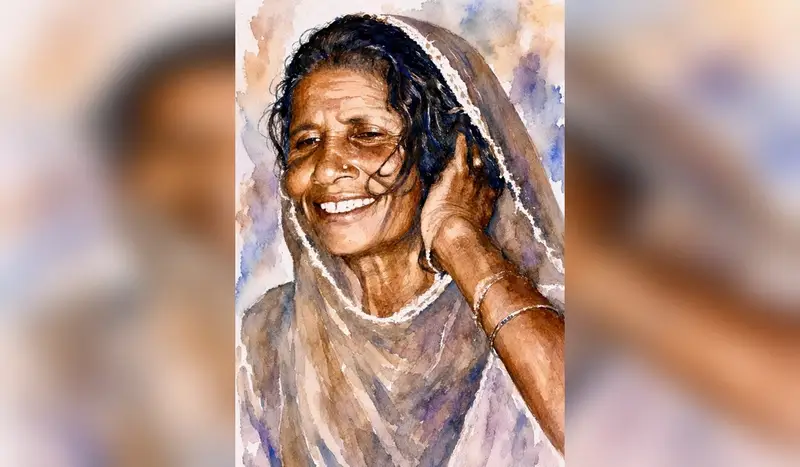

Punjab has produced countless singers whose voices have become part of everyday life, but only a handful have carried the emotional depth of Bibi Nooran. Her singing was never built around glamour, expensive orchestras, or commercial success. Instead, it flowed from lived experience, inherited tradition, and an extraordinary command over folk expression. Those fortunate enough to hear her perform often described her voice as something that travelled beyond music. It felt like the sound of the desert wind, a lonely lamp glowing in the darkness, or a prayer rising quietly into the night sky. Every note carried the fragrance of rural Punjab, where stories, love, separation, faith, and longing lived together in folk songs passed from one generation to another.
Many younger listeners know Bibi Nooran today only because of the later popularity of her musical family. However, long before modern Punjabi music became a global industry, she had already earned respect among radio audiences, folk enthusiasts, and literary circles. Despite living in severe financial hardship, she never allowed poverty to diminish the dignity of her art. She continued singing with unwavering dedication, proving that true music is shaped not by wealth but by honesty of expression. Her life represents both the richness of Punjab’s folk heritage and the painful neglect experienced by many traditional artists.
A Voice First Heard on All India Radio
For countless listeners during the 1970s, All India Radio Jalandhar served as an important cultural bridge connecting villages, towns, and cities through Punjabi folk music. One afternoon, sometime around 1974 or 1975, a remarkable voice emerged from the popular “Lok Geet” programme. That voice belonged to Bibi Nooran. The opening verses immediately created a powerful emotional atmosphere. Her rendition of “Kulli Rah De Vich Pai Asaan Tere” did not sound like an ordinary studio recording. Instead, it felt deeply personal, as though an old storyteller was sharing generations of memories through music. Every word carried emotional weight, while every musical phrase reflected years of disciplined practice and instinctive artistry.
The impact of that first broadcast remained unforgettable. Her singing possessed a natural openness that cannot be manufactured through technical training alone. She stretched notes effortlessly, allowing them to breathe before gently returning to the melody. The emotional intensity never appeared forced. Listeners could almost picture lonely dunes, distant village paths, flickering lamps, and waiting lovers simply by hearing her voice. Such was the power of her interpretation. Without relying on elaborate arrangements, she transformed simple folk poetry into living experiences. That unforgettable radio broadcast introduced many admirers to an artist who would leave a permanent mark on Punjabi folk music, even though history would never fully reward her contributions.
First Meeting with Bibi Nooran
Hearing Bibi Nooran on the radio was one thing, but watching her perform in person revealed an entirely different dimension of her artistry. A few years after that memorable broadcast, the opportunity arrived when noted photographer and writer Harbhajan Singh Bajwa invited her to Batala for a cultural programme organised under the banner of “Sahit Kala Sansar” to mark the death anniversary of the legendary Punjabi poet Shiv Kumar Batalvi. For many in the audience, including those who had admired her voice over the radio, this was the first chance to experience her music without the distance created by microphones and transmitters. She travelled from Jalandhar by an ordinary bus with her sons, carrying little more than a harmonium, carefully wrapped in a thin cotton sheet, and a small bag containing a dholki. There was no orchestra, no stage decoration built around celebrity, and no entourage announcing the arrival of a famous singer. Everything about her appearance reflected simplicity. However, the moment she stepped onto the stage, it became clear that she needed nothing beyond her own voice to command attention.
As she adjusted the harmonium and prepared to sing, there was an almost complete silence in the gathering. Then came the first alaap. It rose gently before expanding with astonishing strength, filling the hall with a resonance that seemed far larger than the modest stage itself. Listeners later recalled that it felt as though every corner of Batala had suddenly awakened. Her voice possessed rare clarity, soaring effortlessly into higher notes without losing warmth or emotional balance. She sang with complete confidence, never rushing through the lyrics and never treating the performance as a routine assignment. Every composition unfolded like a conversation between the singer and the audience, inviting listeners into a shared emotional space. Songs such as “Jee Ve Sohneya Jee” carried extraordinary tenderness. The words spoke of longing, acceptance, and hope, but it was Nooran’s interpretation that transformed them into unforgettable experiences. She continued singing for nearly an hour, moving naturally from one folk composition to another while holding the audience spellbound. Those present that evening did not simply witness a concert. They experienced an artist whose relationship with music was deeply spiritual, sincere, and completely free from theatrical display.
The Simplicity Behind a Divine Voice
Meeting Bibi Nooran away from the stage revealed an even more remarkable truth. A voice capable of filling auditoriums with emotion belonged to a woman living in circumstances that most admirers could scarcely imagine. During a visit to Jalandhar in 1978, accompanied by Punjabi poet and broadcaster S. S. Misha and writer Kuldeep Takhhar, there was an opportunity to visit her home in Abadpura near Nakodar Road. The expectation was that a respected radio artist would at least enjoy modest comfort after years of broadcasting and public performances. The reality was painfully different. Stagnant water, narrow lanes, and poor sanitation surrounded the neighbourhood. The unpleasant smell lingered in the air, and the surroundings reflected the economic hardship faced by many traditional artists of that era. Even more surprising was the absence of basic facilities inside the house. Electricity had not yet reached her home. At night, the darkness was broken not by electric lights but by oil lamps, while the brightest light in the house remained the music she continued to practise.
What made the visit unforgettable was not the poverty itself but the dignity with which Nooran accepted it. She spoke openly, laughed easily, and showed no bitterness towards life. Music remained her greatest wealth. Her home became a place where songs were rehearsed late into the night, children learned rhythm and melody, and folk traditions continued despite financial struggles. She described singing as her ancestral occupation rather than a profession chosen for fame. Born in Kotla Suraj Mall, near Shahkot, she admitted that she did not even know her exact date of birth because such records held little importance in her childhood. What mattered was the family’s musical inheritance. When she demonstrated her singing during that visit, placing one hand gently near her ear while stretching long notes with astonishing control, it became obvious that years of hardship had never weakened her voice. Instead, they seemed to deepen its emotional power. Her music carried the honesty of someone who had lived every word she sang. That rare authenticity became the defining quality of Bibi Nooran’s legacy and explains why those fortunate enough to meet her continued to speak of her with affection long after the performances had ended.
Journey from Kotla Suraj Mall to Jalandhar
Bibi Nooran’s musical journey did not begin inside recording studios or concert halls. It began in the rural landscape of Punjab, where folk traditions were passed from one generation to another through memory rather than written notation. She was born in the village of Kotla Suraj Mall, close to Shahkot, into the Mir Alam family, where singing was regarded as a hereditary calling. Music was woven into everyday life. Children grew up listening to elders perform folk ballads, Sufi verses, wedding songs, and devotional compositions. This environment became her first classroom. Without formal schooling or written lessons, she absorbed melodies simply by listening repeatedly and reproducing them with astonishing accuracy. Later in life, she often admitted that she was completely illiterate, yet she could remember lengthy compositions after hearing them only a few times. Her memory became her notebook, while her voice became the instrument through which tradition survived.
As she grew older, the family eventually settled in Jalandhar, where performance opportunities slowly increased through radio broadcasts, cultural gatherings, village fairs, and wedding celebrations. Although city life offered greater exposure, financial security remained elusive. Her household depended largely on musical performances, with family members accompanying one another on stage. Her sons developed remarkable skills on the harmonium and dholki, turning every performance into a collective expression of inherited artistry. Unlike many performers who attempted to modernise folk music for commercial appeal, Nooran remained committed to its original form. She preserved traditional pronunciation, emotional phrasing, and rural musical structures that had evolved over generations. This unwavering commitment gave her performances a timeless quality. Even today, recordings of her songs reveal an artist who never allowed commercial pressures to dilute the emotional richness of Punjabi folk music. Her journey from a small village to becoming one of the most respected folk voices on All India Radio reflects not only personal determination but also the enduring strength of Punjab’s oral musical heritage.

Leave a Comment