
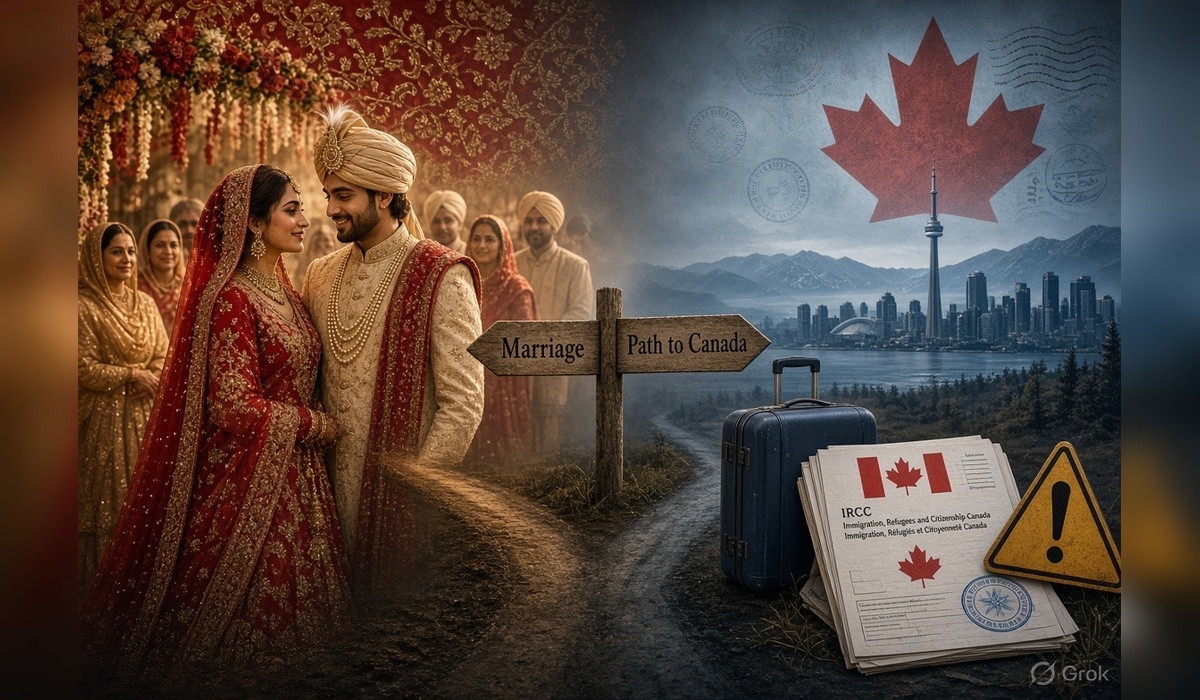

For many families in Punjab, a foreign marriage is no longer limited merely to a relationship between two people. Along with the marriage comes the hope of going abroad, education, economic security, and building a future in Canada.
This very hope is now clashing with cases where some families in Punjab have alleged that they spent lakhs of rupees for a wedding, education, or travel to Canada, but after reaching Canada, the woman allegedly refused to sponsor her husband or broke off all contact with him.
This issue has regained attention because Immigration, Refugees and Citizenship Canada (IRCC) has issued a warning regarding marriage fraud and “relationships of convenience.”
According to IRCC, a marriage, common-law, or conjugal relationship whose main purpose is solely to facilitate a person’s immigration to Canada can be deemed a “relationship of convenience.” Canadian officials investigate such relationships through document verification, interviews, and other methods. According to Canada, Canadian citizens or permanent residents who knowingly engage in such relationships for immigration can face criminal charges. The application of a foreign applicant involved in a fake marriage can be rejected, and they can face a five-year ban from entering Canada.
But behind this legal immigration jargon is a very local story of Punjab—the hope of moving abroad, lakhs of rupees invested or borrowed by families, and the migration expectations tied to a marriage.
When the Promise of Going Abroad is Tied to Marriage
A pattern allegedly emerges in some of the cases reported in Punjab.
A young man unable to find an easy route to Canada is matched with a girl who is already living in Canada or who holds a study or work permit there.
Following this, the boy’s family agrees to bear the expenses of the marriage, education, air travel, or other costs. Allegedly, the expectation is that after the wedding, the girl will sponsor her husband to Canada or help him get there.
A study published in Artha Vijñāna in 2024 examined “contract marriages” occurring in Punjab for international migration. Researchers described this as an informal agreement between two potential migrants aimed at increasing the chances of going abroad. The study highlighted the importance of social and economic networks in facilitating such marriages.
But it is crucial to understand an important difference here. The subsequent breakdown of a marriage does not in itself prove marriage fraud.
Similarly, a wife’s decision not to sponsor her husband to Canada does not automatically prove that she entered into the marriage solely for immigration purposes.
The central question of the investigation is whether fraud or immigration was made the sole objective right from the inception of the marriage.
This distinction also comes to light in two cases registered in Bathinda.
In a case reported in February 2026, Gagandeep Garg of Bathinda alleged that he was married to Priya Garg of Baghapurana in Moga district. According to the complaint, the girl’s family took ₹17 lakh for marriage-related expenses and another ₹5 lakh for expenses related to moving to Canada.
The complainant alleged that after reaching Canada, she refused to sponsor her husband and severed contact with his family.
Following an investigation, the police registered a case against the woman and her parents under sections of the Bharatiya Nyaya Sanhita. However, these are allegations, and the registration of an FIR does not equate to guilt being proven.
In another Bathinda case, Kuljeet Singh alleged that his son, Jasbir Singh, was married to Gagandeep Kaur of Mehma Sarja, and the family spent approximately ₹25 lakh to send her abroad.
According to the complaint, after reaching Canada, Gagandeep Kaur allegedly refused to call her husband over and broke off contact with the family. After investigating, the police registered a case.
In just these two complaints, the amounts cited by the families total nearly ₹47 lakh.
But these are individual allegations. Based on these, one cannot conclude that there has been a widespread surge in such cases across all of Punjab.
The ₹41 Lakh Case of Barnala
A similar case came to light in Barnala in 2025.
According to the Hindustan Times, a family from the village of Ugoke alleged that they spent around ₹41 lakh on their daughter-in-law Kiran Kaur’s education, student visa, tuition, travel, and other expenses related to Canada. The family claimed she was supposed to sponsor their son to Canada later.
Kiran went to Canada in March 2023. Later, her husband also arrived there, but the family alleged that the two separated and demands for more money were made.
The police registered a case against five people, including the woman and her family members. This case is also under legal proceedings.
The significance of such cases does not lie purely in the monetary amount.
For a middle-class or farming family, ₹15 lakh, ₹25 lakh, or ₹41 lakh can represent years of savings, debt, or income derived from land or agriculture.
When the hope of moving abroad remains unfulfilled, the family is faced not only with a marital dispute but also with a massive economic burden.
A Major Alleged Racket Busted in Khanna
In July 2025, the Khanna police claimed to have exposed a different model of alleged marriage-related fraud.
According to the police, Sukhdarshan Kaur and her daughter Harpreet Kaur, who resides in Canada, were accused of luring young men and their families with the promise of marriage. According to the police, prospective grooms were made to interact with the woman via video calls, and money was extracted for various expenses, including education and travel.
According to a report by The Indian Express, the police were investigating transactions worth at least ₹1.60 crore and claimed that at least seven families were allegedly targeted.
This case also demonstrates that alleged marriage fraud does not always begin after the wedding.
In many instances, it allegedly starts with matrimonial advertisements, photos, introductions, video calls, and the aspirations of going to Canada.
Why is Canada So Important in Punjab’s Marriages?
The massive presence of the Punjabi community in Canada helps explain why Canada holds such a prominent place in Punjab’s expectations surrounding marriage and moving abroad.
According to Canada’s 2021 census, 279,950 people identified their ethnic/cultural identity as Punjabi, while roughly 520,390 people reported Punjabi as the language spoken predominantly at home.
In British Columbia alone, over 93,000 people registered a Punjabi identity during the 2021 census, while in the Greater Vancouver area, this number stood at around 71,000.
These statistics do not indicate how many marriages take place between Punjab and Canada, or how many cases relate to marriage fraud.
But they do reflect the deep social and familial ties between Punjab and Canada.
For many Punjabi families, Canada is not a distant country. A daughter, son, sister, brother, relative, or acquaintance may already be living there.
This proximity can make an overseas marriage appear much easier and more achievable.
NRI Marriage Disputes Are Not New in Punjab
This problem is not new.
According to the National Commission for Women (NCW) report for 2024-25, 457 new complaints related to NRI marriages were registered between April 2024 and March 2025. Of these, 68 complaints were from Punjab, marking the highest number in the report’s state-wise list.
But it would be incorrect to classify all these complaints strictly as “marriage fraud.”
Complaints relating to NRI marriages can also encompass domestic violence, abandonment by the husband, dowry-related disputes, passport issues, maintenance, and other marital problems.
Therefore:
An NRI marriage complaint does not equal marriage fraud.
Similarly, an accusation against a wife for not sponsoring her husband to Canada does not automatically prove she married solely for immigration.
Available government data shows that complaints tied to cross-border marriages in Punjab constitute a significant category, but it does not specify how many of these cases actually constitute immigration fraud.
Why is Complete Data on the Real Problem Unavailable?
In March 2025, the Ministry of External Affairs informed the Rajya Sabha that over the past five years, 1,617 complaints were received concerning NRI women allegedly abandoned by their husbands abroad.
However, the Ministry also clarified that it does not maintain state-wise data of women abandoned in India by husbands who later moved abroad. This information is held by state governments and union territories.
This reveals a massive data gap.
Problems associated with NRI marriages in Punjab are frequently discussed, yet no publicly available national database clarifies:
⚬ In how many marriages in Punjab does one spouse live abroad;
⚬ How many of those are specifically linked to Canada;
⚬ How many complaints pertain to alleged marriage fraud;
⚬ How many cases relate simply to a marital breakdown;
⚬ How many complaints reach the FIR stage;
⚬ In how many cases are convictions secured; and
⚬ How much money families in Punjab claim to lose in alleged “contract marriages”.
Therefore, before claiming a “massive surge” or “spike” in such cases in Punjab, more reliable statistics are required.
The Old Problem of Abandoned Women is Also Part of This Story
There is also an older, gender-based dimension to the story of NRI marriages in Punjab.
Research published in the Indian Journal of Social Work studied the experiences of women in Jalandhar who were allegedly abandoned following marriages to NRI men and who faced severe difficulties in securing justice.
A 2024 study in the Panjab University Law Review also examined the hardships stemming from fraud, abandonment, exploitation, and cross-border legal procedures related to NRI marriages in Punjab.
This background is critical because, while discussing the alleged “cheating bride” cases emerging today, the long-standing and ongoing issue of women being abandoned by NRI husbands in Punjab cannot be ignored.
The direction of the alleged fraud may shift.
But the question of vulnerability remains firmly in place.
What Does Canadian Law Actually Say?
Getting married does not automatically grant the right to permanent residence in Canada.
According to IRCC, the relationship with the sponsored spouse or partner must be genuine, and its primary objective should not be merely to acquire permanent residence.
When a Canadian citizen or permanent resident sponsors their spouse, they also sign a financial undertaking with the government.
In Canadian provinces other than Quebec, this undertaking for a spouse, common-law, or conjugal partner generally lasts for three years from the date they receive permanent residence. This obligation does not automatically dissolve even if the relationship breaks down or ends in divorce.
This information is vital for families who view a marriage simply as a private agreement between two households.
In Canada, sponsorship is also a strict legal responsibility.
Consequences of a Fake Marriage Can Affect Both Sides
IRCC advises potential sponsors not to enter into a “relationship of convenience” for immigration in exchange for money or any other benefit.
According to Canada, if a foreign applicant attempts to enter Canada through a fake marriage, the application can be rejected, and a five-year ban on entering Canada can be imposed.
But Canada draws a clear distinction between marriage fraud and the simple dissolution of a marriage.
IRCC acknowledges that genuine marriages can also fail.
At the same time, if a sponsored person is enduring domestic violence, IRCC states they do not need to remain in an abusive relationship to retain their permanent resident status.
This protection is essential because a warning against marriage fraud must not become a reason to force a victim to stay in a violent relationship.
Existing Arrangements for NRI Marriages in Punjab
Institutional arrangements already exist in Punjab for problems associated with NRIs.
There are mechanisms for NRI complaints under the Punjab Government’s NRI Affairs Department, and setups like the NRI and Women Wings are present within the police.
But these arrangements fail to answer another fundamental question:
How much of a marriage proposal is actually a relationship between two people, and how much is merely the expectation of a passport?
The Warning is Not Just for Immigration Applicants
The primary purpose of Canada’s current warning is to curb immigration fraud.
But for the families of Punjab, its implications might be somewhat broader.
A marriage linked to Canada can simultaneously become a matrimonial alliance, a migration strategy, an educational investment, and the hope of future sponsorship.
Because of this, it can sometimes be exceedingly difficult to discern where a standard marriage ends and an informal immigration deal begins.
From recent cases, one cannot conclude that girls living in Canada or foreign marriages in general are inherently tied to fraud.
But one thing is unequivocally clear:
Treating a marriage as an airtight immigration contract can expose families to enormous financial and legal risks.
A Canadian visa or permanent residence is not a “return” on the financial investment made in a wedding.
If lakhs of rupees are being demanded for a marriage with the expectation that the spouse will be taken to Canada post-wedding, it is crucial for families to comprehend what the official Canadian sponsorship process dictates versus what constitutes a private promise between two families.
For the youth, this distinction cannot just be on paper.
It can be the defining difference between a true marriage and a migration deal masquerading as a marriage.
And the major question for Punjab still persists: If the ambition of going abroad is so deeply interwoven with marriages, why do we lack reliable public data that can reveal how many of these unions evolve into real marriages, how many devolve into marital disputes, and in how many cases allegations of immigration fraud are actually leveled?
Until this data becomes available, various FIRs can only inform us about the incidents that transpired with specific families, but not about the true scale of this issue across the entirety of Punjab.


Leave a Comment