
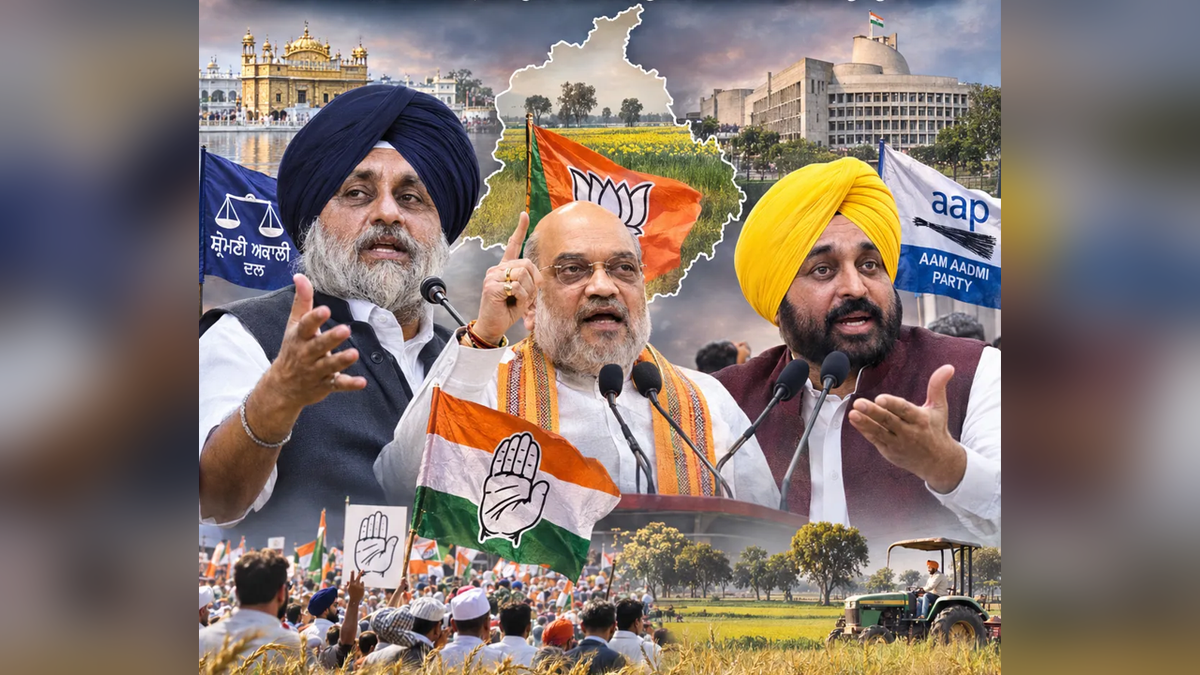

The BJP and the Shiromani Akali Dal are together again, with the Akali Dal as the elder brother. On paper the alliance has the largest combined vote in Punjab. But Punjab has a long habit of siding with whoever looks cornered, and this season that is Bhagwant Mann.
Announced on the Gurpurab
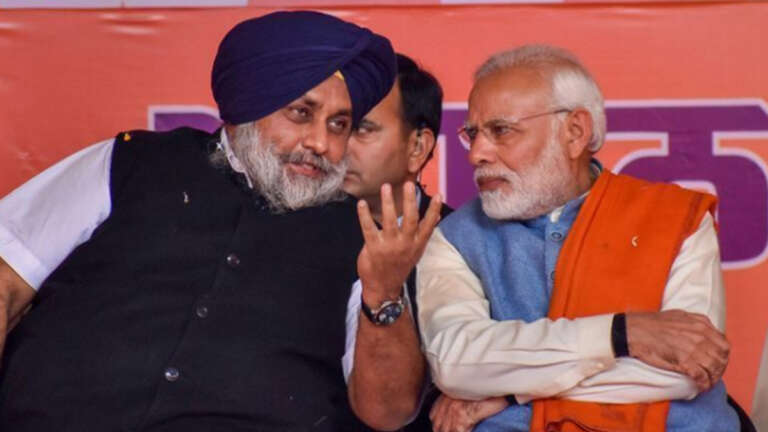
At the BJP headquarters in New Delhi, Union Home Minister Amit Shah, BJP President Nitin Nabin and Sukhbir Singh Badal announced that the BJP and the Shiromani Akali Dal (SAD) will contest the Punjab Vidhan Sabha elections of February 2027 together. The Akali Dal rejoins the National Democratic Alliance (NDA) from today, six years after it walked out over the farm laws in September 2020. Shah noted the Prakash Purab of Sri Guru Nanak Dev Ji, and said the Prime Minister had phoned Sukhbir Badal on Monday.
Asked about the Chief Minister’s face, Shah said, “Big brother will be Akali Dal,” and added, “Bada Bhai Hi Chief Minister Hota Hai”: the elder brother is the one who becomes Chief Minister. The seat-sharing has not been formally announced. The figure doing the rounds is about 77 seats for the Akali Dal and 40 to 44 for the BJP.
On 23 October I suggested the announcement would come on Bandi Chhor Divas or the Gurpurab. It came on the Gurpurab. On 13 November I argued that the alliance would come but would not make Punjab a two-horse race. The first half has happened; the second is for February.
What the ‘Takdi’ Brings to the Table
In the 2024 Lok Sabha election the BJP polled about 18.5 per cent of the vote in Punjab and the Akali Dal about 13.4 per cent, close to 32 per cent together. The AAP and the Congress polled about 26 per cent each. On the last poll’s arithmetic, the combine starts with the largest bloc in the State.
It also has a record. The partnership won Punjab in 1997, 2007 and 2012, and for 23 years the Akali Dal fought the rural Sikh seats while the BJP held the urban Hindu ones. Now that familiar division of labour comes with the resources of the party running the Union Government, and an Akali Dal that still has a branch in nearly every village.
Seventy-seven seats to forty-odd is a long way from the BJP’s “all 117 seats” of August. In conceding the big brother’s role, the BJP has accepted that it cannot win rural Punjab alone.
This is a serious alliance, and it would be foolish to write it off.
Thirty-Two Per Cent on Paper
Vote shares do not add up just because two parties have signed an agreement. Thirty-two per cent on paper is a ceiling, not a floor.
In 2024 the BJP led in 23 Assembly segments, most of them urban. A seat-by-seat reading in Swarajya that adds the Akali vote arrives at 41, still short of the 59 a majority needs. The Akali vote pads urban margins the BJP was winning anyway, while in rural Malwa and Majha the more Panthic voter now has other places to go.
Fifty-six Akali seats in 2012 became 15 in 2017 and three in 2022. The slide began at Kotkapura and Behbal Kalan in October 2015, years before the farm laws, and an alliance does not erase that memory.
The voter will also ask what the Centre has delivered for Punjab, as distinct from what it promises if the alliance wins. Nothing on Chandigarh, the river waters or the Bandi Singhs requires a majority in the Punjab Vidhan Sabha.
Many Yatras, One Destination
The Congress will feel today’s announcement more than any other party, and it may be the better for it.
It won seven of 13 Lok Sabha seats in 2024. In 2022, with the Chief Minister and the Pradesh Congress Committee (PCC) president at war in public, it fell from 77 seats to 18. Yet this autumn it has campaigned in parallel. Rahul Gandhi’s Sangrur rally on 4 November put every senior leader on one stage, with no Chief Minister’s face. A week later Charanjit Singh Channi pedalled out of Chamkaur Sahib at the head of his own Jawani Sambhal cycle yatra. Every leader has a yatra, a following and an eye on the chair.
A formidable BJP–SAD combine changes that calculation. Against a divided Opposition, each leader could run his own campaign; that luxury has gone. It is better to win first and be a minister, or even a Deputy Chief Minister, in a State your party governs than to fritter the chance away chasing the top job and spend five more years in Opposition.
I expect, therefore, greater unity in the rank and file and more seriousness at the top: a common programme, an agreed face or an agreed decision to have none, and one yatra in place of several. A strong opponent has always been the best whip a party has.
Shaking Hands, or Holding Out
Whether a third formation takes shape, an understanding among the Shiromani Akali Dal (Punar Surjit), Bhai Amritpal Singh’s Akali Dal (Waris Punjab De) and the Bahujan Samaj Party (BSP), remains to be seen.
Giani Harpreet Singh Ji has been categorical. On 10 November he said his party would treat a BJP pact with Sukhbir Badal’s party as “anti-Sikh”, and that it cannot sit with those who shake hands with Sukhbir Badal. That keeps Punar Surjit’s Panthic credentials intact. It also shuts the door through which, as I suggested on 23 October, the NDA might have accommodated five to seven of its leaders.
Waris Punjab De carried Khadoor Sahib in 2024 by nearly two lakh votes, and speaks for the young, rural, Panthic voter the Akali Dal once took for granted. The BSP, the Akali Dal’s partner of 2022, is free again, and the Dalit vote of Doaba is no small prize. Together these three could make a real third platform. Apart, each is a spoiler in a different set of seats.
Parminder Singh Dhindsa, Gurpartap Singh Wadala and others who left the Badal Akali Dal on principle have yet to show where they will land: with Giani Ji, back with Sukhbir, or elsewhere. In a close election, a seat or two is the margin.
So the field still has five corners. A five-cornered field suits the underdog.
Punjab Roots for the Cornered Man
Punjab has a habit older than any party now in the field. It sides with whoever it believes is being cornered by a larger power, and most readily when that power is the Union Government.
The ballot box has recorded it again and again. In 1977, after the Akali Dal had spent the Emergency sending volunteers to jail in its morcha, Punjab gave the Akalis and the Janata Party the government. In 1989 Tarn Taran elected Simranjit Singh Mann from a jail cell, by one of the largest margins in the country. In 2014, when the rest of the north went one way, Punjab sent four MPs of a two-year-old Aam Aadmi Party to the Lok Sabha, Bhagwant Mann among them. In 2024 Khadoor Sahib elected Bhai Amritpal Singh while he was detained in distant Dibrugarh. The farm movement of 2020–21 drew its stamina from the same instinct.
One need not approve of each verdict to see the pattern. The Punjabi voter likes to prove the strong man wrong.
The Akali Dal was once the beneficiary of this instinct. Today, with the Home Minister at its side and the elder brother’s chair claimed for it, it is cast as the stronger party. In Punjab that is not always the better role.
Incumbent in Office, Underdog in the Public Eye
By the textbook, Bhagwant Mann should be the defendant in February. He won 92 of 117 seats in 2022 on about 42 per cent of the vote, and mandates that size usually bring anti-incumbency to match. The courts have put the dearness allowance arrears at ₹22,818 crore and asked the Chief Secretary for a plan to clear them. In 2024 the AAP slipped to about 26 per cent.
For four years the Opposition’s sharpest charge was that he was a puppet of the AAP High Command. The Central agencies are another matter. A CBI probe ordered on a PIL and a series of ED raids make him look like a man taking blows in Punjab’s name. Between the High Command’s man and the agencies’ target, the electorate seems to be settling on the second.
The promise kept late helps too. The ₹1,000 a month for women, pledged in 2022, began to be paid only this July, and some 68.5 lakh beneficiaries were counted by August. The critics are right about the delay; the household, however, remembers the latest credit in the passbook better than the four years it waited.
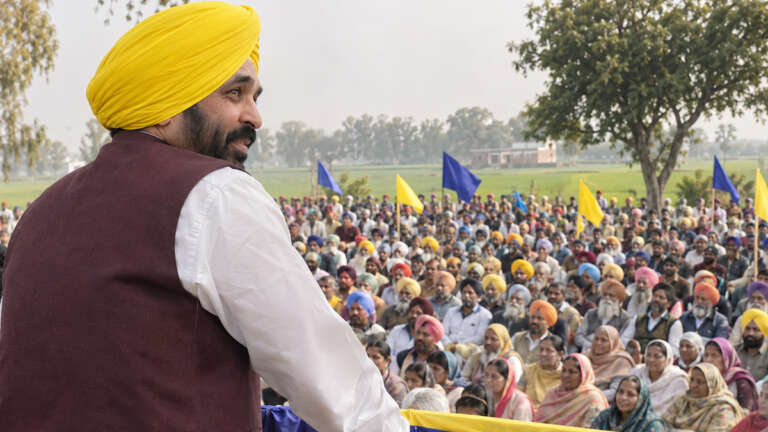
Today’s announcement adds to this. A referendum on five years of governance can now be told as Punjab against the Centre: the Union Home Minister and a big brother named in New Delhi on one side, and on the other a Chief Minister from Sangrur whose party replied within hours that its alliance is with the people of Punjab. Anti-incumbency needs an incumbent who looks powerful. A Chief Minister who looks besieged does not fit the part.
Fifty-Nine, and Who Gets There First
I offer no seat forecast. The majority mark is 59. In a five-cornered field, first-past-the-post is generous to whoever leads, and a party that can deliver its own vote does not need a wave. If the AAP comes close to that mark, it becomes the nucleus around which a government forms, whatever the combined vote shares say on paper.
Each player has a caution to heed.
To the alliance: the elder brother’s role brings the elder brother’s burden. Seventy-seven seats is a great many for a party that won three in 2022, and the voter will judge the Akali Dal on what it brings home from New Delhi before polling day.
To the Congress: unity forced by an opponent lasts only as long as the opponent looks dangerous. It has to hold until the counting is over.
To the Centre, a word in good faith. Timing in an election season is a matter of statecraft. Every raid that looks timed adds to the sympathy for the man it is aimed at.
To the AAP, an equal caution. The underdog’s cloak is lent, not owned. A government that cannot pay its own employees what the courts say they are owed will find it taken back.
Anti-incumbency asks the voter what this government did for him. The underdog instinct asks what is being done to the man who heads it. Today’s announcement in New Delhi has made the second question louder. In February, Punjab will decide which one to answer.

Leave a Comment