
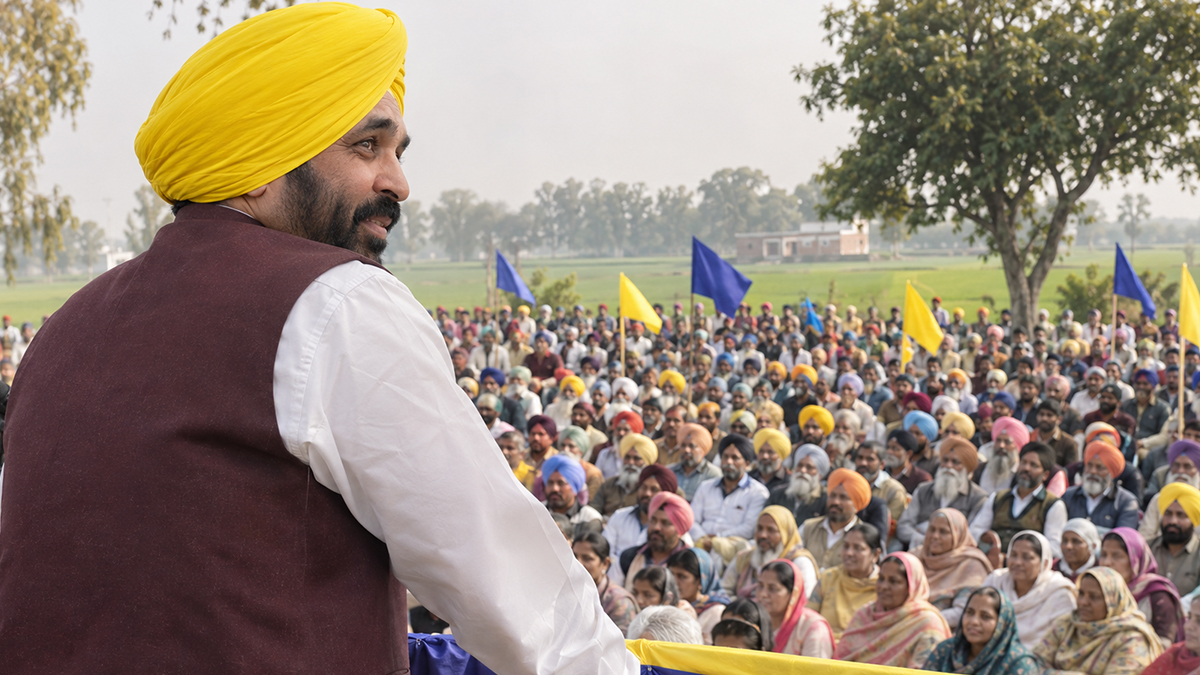

The drawing rooms have written it off. The ballot box has not. With 71 candidates already in the field, a mega rally at Moga behind it and its rivals still arguing over who sits where, AAP enters the 2027 race as the team to beat.
Ask an educated Punjabi in a Chandigarh drawing room, a farm-union activist in Bathinda or a government employee in Ludhiana about the Aam Aadmi Party, and you will hear a familiar charge-sheet. Nasha has not gone. Gangsters rule the headlines. The treasury is drowning in debt. Delhi runs the show. The MLAs are invisible, and the Chief Minister is mocked often in the language of caste and class, as a maskhara who bows to Kejriwal.
Much of this has some basis. Yet the ballot box tells another story. Since its below par performance in the 2024 Lok Sabha polls, AAP has won three of the four bypolls of November 2024, Ludhiana West in 2025 and even Tarn Taran, the heart of Panthic Majha. It swept the zila parishad and panchayat samiti polls of December 2025, and in May 2026 it won 958 of 1,977 municipal wards to become, for the first time, Punjab’s leading urban party. Independent trackers this autumn put it at 34 to 38 per cent, ahead of every rival.
Travel through the villages of Malwa and the same paradox greets you at every sath and dhaba. Voters grumble about chitta, gangsters and Delhi’s interference, and then, asked whom they will vote for, name the jhaadu. So how does a party so widely criticised remain the favourite? The answer lies in ten pillars.
1. The Populist Welfare model
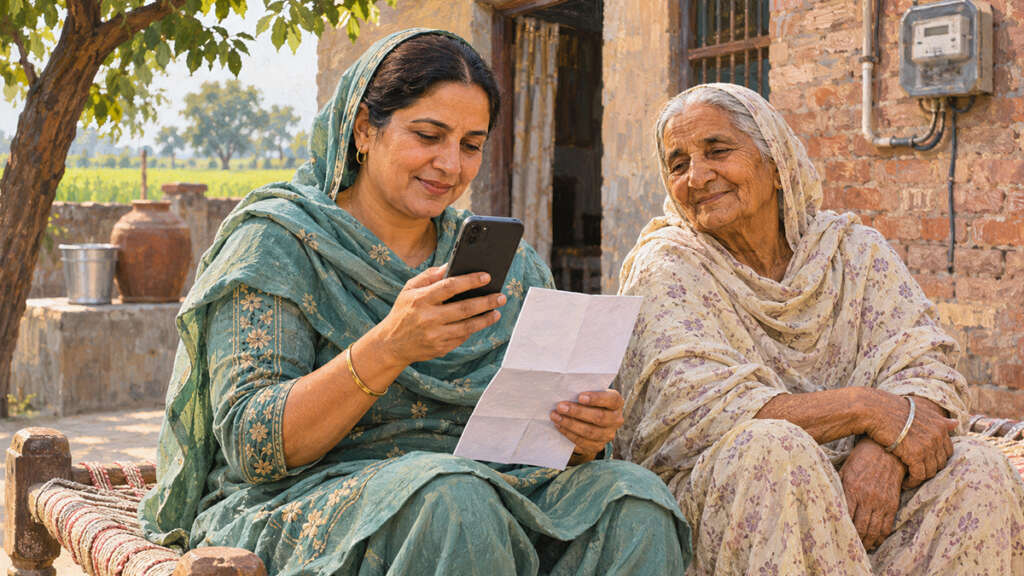
In its brief history of rapid evolution as a political party , if there has been one constant , it is the populist welfare model. After its Delhi model of free electricity and water and mohalla clinics of Delhi, it has replicated the same formula in Punjab. Welfarism is AAP’s strongest pillar.It reaches the household directly and repeatedly: 300 free units of electricity, ₹1,000 a month for women (₹1,500 for Scheduled Caste women) under the Mawan Dheeyan Satkar Yojana, Aam Aadmi Clinics, canal water to tail-end fields and the Mukh Mantri Teerth Yatra. Roads and law and order belong to everyone, and therefore to no one. A zero on the electricity bill and a monthly message from the bank belong to you.Concrete benefit triumph generalised development.
The more of these benefits a household receives, the harder it becomes to pull it away from AAP. Since the women’s payments began in July, women have emerged as AAP’s most dependable voters. Kejriwal knows it: at Moga he asked women to persuade their fathers, husbands and brothers to vote AAP. The bill, of course, is mounting, with debt heading towards ₹4.48 lakh crore by March 2027. But the faida is felt today; the karza falls on tomorrow’s government. This welfare populist model has now shifted AAP’s social base to lower middle class, small peasantry Dalit , Women and more elderly voters.
2. Bhagwant Mann: the common man’s face
Mann remains the most popular leader in Punjab, more popular than his own party and far more popular than Kejriwal, whose standing in the state has never recovered from the charge of remote control. The former comedian from Satoj, in his basanti turban, speaks the language of the village sath and connects strongly with the masses. He champions himself as an “Aam Aadmi” fighting the old establishment. The sneers of the elite only tighten the bond; labourers, homemakers, Dalits and women read scorn for Mann as scorn for people like themselves. Kejriwal named him the face for 2027 in June. Against him the Congress offers three claimants on three vehicles, and the new alliance a face that still carries the baggage of sacrilege.
3. The commissar model
Since 2022 and especially after March 2025 when Manish Sisodia and Satyendar Jain took charge of Punjab, Delhi has run the show directly. Like the Soviet commissar who stood beside every general, party managers and Delhi appointed Consultants sit beside ministers ,MLAs and senior officers dictating policy and micro managing execution.The AAP model is highly authoritarian with the Kejriwal led Delhi leadership controlling both the Punjab govt and the party. This has justifiably led to charges of the Punjab govt being run by unelected “outsiders” .
But central command also means speed and unity of purpose. The Yudh Nashian Virudh campaign claimed 73,000 arrests by July 2026, and the women’s scheme went from budget speech to bank account in four months.Centralised control and unity of command as any general will tell you is invaluable in war and elections are nothing but war by another means.The weakness is brittleness. Seven of AAP’s ten Rajya Sabha MPs, including Raghav Chadha and Sandeep Pathak, crossed over to the BJP in April, and three MLAs followed on November 2. So far, voters have shrugged.
4. A party for everyone
AAP has no fixed ideology. It borrows Bhagat Singh’s basanti pagg, Ambedkar’s portrait, the BJP’s bulldozer and, this year, a stringent sacrilege law. This lets it replicate a strategy congress once specialised in —accommodating everyone . In a pluralistic state like Punjab, a “catch all party” devoid of ideology makes sense. Its strongest support comes from Dalits, OBCs, women and the poor, but it retains a respectable slice of Jatt Sikhs and urban Hindus as well. No other party has such a spread. Its rivals, except the factionalised congress are each tied to one identity.
5. Control of the narrative
No Punjab government has spent so lavishly on publicity. Critics call it an advertisement sarkaar, with life size billboards like Imandar CM and Lokan da CM greeting commuters on every highway and in every town , Front page newspaper advertisements on every govt scheme ,TV channels covering every mundane AAP press conference and an IT cell that never sleeps .It also controls media pejoratively called “kejri media” while targeting unfriendly media—largely small independent digital media outlets.This election season it has also reportedly recruited an army of social media influencers to pedddle AAP narrative.Apart from highlighting AAP achievements, this narrative warfare mercilessly targets opposition whether it is Channi’s cycle yatra or labelling Akali-BJP alliance as “Thagjorh” It works. In the cities, educated voters complain loudly about crores wasted on hoardings and advertisements. In the villages, the complaint is rarely heard; the message has got through.
6. A cadre at the doorstep
The idealists of 2014 have given way to a disciplined cadre ruthlessly culled after each elections.The old passionate but volatile volunteer has given way to a party worker each given a set task, from the booth to following up on beneficiaries and filling party rallies.Previously a weakness of the party , 5 years in power has helped AAP to spread its tentacles in the villages and towns through capture of local body elections.This matters because many of AAP’s voters, older women, labourers and the poor, are the least connected in Punjab, getting their political news not from a smartphone but from family and the village sath. A WhatsApp forward cannot reach them. A volunteer at the door can
7. Listening to feedback, and acting on them
AAP runs on surveys, social media feedback and information culled from multiple sources and is largely data driven. This helps it to change track immediately after a setback. It quickly backtracked on the issue of land acquisition after farmer backlash in 2025 .When it Delhi based leadership line Kejriwal and Sisodia began to be criticised, they took a back step from the public limelight.Its candidate lists were drawn up on the basis of survey feedback, and the message was clear: the government is more popular than many of its MLAs. The party has acted accordingly: its second list on November 12 dropped eight sitting MLAs. Rebels follow such surgery. But it is better to bleed a little in November than to haemorrhage in February.
8. Constant reinvention
AAP rarely stands still. From anti-corruption movement, “Vyavastha Parivartan” to “Delhi model”, “Punjab model”, bulldozers, a sacrilege law and, finally, cash for women, it keeps changing its story. A few months ago the conversation in the villages was about drugs; today it is as often about the ₹1,000. Its critics are left chasing yesterday’s story.
9. Always in election mode, always early
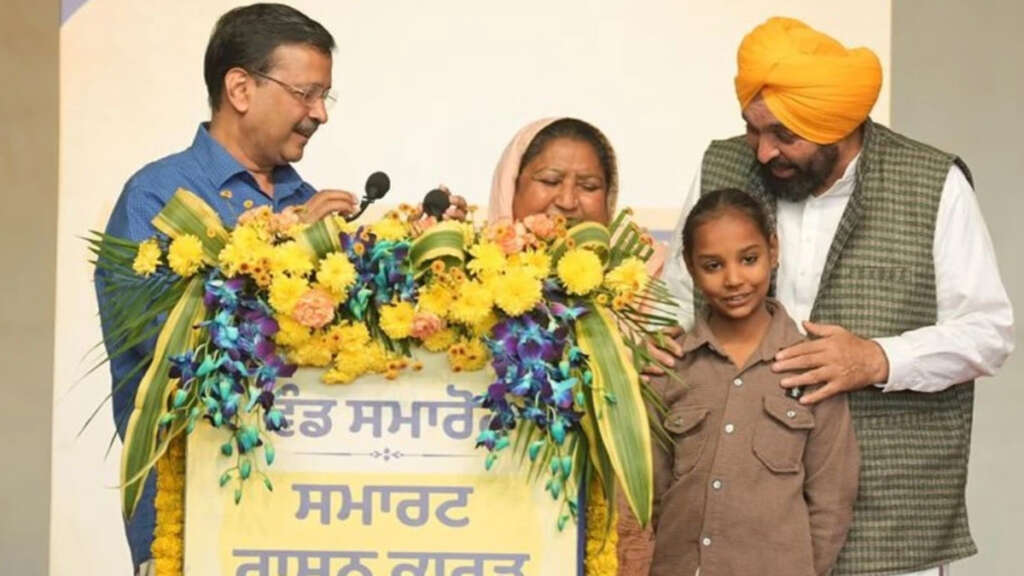
For most parties an election is like the wedding season: a burst of noise, dhol and spending, followed by a long silence. For AAP every month is viah da mahina. It never really stops campaigning.Each day is to stay in the limelight whether with an event, announcement or an attack on the opposition. Bypolls are fought with the full army of ministers and MLAs camping in a single constituency, as in Ludhiana West and Tarn Taran.AAP has made politics a 24 hour*365 days spectacle aimed at dominating the narrative.
Come elections ,AAP always starts early. In rural Punjab they say agetti bijai, early sowing, catches the moisture in the soil; the farmer who waits for his neighbour watches the rain pass him by. AAP named its first 40 candidates on October 31, all sitting MLAs, with Mann again in Dhuri. Its second list of 31 followed on November 12, taking the total to 71 of 117 seats, nearly three months before polling. On November 26, the party’s foundation day, Kejriwal and Mann formally opened the campaign at the Khushhaal Punjab rally in Moga, presented a five-year report card and, by Kejriwal’s own claim, drew over two lakh people. This is an old habit. AAP had named 61 candidates by October 2016, and its first list for 2022 came out in November 2021.
Early sowing pays in three ways:
- Time on the ground. A candidate named in October has three months to settle grievances, attend social functions, court notables and assuage dissent . A candidate named in January has three weeks.
- Rebels surface early. Disgruntled MLAs, like the three who joined the BJP, leave in November, when the damage can still be repaired, not on the eve of polling.
- AAP sets the agenda. While others are still choosing candidates, AAP is already asking voters the question it wants answered: will the others stop your free power and your ₹1,000?
Compare the rivals. The Congress is still on three separate yatras without a chief ministerial face. The Akalis and the BJP announced their alliance only on November 24, and the seatsharing is still being haggled over; before they can fight AAP, they must first settle who fights where.
10. A divided opposition
The final pillar may be the most important. In the 2024 Lok Sabha polls AAP polled only about 26 per cent, level with the Congress (26.3), while the BJP took 18.6 and the Akalis 13.4. The anti-AAP vote was far larger than AAP’s own, but it was split three and four ways. Under first-past-the-post, a party with 35 per cent can win most seats when rivals are this divided. In Tarn Taran last year AAP won by 12,091 votes while the candidate backed by Waris Punjab De polled over 18,000.
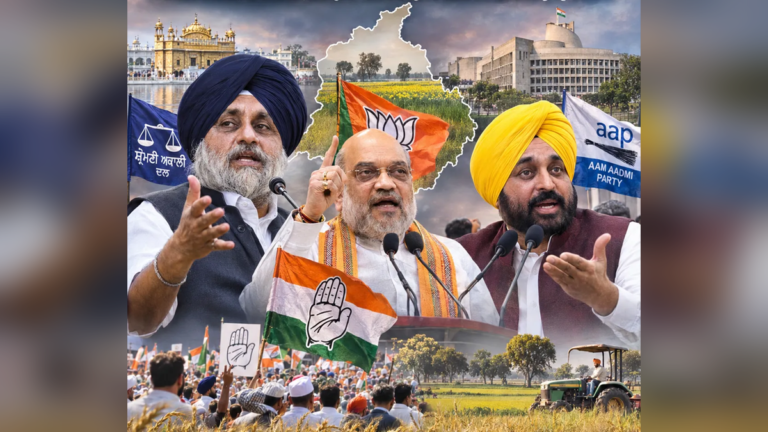
The revival of the Akali–BJP alliance on November 24, with Amit Shah naming the Akalis the bada bhai and promising them the Chief Minister’s chair, is the first serious attempt to close this gap. On paper, the two together polled nearly 32 per cent in 2024, more than either AAP or the Congress. Punjab is now heading for a potentially three-cornered dangal. But arithmetic is not chemistry.The opposition has reduced from four pieces to three. It is still not one. A divided opposition ensures that anti AAP voters like the unemployed youth, govt employees and farmers instead of consolidating behind one player will remain fragmented indirectly helping the rule AAP.
The cracks beneath
AAP’s lead is real, but it stands on uneven ground. Behind the crowds at Moga and the ₹1,000 in the bank lie four deep cracks, any of which could widen once the campaign heats up.
A long charge-sheet of failures. On almost every issue that once fuelled its rise, AAP has fallen short. The Yudh Nashian Virudh has filled jails and flattened houses, yet chitta is still sold in the lanes, and every overdose death in a village mocks the promise to end drugs within months. The killing of anti-drug activist Parvinder Jhota in Mansa turned law and order into the sharpest complaint of all, striking at the very claim that the drug mafia has been broken. Gangsters run extortion rackets from jails and from abroad, and traders in Ludhiana and Jalandhar, and NRI families in Doaba, live in dread of the phone call demanding phirauti. A party born of an anti-corruption movement has seen its own minister, Sanjeev Arora, behind bars. Jobs remain scarce, and the jahaz to Canada or Australia is still the dream of the village boy, even as those doors narrow. Delhi’s hand is visible in every major decision. And the welfare is paid for on credit, with debt heading towards ₹4.48 lakh crore by March 2027. Karza chukk ke ghee peena may please the household today; tomorrow’s government will be left with the bill.
The alienated. AAP’s big umbrella has holes in it. The young unemployed, who voted for badlaav in 2022, feel cheated; appointment-letter ceremonies on stage have not matched the scale of joblessness in the villages. Sikh youth, especially young Jatt Sikh men in Majha and western Malwa, see AAP as a party with no feel for Panthic sentiment, a feeling sharpened when the Akal Takht declared Mann Guru Dokhi in June. Many have drifted towards Amritpal Singh. Government employees, once among AAP’s loudest cheerleaders, are angry over unfulfilled promises on the old pension scheme and pending dearness allowance. And the urban educated, the teacher, the lawyer and the shopkeeper, bristle at the advertisement sarkaar, the remote control from Delhi and the treatment of critics. They may be fewer in number, but they write, talk and shape opinion far beyond their numbers.
A Malwa party. AAP’s strength is unevenly spread. Its fortress is rural Malwa, where welfare counts for most and the son of Sangrur speaks the local idiom. With 69 of the 117 seats, Malwa decides who rules Punjab, and AAP swept almost all of them in 2022. Beyond it the ground is shakier. In the cities, its municipal victories owed much to a divided opposition; the trader and the professional remain sceptical, and the urban Hindu now has the BJP, backed by the Akalis, to turn to. In Majha, Panthic sentiment and Amritpal’s pull make AAP vulnerable, as the 18,000-plus votes for his candidate in Tarn Taran showed. Doaba, with its large Dalit and NRI population, remains open, with the Congress strong and the old BSP base waiting to be wooed. If Malwa wobbles, nothing in Majha or Doaba can make up the loss.
Insipid MLAs and a resented Delhi. Most of the 92 MLAs who rode the 2022 wave were first-timers, and many have remained just that: invisible, ineffective or caught in controversy. In village after village one hears the same refrain: MLA da tan pata hi nahi lagda. The party has dropped eight sitting MLAs in its second list, but many of those renominated carry the burden of anti-incumbency. Above them looms Delhi. Since losing its own capital, the Kejriwal camp has made Punjab its base, with Manish Sisodia and Satyendar Jain running the show and outsiders sent to the Rajya Sabha. Punjab has a long memory of being ruled from Delhi, and Punjab de faisle Punjab vich is an old and potent cry. A party built around one leader and one command centre rarely declines gently. When the tide turns, it collapses, as the BSP in Uttar Pradesh and the Janata parties did.
None of these cracks alone can bring the house down. Together, if a united opposition learns to join the dots, they could.
The situation for now
AAP is the favourite not because it has delivered the badlaav it promised, but because it has built what its rivals lack: a beneficiary vote, a Chief Minister more popular than his party, a machine that never sleeps and a coalition that reaches Dalits, women and the poor. And it started running while others were still lacing their shoes.
The 2027 election will test which is stronger: the welfare ladder and the machine, or the anger over drugs and lawlessness. If the opposition stays divided, AAP could repeat the SAD–BJP feat of 2012. If the new alliance clicks, or the Congress finds a single voice, the cracks could widen fast. In Punjab, as AAP itself showed in 2022, ik mauka is never a lifetime contract.

Leave a Comment