


What began as sporadic extortion complaints in Punjabi-majority neighbourhoods of Canada has evolved into a broader transnational organised crime challenge involving gang violence, diaspora intimidation, immigration vulnerabilities, and cross-border criminal networks stretching from Punjab to British Columbia and California.
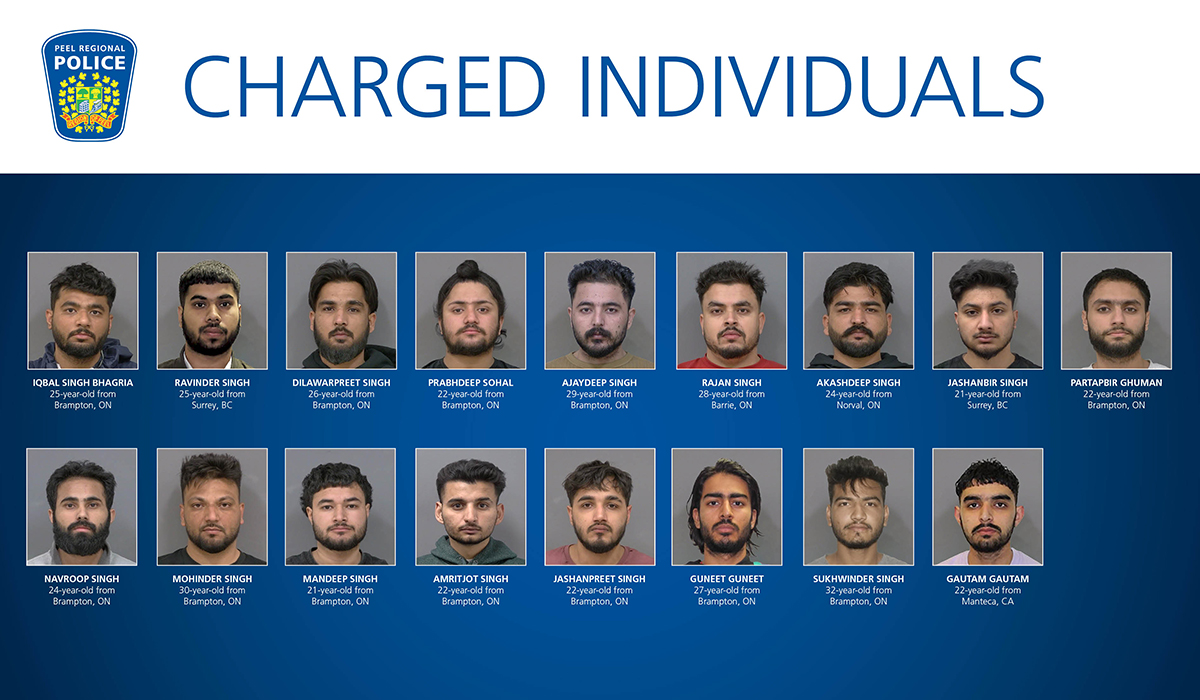
Canadian police recently arrested 17 men, the majority of them of Punjabi origin, accused of extortion, shootings and arson targeting South Asian businesses in the Greater Toronto Area. According to a press release issued by Peel Regional Police, the accused are linked to an international criminal network known as ‘For Brothers’, which allegedly targeted restaurants, trucking companies and other businesses in Brampton, Mississauga, Caledon and parts of British Columbia, with operational links extending to California in the United States.
Authorities allege the organised crime network used intimidation, threats and escalating violence to extort local business owners, reflecting a troubling trend that law enforcement agencies say is increasingly affecting South Asian communities across Canada.
The accused arrested in April 2026 are: Iqbal Singh Bhagria, 25, of Brampton; Akashdeep Singh, 24, of Norval; Ravinder Singh, 25, of Surrey, British Columbia; Jashanbir Singh, 21, of Surrey; Dilawarpreet Singh, 26, of Brampton; Mandeep Singh, 21, of Brampton; Prabhdeep Sohal, 22, of Brampton; Partapbir Ghuman, 22, of Brampton; Ajaydeep Singh, 29, of Brampton; Navroop Singh, 24, of Brampton; Rajan Singh, 28, of Barrie; Amritjot Singh, 22, of Brampton; Jashanpreet Singh, 22, of Brampton; Guneet, 27, of Brampton; Sukhwinder Singh, 32, of Brampton; Mohinder Singh, 30, of Brampton; and Gautam, 22, of Manteca, California.
The arrests followed a Joint Forces Operation launched in December 2025 involving Peel Regional Police, the Ontario Provincial Police (OPP), the Canada Border Services Agency (CBSA), the FBI and the Financial Transactions and Reports Analysis Centre of Canada (FINTRAC). The 17 accused face a total of 106 criminal charges. Police seized six firearms, illicit drugs, multiple mobile phones, SIM cards and fraudulent identification documents during the operation. Six of the accused may also face immigration proceedings, including possible deportation, after the conclusion of their criminal cases.
Peel Regional Police Chief Nishan Duraiappah stated: “These arrests reflect the coordinated efforts of Peel Regional Police and our law enforcement partners across jurisdictions to disrupt these networks and hold those responsible accountable. Extortion is not confined to one region but is connected both nationally and internationally.”
The remarks underscore a growing concern among Canadian authorities: extortion rackets targeting South Asian communities are no longer isolated criminal activity but part of increasingly coordinated networks operating across provinces and international borders.
Rise in gang violence
The concern is especially acute in British Columbia, particularly Surrey, a city with a large Punjabi population that has witnessed repeated incidents of gang-related violence in recent years.
On May 10, two boys aged 16 and 18 were shot dead in a targeted attack inside an underground parking lot in Surrey’s Newton neighbourhood. Despite life-saving efforts by police and paramedics, both teenagers died at the scene. Authorities confirmed the double homicide was linked to the ongoing gang conflict in British Columbia, with both victims believed to be of Punjabi origin.

On April 22, shots were fired outside a residence in Surrey, damaging the house and a vehicle. Following an investigation by the Extortion Response Team, Damanjeet Singh, 22, and Pardaman Singh, 30, were arrested in connection with the case. Surrey Police confirmed that both were foreign nationals and that the CBSA had been engaged in the investigation.
Authorities released photographs of the accused, saying public disclosure was necessary to support ongoing investigations and encourage witnesses or victims to come forward with information related to violent extortion networks.
Surrey Mayor Brenda Locke has expressed concern over the rising violence and called for stronger anti-gang measures. Under “Project Assurance”, authorities are cracking down on organized criminal networks that have been linked to multiple shootings and intimidation tactics across the city. In September 2025, the Surrey Extortion Reward Fund of USD 250,000 was set up to reward individuals providing key information that would lead to conviction of the accused.
Recruitment of vulnerable youth
Canadian authorities increasingly believe that organised criminal networks are exploiting financially vulnerable young Indian nationals, particularly international students and recent migrants. Many students arrive in Canada after incurring substantial debt to finance their overseas education and immigration aspirations. However, rising living costs, high rents, unstable employment and immigration uncertainty have left some vulnerable to criminal recruitment.
FINTRAC recently warned of a sustained campaign involving “financially vulnerable, young male Indian nationals in Canada on study permits who are being used as foot soldiers by gangs for targeted violence” against members of the South Asian diaspora.
Law enforcement agencies believe some recruits are initially drawn into low-level criminal activities such as intimidation, collecting extortion payments, transporting drugs or carrying out threats before becoming involved in more serious acts of violence.
Investigators also point to the growing role of encrypted messaging applications and social media platforms in facilitating recruitment, coordination and intimidation campaigns across provincial and international borders.
Inter-gang rivalry and transnational links
Security agencies have increasingly linked the violence to the expanding influence of India-based organised crime groups, particularly the Bishnoi and Bambiha gangs, whose rivalry originated in northern India but has now acquired an international dimension.
FINTRAC has identified the Lawrence Bishnoi gang and the rival Bambiha gang as key drivers of extortion-linked violence affecting South Asian communities in Canada. The Government of Canada officially designated the Lawrence Bishnoi gang as a listed terrorist entity on September 29, 2025.
Authorities believe the notoriety associated with these gangs has created a climate of fear within sections of the South Asian business community. Investigators say even loosely connected criminals and copycat groups are increasingly invoking the names of these gangs to amplify extortion threats and establish credibility.
Unlike earlier Indo-Canadian gang conflicts, often centred around local turf wars and drug trafficking networks, the current phase increasingly reflects transnational coordination, with operational, financial and logistical links extending beyond Canada.
Deportations and immigration scrutiny
Canadian authorities have begun responding through immigration enforcement mechanisms. In a significant development, two foreign nationals – 20-year-old Prabhjot Singh and 22-year-old Lovebir Singh- were deported from Canada following their arrests earlier this year. The CBSA conducted immigration reviews that resulted in their removal from the country.
The investigation has also led to the arrests of Harjot Singh, 21, Taranveer Singh, 19, and Dayajeet Singh Billing, 21, in connection with a February 1 shooting in Surrey’s Crescent Beach area. Police arrested them when they were trying to flee in a rideshare vehicle after firing at a residence. All three, identified as foreign nationals, remain in custody and face firearms-related charges.
In a separate case, Harshdeep Singh and Hanspreet Singh were charged after officers intercepted a vehicle and recovered a loaded handgun following reports of gunfire near a Surrey Street in late January.
The increasing involvement of foreign nationals in gang-linked investigations has intensified debate in Canada over immigration screening and the exploitation of international students.
Bilateral implications
The surge in extortion and gang violence has deeply unsettled the broader Punjabi diaspora in Canada, the overwhelming majority of whom are law-abiding immigrants, professionals and business owners.
Community members say many victims are reluctant to approach police because of fears of retaliation against themselves or their families. Others worry that the visibility of a small but violent criminal minority risks unfairly stigmatizing the wider Punjabi community.
For Canadian authorities, the challenge is no longer confined to isolated gang rivalries in Surrey or Brampton. It has evolved into a complex national security, immigration and community safety issue with international dimensions.
Indian security agencies are also closely monitoring the fallout from Canada’s crackdown on gang-related violence. Officials fear that deported individuals with exposure to organised criminal ecosystems abroad could bolster extortion and gang operations in India upon their return. Punjab, already struggling with drug trafficking and narcotics addiction, remains vulnerable to criminal networks that exploit unemployment, addiction and social instability to recruit young men.
The growing involvement of Punjabi-origin youth in extortion networks and gang violence has raised difficult questions for both Canada and India about the growing transnational reach of organised crime and the conditions that enable gangs to draw vulnerable youth into violent networks.
Disclaimer: The views expressed in this article are solely those of the author and do not reflect the views or opinions of Sadda Punjab or any affiliated organization.

Leave a Comment