
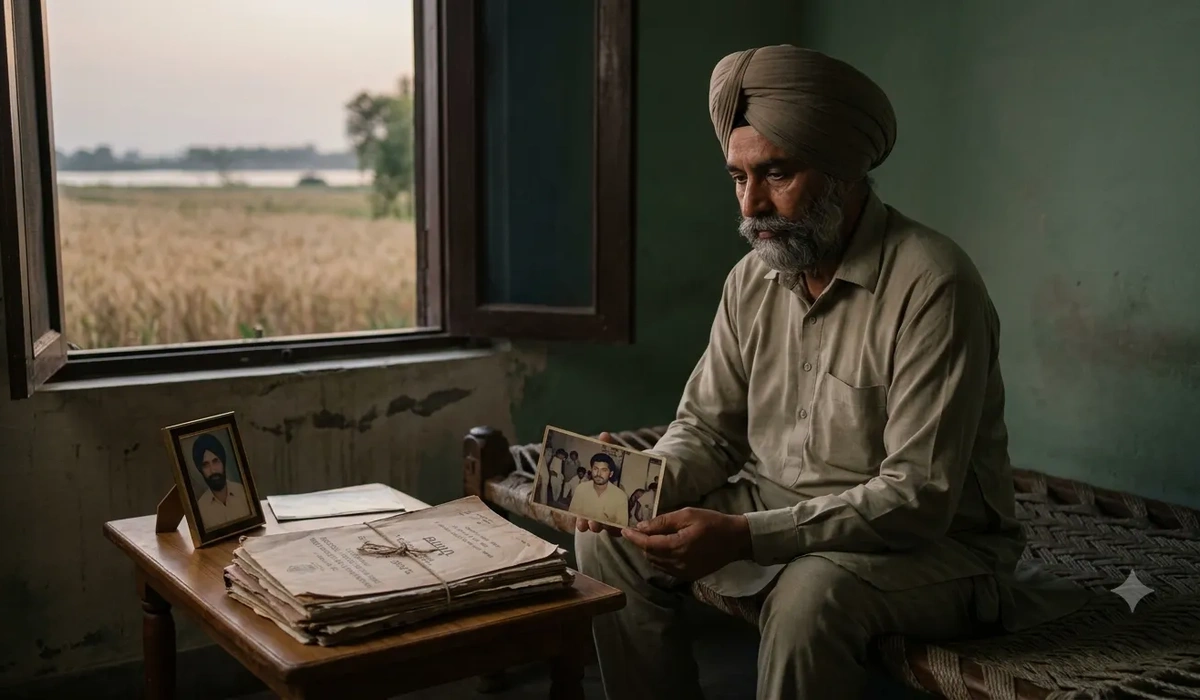

Fake encounters and custodial killings were unlawful then, are unlawful today, and can never be justified.
The sudden withdrawal of Satluj, the film based on the life and work of the human-rights activist Bhai Jaswant Singh Khalra, has reopened one of the most sensitive and painful chapters in Punjab’s recent history.
After years of certification disputes and demands for extensive cuts, the film appeared briefly on an OTT platform, only to disappear from Indian screens within approximately 48 hours. By then, however, copies had begun circulating widely, and the controversy had moved far beyond the question of whether the film could formally be exhibited.
I have addressed several dimensions of this controversy across other platforms in recent days — including a wide-ranging, unscripted 25-minute conversation with Kartikeya Sharma, Managing Editor of News9, recorded specifically on Satluj and the Khalra case (embedded below). What follows here is a more considered, written treatment of the same ground: the issues raised by the film cannot be examined through a single lens. Freedom of expression, public order, national security, historical truth, state accountability and the rights of victims are all intertwined.
Freedom of Expression Is Important—but Not Absolute
The freedom of speech and artistic expression is a fundamental constitutional right. It is central to any democracy. But under the Indian Constitution, it is not an absolute right. Reasonable restrictions may be imposed in the interests of public order, morality, the security of the State and other constitutionally recognised considerations.
A government is not always expected to wait for violence or communal tension to erupt before acting. Preventive administration necessarily operates on a reasonable apprehension of a breach of peace. If the administration fails to anticipate trouble, the same people who condemn preventive action may later ask why the intelligence agencies and law-and-order machinery remained inactive.
At the same time, the regulatory framework governing films and OTT platforms contains obvious inconsistencies. A film may be denied theatrical exhibition unless it accepts numerous cuts, but substantially the same material may then be streamed directly into people’s homes under a different system of certification.
That gap requires a transparent and constitutionally sound resolution.
“Freedom of expression must be protected, but it cannot be discussed in isolation from public order, national security and the constitutional responsibilities of the State.”
The Punjab I Witnessed Was Not an Abstraction
For my generation, the years of terrorism in Punjab are not merely a chapter in a history book.
I served as Additional Deputy Commissioner (Development) in the rural areas of Amritsar district and later as Deputy Commissioner and District Magistrate, Amritsar, from 1992 to 1996. At that time, the district also included the areas that subsequently became Tarn Taran district.
We witnessed senior police officers being killed in encounters. Serving Superintendents of Police and Senior Superintendents of Police were targeted. Police personnel and their family members were massacred. Innocent Hindu and Sikh civilians were selectively murdered. Trains and buses were stopped, passengers were separated on the basis of identity, and people were shot in cold blood.
Pakistan provided weapons, training and logistical support to terrorist groups. Punjab Police personnel, members of the security forces, public servants and ordinary villagers lived under constant threat.
Younger generations, particularly those born during or after the mid-1980s, may have little direct understanding of what Punjab actually endured. A powerful film, viewed without adequate historical background, can therefore become the principal source through which they form their opinion of that period.
That imposes an additional responsibility upon filmmakers.
The Film’s Content Cannot Be Separated from Its Missing Context
I watched a circulated version of Satluj. It is cinematically powerful and emotionally affecting. Even someone like me, who personally witnessed the conditions prevailing at the time, could feel the force of the narrative.
That is precisely why the missing context matters.
The film creates an overwhelming impression that the Indian State, acting almost exclusively through Punjab Police, conducted a systematic campaign against Sikh youth. It does not sufficiently depict the terrorism that preceded and accompanied police action. It does not show the scale on which civilians, police officers and their families were targeted. Nor does it adequately acknowledge the role of Pakistan-sponsored terrorism.
The story of Bhai Jaswant Singh Khalra deserves to be told. Allegations of illegal cremations, custodial deaths and extra-judicial killings cannot be dismissed merely because the State was confronting terrorism.
But historical narration must distinguish between genuine encounters, unidentified bodies recovered after armed operations, custodial deaths, enforced disappearances and deliberately staged encounters. These are not legally or morally interchangeable categories.
“Not every unidentified cremation establishes a fake encounter—and not every police encounter can automatically be presumed genuine.”
Any extra-judicial killing, whether committed then, now or in the future, is indefensible. No emergency and no security challenge can confer upon the State an unrestricted licence to kill. Where individual officers committed crimes, they must be investigated, prosecuted and punished through due process.
The judicial proceedings arising from the abduction and murder of Bhai Jaswant Singh Khalra demonstrate that accountability, however delayed, can be pursued through the legal system.
K.P.S. Gill: Neither a Caricatured Villain nor an Unquestioned Hero
The film’s portrayal also risks reducing K.P.S. Gill to a one-dimensional villain.
Gill was undoubtedly a strong and courageous police leader. Under his overall stewardship, Punjab Police eventually succeeded in overcoming terrorism. His contribution cannot be erased from the historical record.
However, the restoration of peace was not the achievement of a single officer or institution.
Punjab had remained under President’s Rule for nearly five years. Governors came and went. The police had considerable operational freedom, yet terrorism continued. The decisive change, in my assessment, came after the elected government headed by Beant Singh assumed office in February 1992 and began restoring political and democratic legitimacy.
Municipal elections were held in September 1992. Panchayat elections followed in January 1993 despite serious security warnings and apprehensions that armed groups might declare “liberated zones” or disrupt the process.
Those elections created a legitimate grassroots network. Villagers who had previously been trapped between terrorists on one side and police suspicion on the other now had elected panches and sarpanches to whom they could turn.
This local democratic structure helped generate reliable information, reduced disinformation and restored public confidence. By early 1994, normalcy had returned to a remarkable extent.
Punjab was not rescued by coercion alone. It was rescued by the combined strength of policing, political courage, democratic restoration and the resilience of its people.
The Victims of Police Excesses Deserve Justice
It is important not to turn the debate into a competition between different categories of victims.
Families whose sons disappeared deserve truth and justice. Families of police personnel who were assassinated also deserve remembrance. Hindu and Sikh civilians who were murdered by terrorists must not disappear from the historical narrative. Nor should the suffering of women, children and villagers caught between competing forces be forgotten.
Acknowledging terrorism does not justify extra-judicial killings. Acknowledging police excesses does not require the erasure of terrorism.
“Punjab’s history cannot be honestly written by remembering only one set of victims and rendering all the others invisible.”
The greatest weakness of Satluj, therefore, is not necessarily what it shows, but what it leaves out.
A film lasting nearly three hours had sufficient space to provide at least a meaningful account of the violence unleashed by terrorist groups, the targeting of police families, the assassinations of public officials, and the suffering of innocent Hindu and Sikh citizens.
Without that context, the film risks conveying that the violence of the period originated almost entirely with the State.
Political Parties Must Also Confront Their Own Records
The controversy has predictably become a political instrument.
The Shiromani Akali Dal invokes Bhai Jaswant Singh Khalra’s association with the party and his human-rights work. Yet it must also answer questions concerning what happened after the Parkash Singh Badal government assumed office in February 1997, when the CBI investigation into Bhai Khalra’s disappearance and murder was continuing and the subsequent trial was under way.
Why was the principal prosecution witness, Special Police Officer Kuldeep Singh, allegedly harassed by police personnel or their associates during that period? Why did the political executive fail to protect him adequately?
The Congress cannot discuss the controversy solely from the standpoint of freedom of expression while ignoring the fact that many of the events depicted occurred when Congress governments were in power.
The Aam Aadmi Party initially appeared relatively free from this historical burden. However, media reports concerning remission or parole-related developments involving persons convicted in the Khalra murder case have raised fresh questions. Such matters require an official, transparent and verifiable explanation.
No political party should appropriate Bhai Jaswant Singh Khalra’s memory while evading scrutiny of its own actions or omissions.
Punjab’s Present-Day Grievances Cannot Be Ignored
The possibility of renewed radicalisation must not be exaggerated, but neither should it be dismissed.
Gangsterism, cross-border drug trafficking, drones carrying narcotics and weapons, and international extremist networks remain genuine concerns. Overseas separatist groups continue to exploit grievances and target Indian diplomatic missions.
Films and political controversies do not create discontent out of nothing. They can, however, activate grievances that already exist beneath the surface.
Punjab’s youth face unemployment, diminishing opportunities for migration, inadequate industrial investment and a lack of confidence in the future. Punjabi entrepreneurs are increasingly investing in other states where incentives and infrastructure appear more attractive.
These economic and social anxieties require serious political attention. They cannot be answered merely through policing, censorship or political rhetoric.
Punjab is a Sikh-majority state with a proud, resilient and deeply democratic society. Its concerns must be addressed with sensitivity rather than suspicion.
Let the Truth Be Told—But Let the Whole Truth Be Told
Punjab has survived far worse than a controversial film. Its social fabric is resilient, and its people have repeatedly rejected violence.
But old wounds should not be reopened carelessly or selectively.
The answer is not to suppress every uncomfortable account of State excess. Nor is it to present a narrative in which terrorism, foreign interference and the sacrifices of police officers and civilians are almost completely absent.
Bhai Jaswant Singh Khalra’s courage, his investigation and his tragic murder form an indispensable part of Punjab’s history. So do the thousands of innocent people killed by terrorists. So do the police personnel who fought and died. So do the excesses committed by individuals acting in the name of the State.
History must be told.
But it must be told with evidence, proportionality and context—not as propaganda for the State, and not as an indictment of an entire police force or community.
Only a complete account can honour all those who suffered and help Punjab move forward without forgetting either justice or truth.

Leave a Comment