
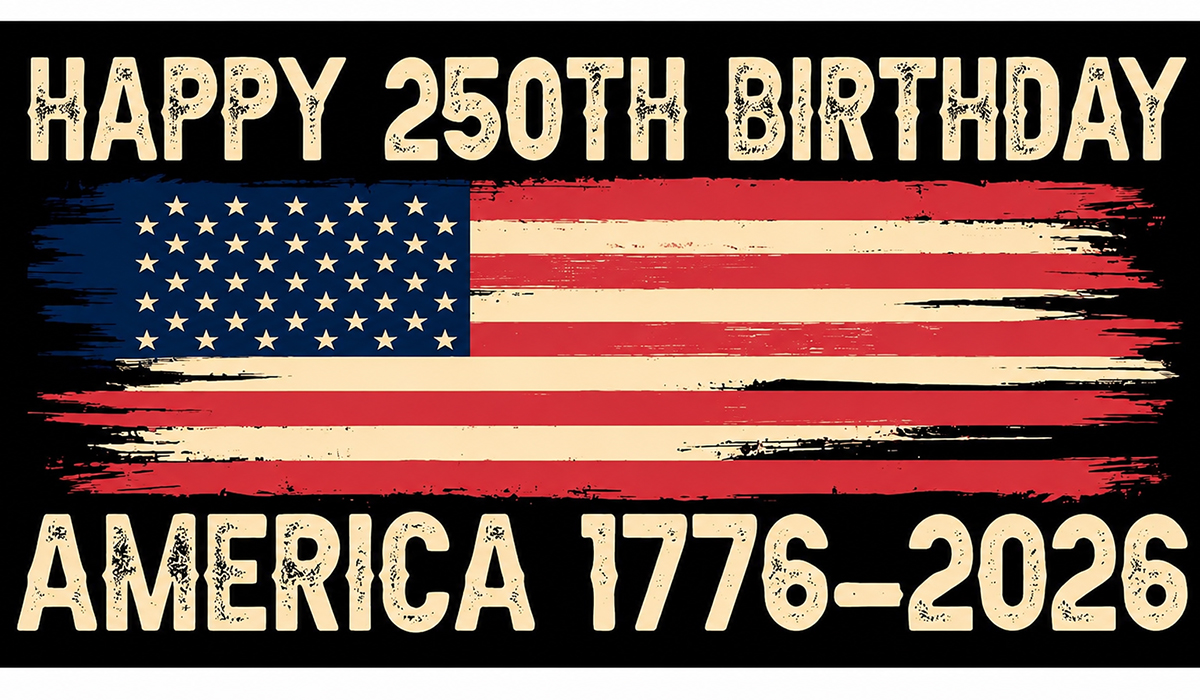

America’s Semiquincentennial — 250 Years Since the Declaration of Independence
I. The Semiquincentennial — A Word Worth Knowing
On 4 July 2026 — the United States of America marks a milestone so extraordinary that the English language had to strain to find a name for it. The occasion is the Semiquincentennial — half of five times a hundred years, or in plain arithmetic, 250 years since the Second Continental Congress adopted the Declaration of Independence in Philadelphia. The word is a mouthful. The moment is not.
The occasion has also been styled the Bisesquicentennial, the Sestercentennial, and, most simply, the Quarter Millennium. Whatever name one reaches for, the substance is the same: a democratic republic, conceived in rebellion, sustained through civil war, tested by depression and world conflict, and still standing, has completed two and a half centuries. That is no small achievement in the unforgiving ledger of history.
For those of us who observe from the outside — who have studied America, been shaped by its institutions, debated its contradictions, and watched its extraordinary oscillations — the Semiquincentennial is not merely an American occasion. It is a civilisational marker.
II. The Philadelphia Summer That Changed the World
The summer of 1776 in Philadelphia was insufferably hot. The delegates to the Continental Congress, already exhausted by months of argument, gathered in the Pennsylvania State House — later called Independence Hall — under conditions that today would prompt the cancellation of any serious meeting. The windows were sealed to keep out flies. The debates were acrimonious. The outcome was far from certain.
Thomas Jefferson, the principal draughtsman of the Declaration, had come to Philadelphia with a rented lodging, a portable writing desk, and a set of convictions about natural rights that he had absorbed from John Locke, from the Scottish Enlightenment, and from the crackling intellectual atmosphere of colonial Virginia. What he produced in that upstairs parlour was a document that would outlast every one of its signatories by centuries.
“We hold these truths to be self-evident, that all men are created equal, that they are endowed by their Creator with certain unalienable Rights, that among these are Life, Liberty and the pursuit of Happiness.” Fifty-six men signed the Declaration. Many of them knew they were committing what the British Crown would call high treason. John Hancock, whose signature is the most visible on the parchment, reportedly declared he wrote it large enough for King George to read without his spectacles.
The Revolutionary War that followed was neither swift nor certain. The Battle of Saratoga in 1777 brought France into the war as America’s ally — a Franco-American alliance that proved decisive. The final British surrender at Yorktown in October 1781 ended the fighting, and the Treaty of Paris in September 1783 gave it formal legal shape. A new nation had been born.
III. The Experiment That Was Not Supposed to Last
The Founders were acutely aware that republics had a dismal historical record. Greece, Rome, the Italian city-states — all had eventually collapsed into tyranny or oligarchy. Benjamin Franklin, emerging from the Constitutional Convention of 1787, was reportedly asked by a bystander what form of government had been decided. “A republic,” he replied, “if you can keep it.”
They very nearly could not. The young republic faced existential tests at every generation. The War of 1812 saw British forces burn the White House. The American Civil War of 1861 to 1865 — the bloodiest conflict in the nation’s history, with approximately 620,000 dead — put the question of national survival to the ultimate test. Abraham Lincoln, in his Gettysburg Address of November 1863, framed the stakes with incomparable precision: the war was testing whether “any nation so conceived and so dedicated, can long endure.”
It endured. The Reconstruction era, however imperfect, stitched the republic back together. The late nineteenth century saw the United States emerge as an industrial and demographic giant. Two world wars in the twentieth century saw it become the guarantor of the liberal international order. The moon landing of 1969 — completed barely eight years after John F. Kennedy’s audacious pledge to achieve it — became the defining image of what American ambition could achieve.
The arc of American strategic engagement with the world is itself one of history’s great transformations. The republic began in deliberate aloofness. George Washington’s Farewell Address of 1796 counselled against “permanent alliances” with any portion of the foreign world. James Monroe in 1823 codified this instinct into doctrine: the Western Hemisphere was closed to further European colonisation, and the United States would, in turn, stay out of European quarrels. The Monroe Doctrine was, at its core, an assertion of Splendid Isolation in American dress — the conviction that geography, the Atlantic, and republican virtue together constituted sufficient armour. For over a century, with the Spanish-American War of 1898 as the first significant rupture, the United States broadly held to this posture. Even the First World War, which Woodrow Wilson eventually joined in 1917 with transformative idealism, was followed by a retreat: the Senate rejected the League of Nations, and America withdrew once again behind its oceans. Then came the morning of 7 December 1941. The Japanese attack on Pearl Harbour did not merely sink battleships; it sank isolationism as a serious proposition for American foreign policy. The United States that emerged from the Second World War in 1945 was not the republic that had entered it. It held atomic weapons, an unmatched industrial base, and half the world’s GDP. Isolation was no longer a choice — it was not even a coherent idea. What followed was the Cold War: four decades of ideological and strategic confrontation with the Soviet Union, conducted through proxy conflicts from Korea to Vietnam, through the Berlin Airlift and the Cuban Missile Crisis, through the Truman Doctrine and the Marshall Plan and the creation of NATO. The United States became, often reluctantly and sometimes disastrously, the architect of the liberal international order — the guarantor of open seas, open markets, and the basic rules of inter-state conduct. The Soviet Union’s collapse in 1991 left it, briefly and bewilderingly, as the world’s sole superpower. The strategic question that now confronts the republic at its 250th year — how to manage the rise of China, how to sustain alliances built for a different era, how to remain globally engaged without being globally exhausted — is in many ways the same question that Washington, Monroe, and the architects of the post-war order each faced in their own idiom: what does a free republic owe to the world beyond its shores?
The civil rights movement of the 1950s and 1960s was, in many respects, the second founding of the republic — the belated redemption of the Declaration’s promise that all men are created equal. Martin Luther King’s invocation of the Declaration, his insistence that the United States honour its “promissory note,” placed the founding document at the centre of a moral revolution.
IV. The India Connection — A Thread That History Often Forgets
On this Semiquincentennial, there is a connection that deserves a particular moment of reflection by Indian observers. It is not widely acknowledged in mainstream American historiography, but the catalyst for the Boston Tea Party of December 1773 — the spark that lit the revolutionary fuse — was the British East India Company.
The Tea Act of 1773 was passed by the British Parliament to rescue the nearly bankrupt East India Company, which held a Royal Charter and dominated the tea trade primarily sourcing from the Indian subcontinent. By granting the Company a monopoly on tea exports to the American colonies, Parliament set in motion a chain of events that culminated on the night of 16 December 1773, when American patriots dumped 342 chests of East India Company tea into Boston Harbour.
Here is the paradox that history rarely pauses to savour: the very act that triggered the American Revolution was a protest against cheaper tea — tea made cheaper by a corporate monopoly backed by British imperial power. The colonists were not objecting to the price. They were objecting to the principle: that a Parliament in which they had no representation could dictate the terms of their commerce and their lives. The East India Company was the instrument. Self-governance was the cause.
The same East India Company that inadvertently ignited the American Revolution was, within decades, tightening its grip on the Indian subcontinent. The Boston Tea Party of 1773 and the Great Rebellion of 1857 were separated by 84 years, but they shared a common antagonist. Two nations, on opposite sides of the globe, found their paths to independence obstructed by the same corporate-imperial machinery. America won its freedom in 1783. India waited until 1947.
The thread connects. Indian Assam and Darjeeling — whose teas would eventually dominate the British market after China’s hold was broken — were being colonised commercially in the very decades after American independence. The tea thrown into Boston Harbour was Chinese. The company that carried it was the one that would make India’s hills synonymous with the world’s cup.
V. Previous Milestones — What History Teaches
Each major anniversary of American independence has come at a pivotal moment in the nation’s history, and each has carried its own symbolic charge.
The Fiftieth Anniversary in 1826 was marked by a coincidence so remarkable that it seemed almost scripted: both John Adams and Thomas Jefferson — the second and third Presidents, the last surviving signatories of the Declaration — died on 4 July 1826. Adams’s last recorded words were, reportedly, “Thomas Jefferson survives.” He did not know that Jefferson had died hours earlier in Virginia. History had arranged its own punctuation.
The Centennial of 1876 was celebrated with the great Centennial Exhibition in Philadelphia — a world’s fair that showcased American industrial might, attended by ten million visitors. It came, however, in the shadow of post-Civil War Reconstruction and the contested Presidential election of that very year between Rutherford Hayes and Samuel Tilden. American democracy’s resilience was being tested even as its birthday was being celebrated.
The Sesquicentennial — the 150th anniversary in 1926 — fell in the roaring prosperity of the 1920s, a decade that would end three years later in the catastrophe of the Great Depression. The Bicentennial of 1976 was among the most elaborately planned celebrations in American history, with the tall ships parade in New York Harbour, fireworks across the nation, and President Gerald Ford presiding over a republic still shaken by the Watergate scandal and the Vietnam withdrawal. America was celebrating at a moment of profound self-questioning.
Now comes the Semiquincentennial. It arrives in 2026 under a different set of tensions — political polarisation, questions about democratic norms, a world order in flux, and a republic debating, as it has in every generation, whether it is living up to its founding promise.
VI. The Celebrations — A Nation at Its Own Party
The scale of the Semiquincentennial celebrations reflects both the ambition and the complexity of modern America. Congress established the United States Semiquincentennial Commission in 2016 — a decade in advance — under the banner of America250. The Commission’s goal was the largest and most inclusive anniversary observance in the nation’s history, seeking to engage all 350 million Americans.
In 2025, President Trump’s administration established the White House Task Force on Celebrating America’s 250th Birthday — called Freedom 250 — adding a second, more executive-driven stream of celebrations. Major events are concentrated in the founding cities: Philadelphia, Boston, New York, and Charleston. A grand military parade has been planned for Washington, D.C. The largest international maritime gathering in modern American history — bringing tall ships and naval vessels from across the world — is assembled in the Port of New York and New Jersey from 3 to 8 July 2026.
Former Presidents George W. Bush and Barack Obama, and their respective First Ladies, serve as honorary national co-chairs of America250 — a bipartisan gesture that itself speaks to the aspiration, if not always the reality, of American unity. The U.S. Mint has issued special Semiquincentennial coinage, including redesigned dimes, quarters, and half-dollars bearing commemorative designs — collectors’ items that will mark this year in American numismatic history for generations.
A time capsule, containing contributions from all 50 states, five territories, and the District of Columbia, is to be buried in Philadelphia on 4 July 2026. What future Americans will make of it when it is opened — and when — is a question that history will answer in its own time.

$250 Bill— Trump on Top?
And then there is the matter of the money — literally. Just days before this article was written, Treasury Secretary Scott Bessent confirmed at a White House briefing that the Bureau of Engraving and Printing has been directed to design a new $250 banknote bearing President Trump’s portrait — pending legislation in Congress to overturn the Thayer Amendment of 1866, which has barred any living person from US currency for 160 years. The denomination is a neat piece of symbolism: $250 for the 250th anniversary. The irony embedded in the prohibition is itself delicious: it was enacted because a minor Treasury official named Spencer M. Clark had the audacity to place his own face on a five-cent note meant to honour explorer William Clark — the legislation having carelessly specified only “Clark.” That bureaucratic vanity of 1866 set a rule which a President now seeks to overturn, not by stealth, but by Act of Congress, in plain sight. Whether this is a fitting tribute or an uncomfortable conflation of the republic’s milestone with one man’s brand, Congress will decide. As Bessent put it with careful precision: “We will stick to the law.”
VII. The Unfinished Business of a Great Republic
No honest commemoration of 250 years of American independence can be entirely celebratory. The Declaration proclaimed that all men are created equal in 1776. The Constitution of 1787 counted enslaved persons as three-fifths of a human being for the purposes of congressional representation. The contradiction between founding ideals and founding practice is not a footnote in American history — it is the central tension around which American history has revolved for two and a half centuries.
The civil rights movement resolved part of that contradiction. The Voting Rights Act of 1965 and the Civil Rights Act of 1964 were the legislative culmination of a century of struggle. But the project, as Lincoln said at Gettysburg, remains unfinished. Each generation of Americans has had to decide, afresh, how much of the founding promise it intends to honour.
Tocqueville, visiting America in the 1830s, observed that the greatness of America lay not in her geography or her natural resources but in her capacity for self-correction. Whether that capacity remains operative in 2026 is a question that Americans themselves are actively, sometimes agonisingly, debating. From the outside, the debate can seem alarming. From the inside, perhaps it looks like democracy functioning precisely as intended — noisily, imperfectly, and without final answers.
VIII. What a Quarter-Millennium Teaches
Two hundred and fifty years is a remarkable span for a democratic republic in the modern era. The United States is older than most of the constitutions under which the world currently lives. It is older than the unification of Germany and Italy. It is older than modern Japan. It has outlasted empires, weathered two world wars, survived a catastrophic civil war, navigated the Cold War, and remained — whatever its internal contradictions — the world’s most consequential democracy.
The Semiquincentennial is an occasion to take the long view. The temporary occupants of the White House, whatever their disposition, are just that — temporary. The founding document, with its assertion of unalienable rights and its insistence on government by consent, has proved more durable than any of its interpreters. That is perhaps the most remarkable fact about the American experiment: it has survived not only its enemies but also some of its custodians.
On the very eve of this 250th anniversary, the Supreme Court provided a striking illustration of precisely that point. On 30 June 2026 — four days before the republic turned 250 — the Court ruled 6-3 in Trump v. Barbara to strike down President Trump’s executive order curtailing birthright citizenship. Chief Justice John Roberts, writing for the majority, reaffirmed that the Fourteenth Amendment automatically confers citizenship on virtually every child born on American soil, regardless of the parents’ immigration status. The ruling carries a deeper historical resonance than a mere immigration judgment. The Fourteenth Amendment was born in blood — it was the constitutional fruit of a catastrophic civil war that cost over 620,000 lives, followed by a decade of turbulent Reconstruction. It was written in 1868 specifically to reverse the Supreme Court’s own Dred Scott verdict of 1857, which had held that Black Americans could never be citizens. A republic that in 1776 proclaimed all men equal while permitting slavery, that in 1857 judicially confirmed the non-personhood of an entire race, and that in 1868 enshrined universal birthright citizenship into its fundamental law after its bloodiest reckoning — and that in 2026 upheld that guarantee against executive assault — has demonstrated, across two and a half centuries, precisely the capacity for self-correction that Tocqueville identified as America’s most distinctive quality. The executive order never came into force; every court that reviewed it found it, in one judge’s phrase, “blatantly unconstitutional.” The Constitution held. The republic held.
As India and the United States deepen their strategic partnership in the twenty-first century — bound together by democratic values, technological ambition, shared security concerns, and an increasingly intertwined diaspora — the Semiquincentennial offers both nations an occasion to reflect on what they share: the experience of colonial rule, the struggle for self-determination, and the ongoing effort to make democracy work in a diverse and contentious society.
The parchment signed in Philadelphia in 1776 was not perfect. Neither was the Constituent Assembly’s Constitution adopted in New Delhi in 1949. But both documents represented the aspiration of free peoples to govern themselves by reason and by law rather than by hereditary power or imperial decree. That aspiration remains the most important political idea in the modern world.
This writer’s elder son — a talented technologist who has made his career in the American innovation ecosystem — is now a naturalised American citizen, resident in Texas. My personal loyalty to India as an Indian citizen is absolute and unqualified. But across the distance of continents and generations, I have told him more than once, borrowing the phrase from Warren Buffett that has guided the most successful investment mind of our era: never bet against America.
Happy 250th Birthday, America — a month early, and with every sincerity.


Leave a Comment