

Answering Sri Akal Takht Sahib’s Call to the Sikh Panth — a Bill faithful to both the Rehat Maryada and the Constitution of India
An Unprecedented Summons
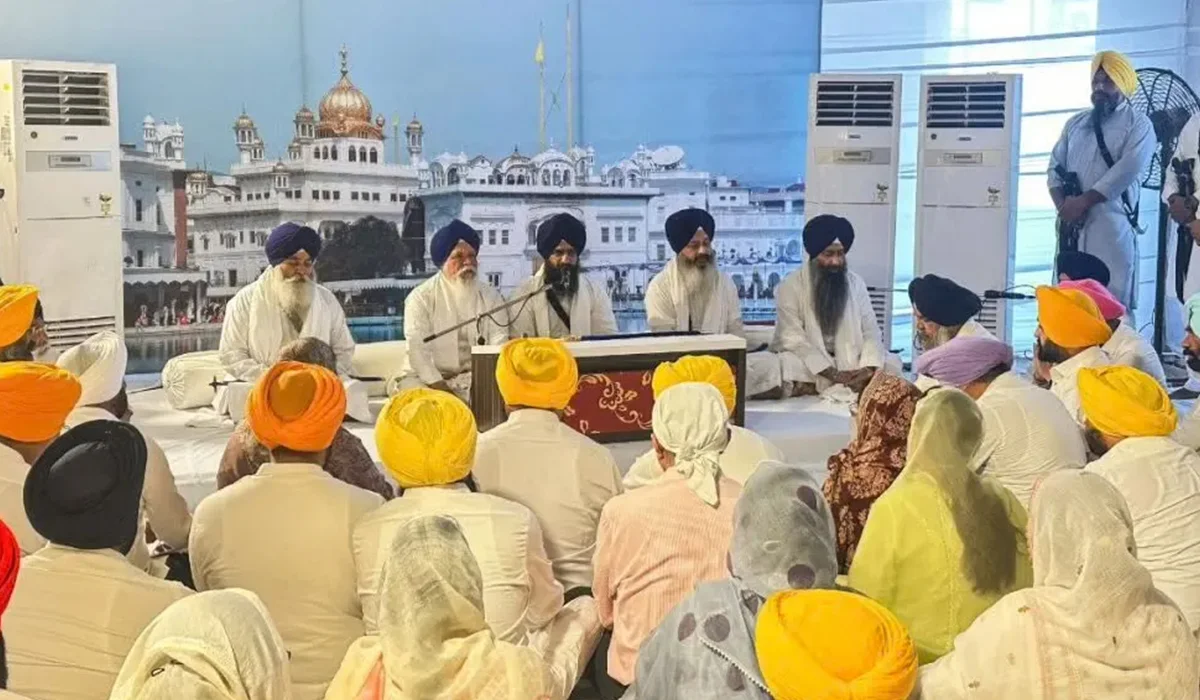
On Monday, 29 June 2026, something happened at Sri Akal Takht Sahib that Punjab had not witnessed in over four decades. Seventy-eight Sikh MLAs and nine Sikh Cabinet ministers — drawn from the ruling party and the Opposition alike, with the Speaker of the Vidhan Sabha among them — appeared before the Secretariat of the Takht, summoned by the Acting Jathedar, Giani Kuldeep Singh Gargajj, to explain how the Jaagat Jot Sri Guru Granth Sahib Satkar (Amendment) Act, 2026, had been passed without consulting the highest temporal authority of the Sikhs.
How We Got Here
The background is briefly told. The original Satkar Act of 2008 was amended by the Punjab Assembly on 13 April 2026, on Baisakhi itself. The amended law drew formal objections from Sri Akal Takht Sahib within weeks: the use of the term “custodian” for those in whose care a Saroop rests — anathema to the Sikh understanding that the Guru is the custodian of the Sikhs, who are merely sewadars; the substitution of Panthic terminology by legislative fiat; the requirement to publish a central register of Saroops on a website; and, cumulatively, the placing of Sri Guru Granth Sahib, the SGPC, granthis, pathis, and the Sangat within a legal framework of the kind reserved for regulated entities. When a month passed without amendment, the summons followed.
The Jathedar’s Directions — and His Open Call
At the hearing, the Jathedar directed that the implementation of the Amendment Act be suspended forthwith and gave the government one month to remove the objections. But his address went beyond clause-by-clause criticism to the deeper failing of the legislation: it sees the crime of sacrilege but not the causes that give birth to it. The one who commits beadbi, he observed, is a mere pawn, acting at another’s bidding; the law must reach the instigator — the head of the sect or dera that prepares its followers for such acts — through a fair, transparent investigation. He drew the analogy of the dowry and caste-atrocity laws, which punish not only the hand that kills but those who drove it. And, significantly, he issued an open call: that Sikh scholars, Panthic thinkers, legal experts, and the Sangat should deliberate seriously on this subject and write about it, so that the law that finally emerges uproots the phenomenon of sacrilege rather than merely punishing it.
The Citizen’s Draft: What It Proposes
It is in humble pursuance of that call that I have prepared, and now formally submitted to the Secretariat of Sri Akal Takht Sahib and to the SGPC, a citizen’s working draft: the Punjab Prevention and Deterrence of Sacrilege Act, 2026. I have also circulated it to a select group of Punjabi and Sikh intellectuals and legal experts for scrutiny.
The draft proposes the total repeal of the Satkar Act, 2008, as amended — with the repeal itself dissolving the contested custodianship framework — and its replacement by a short, self-contained code of seventeen sections. Its architecture tracks the Jathedar’s address point by point. Liability reaches the instigator: where sacrilege is committed by a follower of a group, and a pattern of incitement or organisational instruction is proved before the court, a rebuttable presumption of abetment arises against its head — modelled on the presumption device the courts have upheld in dowry-death cases, and hedged with due-process safeguards so that no one is named on a complainant’s word alone. The Act is expressly made subject to Articles 25 and 26 of the Constitution. It declares that Sri Guru Granth Sahib Ji cannot be brought within any legal definition or ambit; a Saroop can never be seized as “case property.” The Rehat Maryada, and every matter of reverential procedure, is left entirely to the SGPC in consultation with Sri Akal Takht Sahib. The State Government receives no rule-making power whatsoever — any change must come from the Legislature, in the open. Punishment is fixed at rigorous imprisonment of one to ten years, with probation and release on good conduct expressly excluded.
Not the Last Word — an Invitation to the Sangat
I have tried, throughout, to remain faithful both to the Sikh Rehat Maryada and the sentiments articulated from Sri Akal Takht Sahib, and to the Constitution of India and the central criminal codes. This is not the last word. It is a draft to begin with — one that seeks to encapsulate every point raised by the Jathedar of Sri Akal Takht Sahib in a form that can survive both legislative scrutiny and constitutional challenge.



Leave a Comment