

The events of the past few days have pushed Punjab into a new religious, political and constitutional crisis. If this crisis continues, it will also affect the lives of ordinary people. With the Punjab Assembly elections looming ahead, attempts are being made from all quarters to derive political mileage from it.
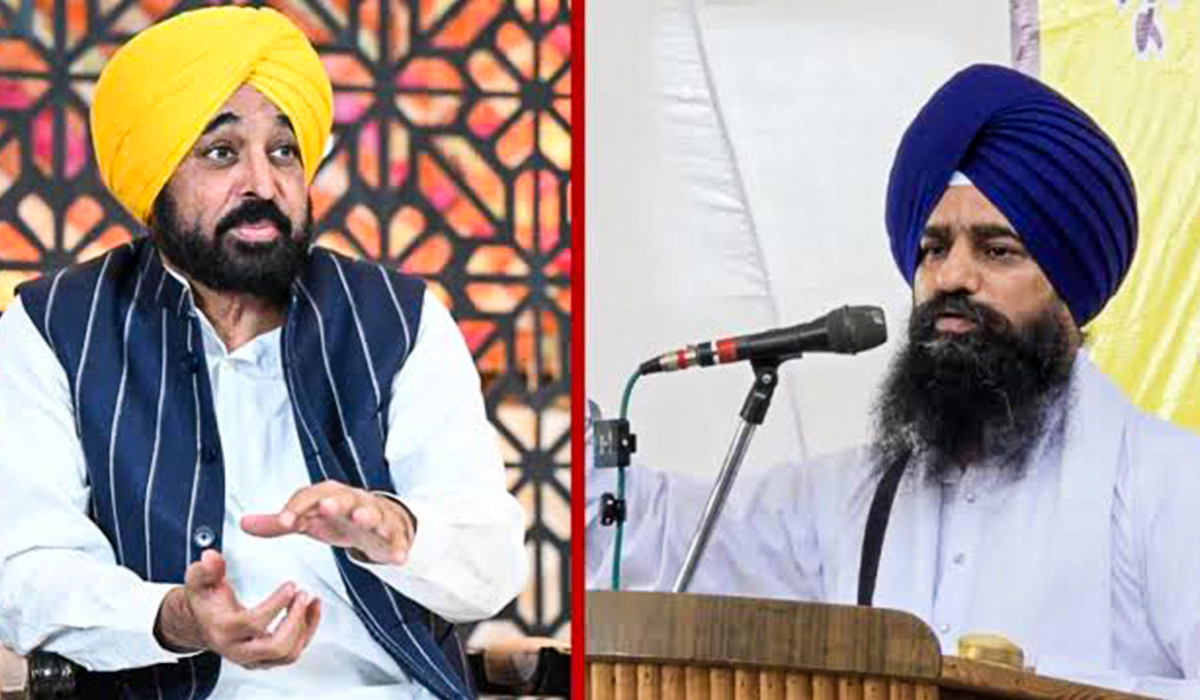
Acting Jathedar of the Akal Takht Giani Kuldeep Singh Gargaj has issued a directive to the Punjab government, asking it to amend the anti-sacrilege law within one month. Members of the Legislative Assembly, duly elected by the people, were summoned before the Akal Takht and scolded like schoolchildren. While this has put many MLAs who appeared there under question, they also had to face embarrassment when they admitted before the Jathedar that many of them had not even read the law passed in the Assembly.
Constitutionally, the real power to make laws rests with legislative assemblies elected by the people. Governments are answerable to the Constitution of the country. Whatever legislators do or say inside the House cannot be challenged elsewhere. MLAs are answerable only to the Speaker, the courts and the people. In that sense, this action appears to be a secular state government’s capitulation before the head of a religious institution.
The second matter is linked to the alleged controversial video of Punjab Chief Minister Bhagwant Mann showing him in an act that hurt Sikh religious sentiments. Because of this, the Jathedar has declared the Chief Minister a “Guru dokhi” and “Khalsa Panth virodhi”. The Chief Minister has claimed that the video was created using a mask to impersonate him as part of a political conspiracy. The public seems to believe Mann on this issue. Crowds continue to attend the Chief Minister’s rallies as before. However, the alleged sending of police to Gurugram and the claim that a mask was used in the video have complicated the matter further.
The Shiromani Gurdwara Parbandhak Committee called a Panthic gathering on July 5 at Gurdwara Manji Sahib in Amritsar, in which leaders of Nihang organisations and other Sikh institutions participated. The Jathedar of Akal Takht was also present. At the meeting, support was expressed for the Akal Takht Jathedar’s decision to declare the Chief Minister “Guru dokhi” and “Khalsa Panth virodhi”. The gathering also spoke of taking the message of Akal Takht to the common people and taking strict action against some “pro-government” IT cells on social media that were allegedly campaigning against Panthic institutions. If attempts are made to implement the decisions of this gathering at the village level, the possibility of a confrontational atmosphere emerging in Punjab cannot be ruled out.
In reality, the politics of religion always proves to be a double-edged sword. Sometimes it may provide political benefit, but at other times it can prove extremely damaging. The Shiromani Akali Dal is a clear example of this. In religious politics, the party that is the original player of that politics has a greater chance of winning. For instance, the Congress cannot counter the BJP through soft Hindutva politics because the BJP is the master of Hindutva politics. You cannot defeat it on its own pitch. Similarly, Bhagwant Mann or the Aam Aadmi Party cannot gain long-term benefit in Punjab through Panthic politics because expertise in this kind of politics lies with the Shiromani Akali Dal and some other Panthic groups in Punjab, including hardline groups. This is especially true when the Shiromani Gurdwara Parbandhak Committee and the Jathedar of Akal Takht are under the control of the Sukhbir Badal-led Akali Dal.
This is the mistake Bhagwant Mann has made. Instead of expanding his vote bank through people-centric work, he has relied on the politics of religious appeasement. Just as Kejriwal is following the BJP’s path by announcing the construction of new temples and free religious pilgrimages in Punjab to attract urban Hindu voters, Bhagwant Mann tried to woo the rural Sikh voter through his fluent speeches as well as reliance on Panthic issues. As part of this approach, he got the “Jagat Jot Sri Guru Granth Sahib Satkar (Amendment) Act” passed in the Assembly.
The ground for such a law had already been prepared by the Akali Dal government in 2008. When the Mann government brought this anti-sacrilege bill, the Shiromani Gurdwara Parbandhak Committee supported it and the Akali Dal did not oppose it either. But when the SGPC realised that the provisions of this law also challenged its own jurisdiction, it began opposing it.
In the hope of gaining political benefit by making an anti-sacrilege law, Bhagwant Mann now seems to be trapped in a difficult position.
The tragedy of Punjab’s politics is that issue-based politics has disappeared from the state. Political parties are trying to fulfil their political interests by playing with people’s religious sentiments. At present, no political party in Punjab appears to be fighting for people-centric issues. Everyone is trying to fool the people and achieve their political objective. If anyone seems to be fighting for real issues in Punjab, it is the farmers’, labourers’ and employees’ organisations. But political parties are refusing to fight that battle. If religious and sensitive issues dominate Punjab’s politics in the coming days, politicians may benefit from it, but the common people will once again be cheated.
Disclaimer: The views expressed in this article are solely those of the author and do not reflect the views or opinions of Sadda Punjab or any affiliated organization.

Leave a Comment