

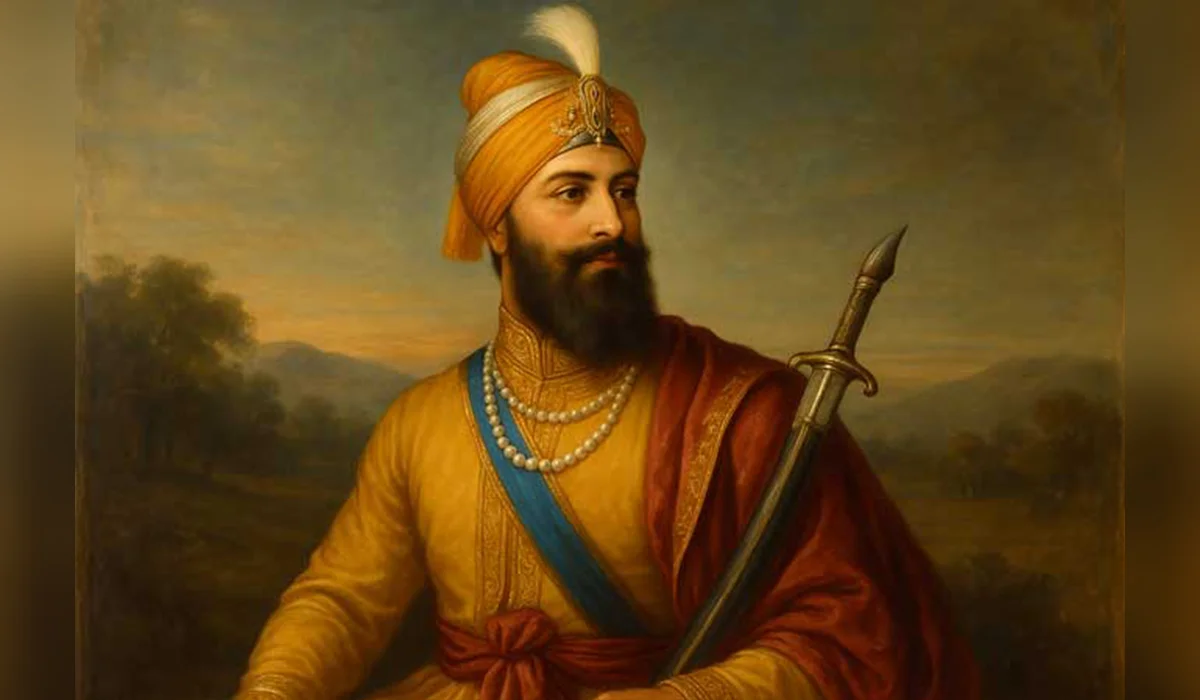

At the beginning of the 18th century, the Mughal Empire held sway over almost the entire Indian subcontinent. Aurangzeb, the most orthodox Mughal emperor, spent the last twenty years of his life conquering the two great Deccan kingdoms of Golconda and Bijapur. Having remained in the Deccan for two long decades, Aurangzeb was largely unaware of the conspiracies and intrigues unfolding in the Delhi court. As soon as Aurangzeb died in 1707 CE, his eldest son Muazzam, who was then leading a military campaign in Afghanistan, declared himself the next emperor. Taking advantage of Muazzam’s absence from the imperial court, his younger brother Prince Azam seized the throne and proclaimed himself emperor. When Muazzam learned of this, he hurried back to fight for his rightful inheritance. He sought the advice of his close friend Nand Lal on how victory could be achieved. Nand Lal advised him to seek the support of Sri Guru Gobind Singh Ji.
Nand Lal, the renowned Persian poet, told Muazzam that if anyone could bestow the throne upon him, it was Tenth Master Guru Gobind Singh Ji. When Nand Lal conveyed Muazzam’s request to the Guru, Guru Ji not only promised him assistance but also blessed him with the throne itself. However, Guru Ji placed one condition before him: he must keep his word and never become dishonest like his father. Muazzam agreed to these undefined conditions, and Nand Lal conveyed his acceptance to Guru Ji. Guru Ji then sent Bhai Dharam Singh and other trusted Sikhs to extend every possible assistance. Concerned about the grave political situation in the country, Guru Ji also set out towards North India with the hope of meeting the future emperor and discussing matters of great importance.
Once Muazzam had fully prepared his army, he marched towards Agra, while Prince Azam was then stationed far away at Ahmednagar. On hearing of his brother’s advance, Azam marched through Gwalior to secure the imperial throne. Muazzam also advanced to confront him and established his camp at Jajau near Dholpur, where the two armies met in battle. After three days of fierce fighting, not only was Prince Azam killed, but many of his senior officers also lost their lives. His army eventually fled, and victory belonged to Muazzam. He now assumed the imperial title of Bahadur Shah and declared himself emperor, becoming the undisputed ruler of India. Bahadur Shah then returned to Agra and sent Bhai Dharam Singh to Guru Ji with the news of his victory. By then, Guru Ji had reached Delhi and established camp on the left bank of the Yamuna. When the news of Bahadur Shah’s triumph reached Guru Ji, he decided to travel to Agra to congratulate the new emperor.
Before departing, Guru Ji arranged for Mata Sundari Ji to remain in Delhi under the protection of the Sikhs. On hearing this, Mata Sundari Ji wept bitterly. Guru Ji comforted her with the same reasoning and spiritual teachings that he had earlier shared at Damdama Sahib, explaining the impermanence of human life and the eternal bliss attained in heaven by her son as a great hero and martyr. On the third day after leaving Delhi, Guru Ji reached Mathura and camped at Suraj Kund on the banks of the Yamuna. He visited Vrindavan and paid homage at its famous and sacred places. Guru Ji then met Bahadur Shah at Agra. The emperor thanked Guru Ji for the invaluable support that had helped him secure the throne. He presented Guru Ji with many costly gifts and requested that Guru Ji spend some time with him. These valuable presents included an expensive robe of honour (khillat), a jewelled turban, a necklace, a jewelled aigrette, and other precious ornaments worth nearly ₹60,000. Guru Ji graciously accepted the emperor’s request. During this period, several Rajput rulers also came to seek Guru Ji’s blessings. Guru Ji reminded them that they had committed a dishonourable act by marrying their daughters to Muslim rulers and princes. He made them pledge that they would abandon this practice forever.
Historical records reveal that Guru Sahib’s meetings, first with Khan-i-Khanan and later with Emperor Bahadur Shah, were of great historical significance. The discussions that Guru Ji had intended to hold with Emperor Aurangzeb in the Deccan now seemed to have begun with Bahadur Shah instead. Guru Ji wished to conclude these matters successfully at the earliest so that he could return to Punjab. It was for this reason that Guru Ji wrote several Hukamnamas to the Sikhs of Anandpur Sahib, instructing them that when he reached Kahlur, all the Sikhs should come there to meet him. One authentic written document composed by Guru Ji from Agra on 2 October 1707 reads as follows:
10 Satguru Ji
“To the entire Sangat of Dhaul: You are my Khalsa. The Guru shall protect you. Chant the Name of the Guru and your life shall be fulfilled. By the Guru’s grace, I have arrived safely before the Emperor. I have been honoured with a robe of honour and a jewelled ornament worth sixty thousand. By the Guru’s blessings, all other affairs are also progressing well. We too shall return within a few days. It is my command to the entire Khalsa Panth that you should remain united among yourselves. When we arrive at Kahlur, let the entire Khalsa come before us fully armed. Whoever comes shall be blessed.”
This letter of Guru Sahib carries immense historical importance. Besides mentioning Guru Sahib’s audience with the Emperor and the presentation of the robe of honour, it also hints at the discussions that were taking place with the Emperor through the Guru’s influence. What else could these discussions have been, other than efforts to end the centuries-old hostility of the Mughal rulers towards the Sikh Gurus and establish peaceful relations? From the Emperor’s conduct, Guru Sahib believed that these matters would soon reach a successful conclusion, allowing him to return to Punjab within a few days. However, Guru Ji also anticipated that while travelling towards Anandpur Sahib, opposition might arise at Kahlur from one side or another. It was for this reason that he instructed the Khalsa to come armed so that, if circumstances required self-defence or participation in battle, they would be fully prepared.
Guru Sahib would certainly have returned to Punjab had it not been for the rebellion of Bahadur Shah’s brother, Kam Bakhsh. His rebellion completely altered the situation, and Guru Sahib, whose discussions with Bahadur Shah were still continuing, had to accompany the Emperor towards the Deccan. After crossing the Narmada, the imperial camp reached the banks of the Tapti River, which was crossed between 22 and 24 June 1708, and then arrived at Burhanpur. From Burhanpur, the Emperor sent Guru Sahib an urgent message. The journey then continued through Malkapur, and by early September Guru Sahib reached Nanded.
At Nanded, Guru Sahib initiated the Vaishnav Bairagi Madhodas, also known as Lachhman Das, a disciple of Aughar Nath, into the Khalsa. While Guru Sahib was travelling south, a Dadupanthi saint named Jai Ram (or Chait Ram) from the Dadu Dwara at Naraina in the Jaipur State had advised him not to visit this Bairagi’s hermitage. Jai Ram warned Guru Sahib that the ascetic delighted in using magical powers upon visitors and then mocking them. But Guru Sahib was the true successor of Guru Nanak Sahib, who had often travelled hundreds of miles to guide even a single wandering soul onto the right path. Guru Sahib paid no attention to Jai Ram’s warning and, upon reaching Nanded, went directly to the Bairagi’s monastery.
Madhodas was not present there. Guru Sahib calmly seated himself upon the only cot lying there and waited for the Bairagi’s return, while the Sikhs became engaged in preparing Maha Prashad. The zealous disciples of the Vaishnav Bairagi were deeply offended by this and rushed to inform their master about the arrival of the unusual stranger. The Bairagi became furious, but none of his charms, incantations, spirits, or occult practices could make Guru Sahib fall from the cot. Guru Sahib’s mind remained perfectly steady, and all the Bairagi’s attempts failed completely. When Madhodas finally came near Guru Gobind Singh Ji, he recognised his true Guru and immediately fell at his feet. Ahmad Shah Batali records their meeting in the following words:
Madhodas: Who are you?
Guru Gobind Singh Ji: The One whom you already know.
Madhodas: What do I know?
Guru Gobind Singh Ji: Search within your own heart.
Madhodas: (After a pause) Are you Guru Gobind Singh?
Guru Gobind Singh Ji: Yes.
Madhodas: How have I been blessed with your presence here?
Guru Gobind Singh Ji: I have come here to initiate you as one of my Singhs.
Madhodas: I accept with complete devotion, Maharaj. I am your servant.
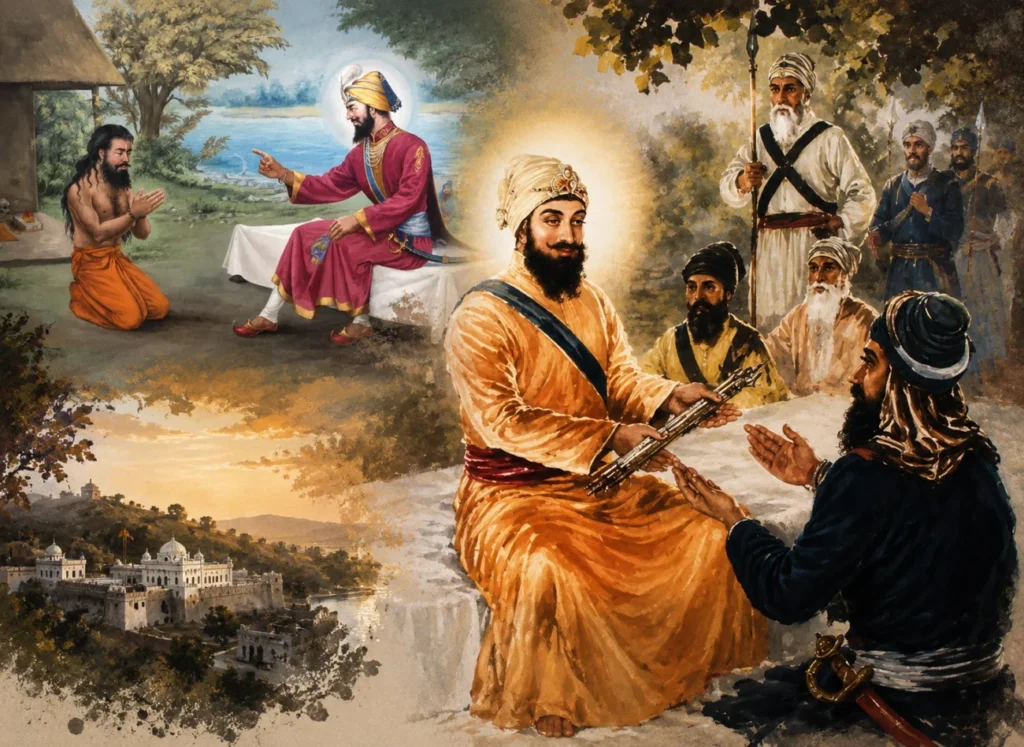
The proud and unconquered Bairagi Mahant became a servant of Guru Sahib. Guru Sahib struck the spark needed to ignite the fire that had arisen within this young ascetic. He dressed him in the attire and weapons of the Sikhs and, in accordance with the complete discipline and tradition of Pahul, administered to him the immortalising Amrit of the Khalsa. His new name was given as Banda Singh. However, during his lifetime and even after his death, he continued to be commonly remembered by the title he had himself chosen, Banda.
During Guru Sahib’s journey to the Deccan, two Pathans from Sirhind secretly followed him. As the relationship between Bahadur Shah and Guru Sahib grew increasingly close, Wazir Khan, the Nawab of Sirhind, began to feel threatened. Wazir Khan was responsible for many of the atrocities committed against Guru Sahib’s Sikhs.
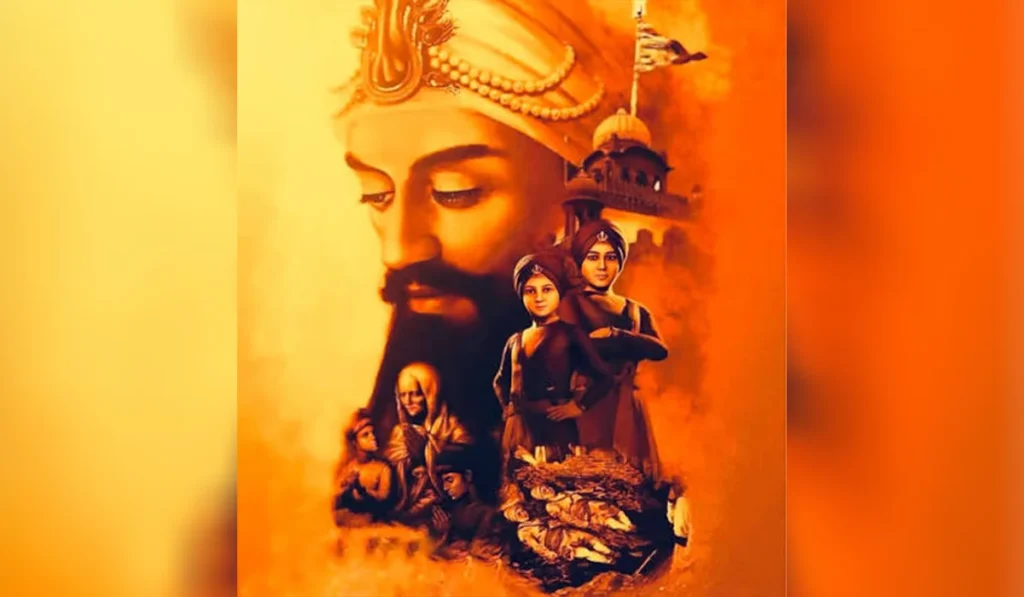
It was on his orders that Guru Sahib’s younger Sahibzadas were bricked alive and later put to death. Guru Sahib’s two elder Sahibzadas were martyred in the Battle of Chamkaur while fighting against his treacherous army. Guru Sahib’s mother was also martyred in the Thanda Burj on the orders of the same Wazir Khan.
He was now the one most frightened by the friendly relations between Emperor Bahadur Shah and Guru Sahib. It was widely believed that Guru Sahib was accompanying the Emperor in order to find a way to avenge the martyrdom of his younger Sahibzadas. For this reason, Wazir Khan knew that as long as Guru Gobind Singh Ji remained alive, the fear of death would continue to haunt him.
He engaged a Pathan to assassinate Guru Sahib, but the conspiracy could not succeed. He then easily inflamed the emotions of the Pathan’s sons, incited them against Guru Sahib, and sent them to the Deccan so that, whenever an opportunity arose, they might kill him. From Chatur Yugi, it is learned that these Pathans first went to Delhi. After obtaining information about Guru Sahib’s location from Mata Sundari Ji’s residence, they set out towards the Deccan to carry out their murderous conspiracy.
According to Sri Guru Sobha, after reaching Nanded Sahib, these Pathans came to Guru Sahib every second or third day, but they could not find a suitable opportunity.
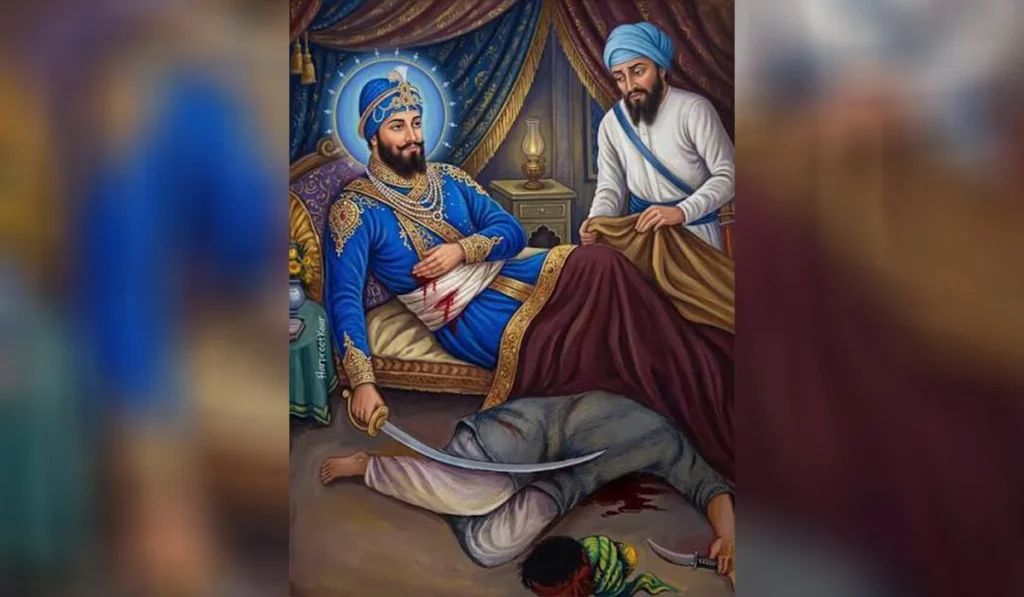
Finally, one evening after Rehras, when Guru Sahib was taking some rest, one of the Pathans quietly moved forward and plunged a dagger into Guru Sahib’s left side, slightly below the heart. Before he could strike again, Guru Sahib killed him with his sword. His companion tried to flee, but the swords of the Sikhs brought him down.
When Bahadur Shah learned of the incident, he sent one of his European doctors, Cole, to treat Guru Sahib. Within a few days, the wound healed and Guru Sahib became capable of walking again. However, the wound had not yet fully healed from within. One day, Guru Sahib forcefully drew a hard bow and fixed its string. The wound reopened, and because of the heavy loss of blood, Guru Ji became extremely weak.
Shortly after midnight, Guru Ji proclaimed his final Fateh, “Waheguru Ji Ka Khalsa, Waheguru Ji Ki Fateh,” and in the early hours of the morning of 7 October 1708 CE, he merged into the Divine Light.
Leave a Comment