

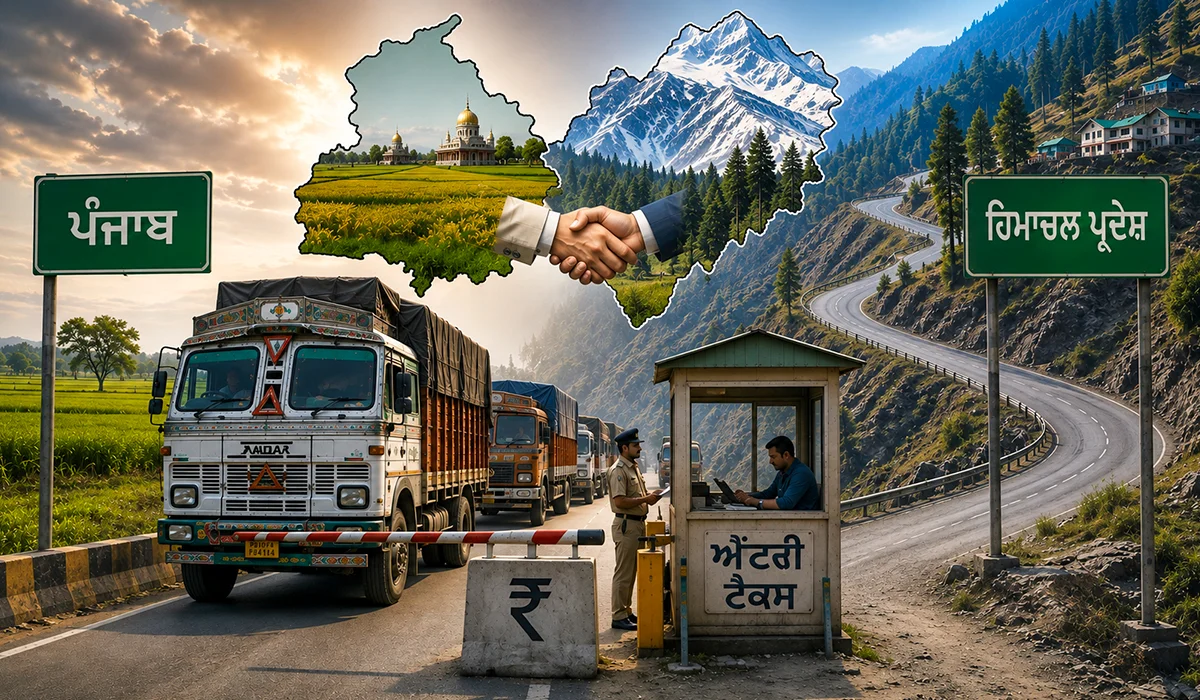

Although Punjab and Himachal Pradesh are often regarded as sister states, disputes between them over one issue or another continue to arise from time to time. On several occasions, these disagreements have assumed a wider dimension. The issues are now visible not only at the administrative level but also in social interactions between people of the two states.
Entry Tax Sparks Fresh Dispute
The Himachal Pradesh government’s decision to impose an entry tax on certain commercial vehicles and goods entering the state has triggered a controversy that has continued for several months.
According to the Himachal Pradesh government, the tax has been introduced to help meet the costs of maintaining mountain roads, developing infrastructure, and managing the additional burden placed on local resources.
On the other hand, transporters and traders from Punjab and several other states argue that the tax increases transportation costs and adversely affects the movement of goods across state borders.
The issue has become a major point of discussion between Punjab and Himachal Pradesh. Several trade associations and transport unions in Punjab have opposed the tax, arguing that it makes business more expensive and negatively impacts interstate trade. Demonstrations have also been organised on several occasions.
Himachal Government’s Position
The Himachal Pradesh government maintains that the entry tax is legally valid and serves as a means of generating financial resources required for the state’s development.
The government led by Chief Minister Sukhvinder Singh Sukhu has argued that maintaining roads in mountainous regions is significantly more expensive than in the plains, making such revenue measures necessary.
Opposition from Punjab
Critics in Punjab contend that the entry tax hampers commercial activity and may weaken the spirit of cooperation between states. They advocate resolving the dispute through dialogue and policy-level negotiations rather than through confrontation.
Need for a Cooperative Solution
A lasting solution to this dispute, they argue, can only emerge through mutual agreement between the two states, constructive involvement by the Central Government, and due legal process.
If a balanced solution is reached—one that safeguards both the financial interests of the states and the ease of interstate trade—it would benefit businesses as well as the general public.
However, the author expresses the view that the BJP-led Central Government appears more interested in allowing the issue to remain unresolved for potential political advantage than in actively resolving it.
More Than Just a Tax Issue
The Himachal entry tax is not merely a question of taxation. It is also a matter involving the financial rights of states, the smooth movement of trade, and maintaining balance within India’s federal structure. For this reason, the issue should be resolved on the basis of facts, law, and mutual cooperation.
Political Reactions
Punjab Chief Minister Bhagwant Mann warned the Himachal Pradesh government that if the entry tax was not completely withdrawn, Punjab could impose a reciprocal entry tax on vehicles coming from Himachal Pradesh. Various organisations also staged road blockades in border areas between the two states.
At the same time, reports emerged that certain Nihang groups had begun collecting a symbolic “Khalsa Tax” from vehicles bearing Himachal Pradesh registration numbers as a retaliatory measure, leading to widespread public debate.
The author describes the attempt by some Nihang organisations to give the issue a communal colour as particularly unfortunate. According to the author, such groups become emboldened only when governments remain indifferent to serious issues or fail to resolve them effectively.
Social Issues Between the Two States
Apart from administrative disputes, several social issues have also surfaced between Punjab and Himachal Pradesh in recent years. For example, during the summer tourist season, minor altercations involving tourists from Punjab have at times escalated into larger confrontations. The author argues that Hindu and Sikh extremist groups have occasionally attempted to portray such incidents as conflicts between two states or two religious communities.
A Matter of Mutual Understanding
In reality, the author believes these disputes largely arise from a lack of mutual understanding. They also reveal that, as Indians, people have yet to fully learn how to be considerate tourists and gracious hosts.
Visitors should understand the local people, interact with them respectfully, and appreciate the cleanliness, traditions, and culture of the places they visit. According to the author, this mindset still needs to develop more fully.
Taxi Drivers’ Disputes
During the tourist season, disputes also frequently arise between taxi drivers from Punjab and Himachal Pradesh, sometimes escalating into larger conflicts. These tensions are generally attributed to limited parking space in the hill regions and concerns among local Himachali drivers about losing business and income. The author considers this to be an administrative issue that the Himachal Pradesh government should address more effectively.
A Shared Future
Ultimately, the author concludes that these issues can only be resolved through greater understanding between governments and greater awareness among citizens. If left unresolved, small disagreements can grow into larger conflicts, creating opportunities for divisive and communal forces to exploit them.
It is also important to remember that Punjab and Himachal Pradesh have shared close historical, cultural, and economic ties for generations. The two neighbouring states remain deeply interdependent, and preserving this relationship through dialogue, mutual respect, and cooperation is in the interest of both.

Leave a Comment