

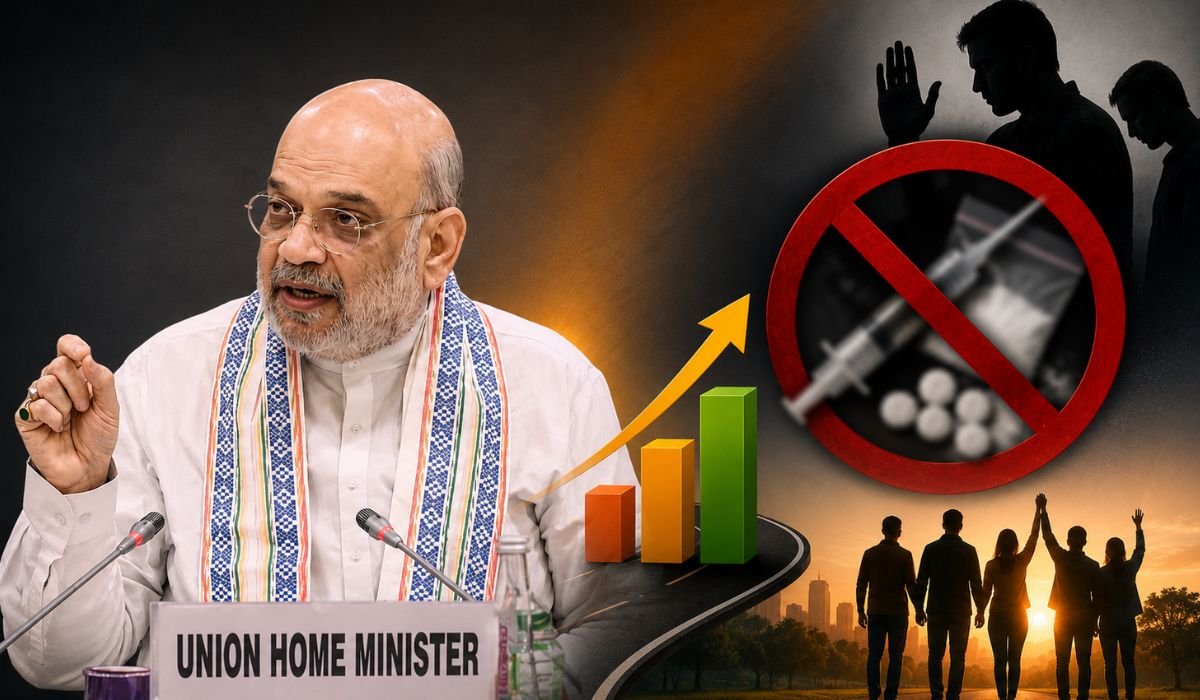

Drug abuse is a problem that affects not just one individual, but an entire family and society.
When a son in a family falls into addiction, its impact is not limited to his health alone. The family’s financial condition, social reputation, parents’ mental well-being, and even the future of coming generations become connected to it.
That is why, across the world today, drugs are seen not merely as a health issue, but as a serious challenge linked to national security, economic development and social stability.
Every year, June 26 is observed as the International Day Against Drug Abuse and Illicit Trafficking. The purpose of this day is not only to spread awareness, but also to send the message that the fight against drugs is not the responsibility of governments alone; it is a shared responsibility of society as a whole.
For India, the day in 2026 was significant in many ways. Union Home Minister Amit Shah chaired the tenth meeting of the apex-level committee formed for coordination against drug trafficking and released a new action plan for the next three years. On the occasion, he made it clear that India is committed to making its fight against drugs stronger, more modern and more result-oriented.
Why is June 26 observed?
The United Nations General Assembly decided in 1987 to observe June 26 as the International Day Against Drug Abuse and Illicit Trafficking.
Its aim is to bring countries across the world onto a common platform so that effective efforts can be made together for drug prevention, treatment, rehabilitation and action against illegal trafficking.
Today, this problem is no longer limited to any one country. Almost every continent, including Asia, Europe, Africa and America, is facing this challenge. Drug trafficking has now taken the form of an international criminal network, which is often linked to terrorist groups and organised crime syndicates.
Why is this challenge even more serious for India?
India’s geographical location makes this fight even more difficult. To the west of the country lies the Golden Crescent and to the east lies the Golden Triangle — regions long known for the production of illegal narcotic substances.
Because of this, India becomes an important transit route for traffickers. In addition, long borders, maritime routes, online payment systems and technologies such as the darknet have made the illegal drug trade even more complex.
Another worrying development is that along with traditional drugs, the trafficking of synthetic drugs is also rising rapidly. These substances can cause major harm even in small quantities and are often difficult to detect.
What is the government’s message?
On the International Day Against Drug Abuse, Union Home Minister Amit Shah said that public participation is the most important part of the fight against drugs. Until people themselves come forward, it will not be possible to eliminate this problem completely.
He said that under Prime Minister Narendra Modi’s leadership, the central government is working with a policy of “zero tolerance” towards drugs. In the past few years, various agencies have jointly exposed several major gangs and have also succeeded in breaking international trafficking networks.
Why has NCORD’s role become important?
Coordination among different agencies is one of the biggest requirements in the fight against drugs. With this aim, NCORD was created as a platform where the Ministry of Home Affairs, NCB, police, border security forces, customs, revenue intelligence departments and state governments work together.
Earlier, every agency acted separately. Now, intelligence inputs, technical data and investigation-related information are shared with one another. This has made it much easier than before to reach the entire network of traffickers.
What is the government’s plan for the next three years?
The central government’s new action plan for 2026 to 2029 focuses not only on the seizure of narcotic substances, but also on dismantling the entire trafficking ecosystem.
Under this plan, special monitoring will be carried out on synthetic drugs. Modern technology and artificial intelligence will be used to tighten the noose around trafficking conducted through the darknet. Coordination between states will be strengthened further, surveillance will be increased in border areas, and awareness campaigns to keep young people away from drugs will be expanded.
Along with this, the treatment and rehabilitation of people affected by addiction has also been made an important part of the government’s strategy. This makes it clear that the government no longer wants to limit itself to action against traffickers alone. It is moving towards tackling the drug problem from every angle.
2.09 lakh kg of drugs destroyed in six years: What do these numbers show?
The intensity of action against drugs is measured not only by statements, but by ground-level action. According to figures released by the central government, around 2.09 lakh kilograms of narcotic substances were destroyed across the country between 2020 and 2025. Their estimated value is said to be around ₹6,000 crore.
This action was not carried out by one department alone. Several central and state-level agencies working against drugs jointly undertook this operation. The aim was not only to seize drugs, but also to ensure that seized narcotic substances do not reach the illegal market again under any circumstances.
While these numbers present a picture of major enforcement action, they also show how large and organised the illegal drug trade has become.
Now, not just borders — the darknet has also become a new threat
There was a time when drug trafficking meant illegal movement across borders. But with technological development, trafficking methods have also changed.
Today, the darknet has become a platform where narcotic substances are bought and sold in hidden ways. Payments are made through digital currencies and attempts are made to send substances through ordinary parcels or courier services. This has created new challenges for investigating agencies.
That is why the government has prioritised darknet monitoring, digital investigation and the use of modern technology in its new action plan.
Why are synthetic drugs becoming a major concern?
Earlier, trafficking was mainly centred around traditional narcotic substances such as opium, charas or heroin. But now, chemically produced drugs are spreading rapidly.
These can be manufactured even in small secret laboratories. In many cases, even a small quantity can be converted into thousands of doses. This makes transportation easier for traffickers and multiplies their profits.
For this reason, the government has decided to give special attention to monitoring the chemicals used in the production of synthetic drugs and preventing their illegal use.
Why is this campaign important for border states like Punjab?
Punjab has been struggling with the drug problem for a long time. Since it is a border state, attempts at trafficking have also been frequent. In the past few years, several cases of drugs and weapons being sent through drones have come to light, increasing the concern of security agencies.
In this context, the Centre’s new strategy is being seen as important for Punjab and other border states. If border surveillance becomes stronger, coordination among agencies improves and technology is used properly, major trafficking networks can be weakened to a large extent.
At the same time, the role of society is equally important. If young people stay away from drugs and citizens report suspicious activities on time, this fight can become far more effective.
The fight against drugs is not just the government’s responsibility; it belongs to society as a whole
The drug problem cannot be solved merely by arresting traffickers. As important as it is to stop the supply of drugs, it is equally important to reduce the demand for them. If young people stay away from drugs, the biggest market for traffickers will begin to collapse on its own.
Keeping this thought in mind, the central government’s new action plan gives special emphasis to awareness campaigns, public outreach programmes in schools and colleges, making de-addiction centres more effective, and rehabilitating those who have overcome addiction.
Experts believe that a person struggling with addiction should not be seen as a criminal, but as someone who needs proper treatment, family support and society’s trust. If rehabilitation is not prioritised, a person who has quit drugs may fall back into the same cycle.
The anti-drug fight is becoming technology-driven
The government is now using modern technology along with traditional methods to deal with drug trafficking. Steps such as digital data analysis, monitoring suspicious transactions, detecting drones and enabling quick information-sharing between agencies can make this campaign more effective.
In cases related to the darknet and synthetic drugs, the role of modern technology is expected to increase significantly. This is why, in the coming years, the fight against drugs will not be fought only on the ground, but also in the digital world.
Is government action alone enough?
In the past few years, the seizure of large quantities of narcotics, the destruction of drugs worth thousands of crores of rupees, and action against major gangs show that the anti-drug campaign has intensified. Still, it must be acknowledged that this is a long fight.
As long as demand for drugs exists, traffickers will keep finding new routes. Therefore, along with legal action, social awareness, the role of families, the responsibility of educational institutions and the participation of young people are equally important.
Conclusion
Drugs are not the problem of one person alone; they are a challenge for the entire society. They are a poison that slowly breaks families, destroys the dreams of young people and affects the nation’s progress.
At such a time, the central government’s new three-year action plan signals that the fight against drugs will no longer remain limited to borders or traffickers. The darknet, synthetic drugs, digital trafficking and organised criminal networks will also remain at the centre of this campaign.
But the true success of this campaign will be possible only when the government, security agencies, teachers, parents, social organisations and, most importantly, young people come together and resolve that there will be no place for drugs in society and no compromise with the future of coming generations.
This fight against drugs is certainly long. But if the whole society comes together and contributes to it, winning this war is not impossible.

Leave a Comment