
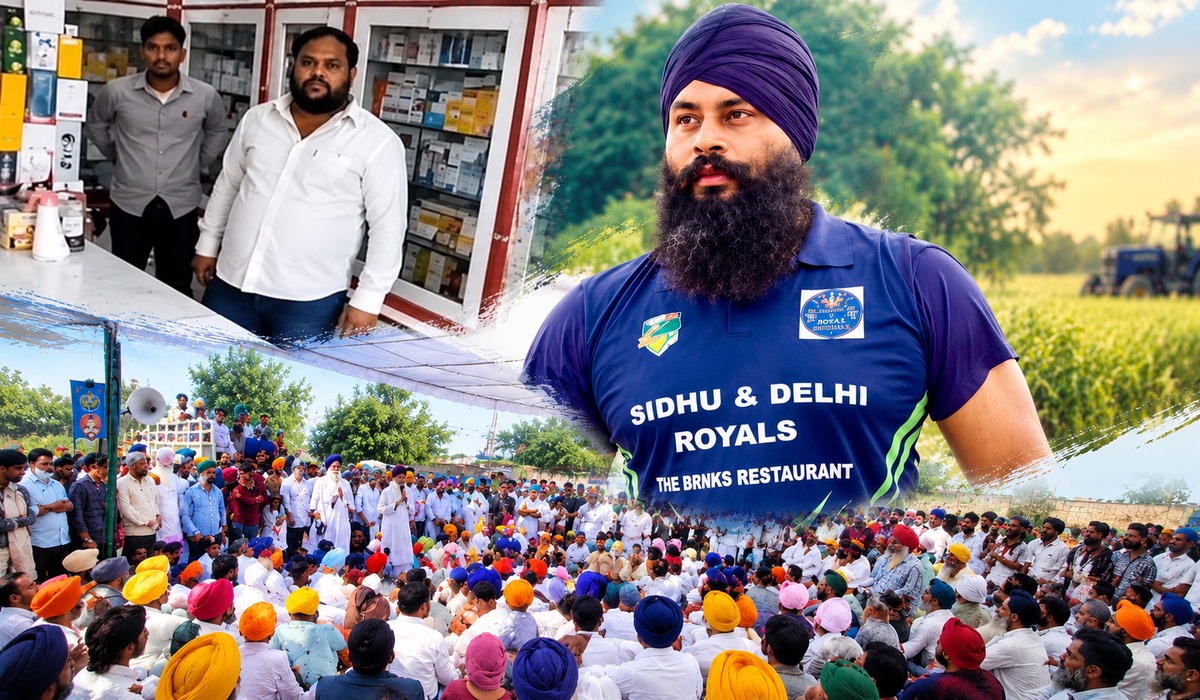

The broad daylight murder of Parvinder Singh Jhota, known as an anti-drug activist from Mansa, not only reflects the horrifying situation of drugs in Punjab but also deflates the claims and steps taken by the Punjab government against drugs. This clearly shows that the morale of drug peddlers has become so high that they can murder any anti-drug activist or anyone raising a voice against drugs. This audacity is difficult to come by without the encouragement of a ‘powerful faction’.
An argument begins between Parvinder Singh Jhota and Ashwani Kumar (the medical store owner) over the allegation of selling drugs inside the medical store. In a video of the time of Jhota’s murder circulating on social media, Parvinder Singh Jhota is heard talking about calling the police against the medical store owner, a person named Ashwani. The video also mentions Ashwani having a pistol, in which Jhota can be heard challenging the shop owner to fire the pistol. After some time, a shot is fired, which hits Parvinder Singh Jhota. He comes out of the medical store and goes to hide in another shop. Another video shows Ashwani Kumar walking behind in the market with a pistol in his hand. The sound of another gunshot is heard in this video, and then the person turns back towards the store with the pistol. Parvinder Singh Jhota was brought to the Civil Hospital in Mansa, where he was declared dead.
There has been a dispute between the two earlier as well. In the year 2023, Jhota had lodged a complaint against this same chemist Ashwani Kumar, accusing him of selling banned capsules. The police had registered a case against the shopkeeper, but had also arrested Jhota, accusing him of taking the law into his own hands because he had paraded him in the market wearing a garland of shoes. Now, three years later, in another clash at the same shop, Jhota died and four of his companions were injured. Even before this, the deaths of anti-drug activists in Punjab have occurred due to attacks on them for opposing drug trafficking.
After Jhota’s death, Ashwani Kumar and those who helped him flee have been caught. The administration and angry people demolished Ashwani’s house and shop, which cannot be called justified in a democratic setup at all. The Chief Minister of Punjab has condemned this and assured justice to Jhota’s family.
The people of Mansa city are expressing solidarity with Jhota’s family. Some people say that while many might have objections to Parvinder Singh Jhota’s method of working against drugs, he was fighting the battle against drugs with great honesty. To get justice for Parvinder Jhota, a sit-in protest (dharna) is going on at two places in Mansa. There was a call for a Punjab Bandh on October 15, which received the support of all political parties and public democratic organizations. Leaders of all public organizations and political parties are also marking their presence in the dharnas held in the city.
All the opposition parties of Punjab have started cornering the Punjab government and Punjab Police on the issue of drugs.
The Punjab government had launched the ‘War against Drugs’ campaign with great fanfare and spent a lot of money on advertisements for its promotion. The police also carried out several fake encounters. Following UP’s Yogi model, the houses of drug smugglers were also demolished, which cannot be called justified in any democratic country. There should be no place for ‘bulldozer’ culture in a democracy. Governments do such things to escape their broader responsibility.
But in Punjab, drugs are still being sold at the local level through shops or individuals. Every party has been playing its politics over drugs in Punjab. When a party is in power, drugs are sold vigorously in the same manner under their rule. Drugs started selling most rapidly in Punjab during the rule of the Akali Dal and BJP alliance government (between 2007 and 2017). It had full political patronage. Back then, when anyone raised this issue, both parties would start saying that the government was being defamed. Today, out of power, both parties are making big promises and claims. The Congress government led by Captain Amarinder Singh also could not eradicate drugs and kept making empty claims. The same is the condition of the Aam Aadmi Party government.
In reality, no party in Punjab has a roadmap to eradicate drugs. Without understanding the root of the drug problem, it cannot be eradicated with emotional slogans. Drugs are not just a problem in Punjab; even developed countries of the world are in its grip. According to the Narcotics Bureau report, 73 districts of India are severely in the grip of drugs. Among them, six districts of Punjab are included, while 67 districts are from other states of India. Out of these, the number of states where the BJP is in power is higher, but BJP leaders speak on the issue of drugs focusing only on Punjab. Recently, people in some areas of Haryana, fed up with the problem of ‘Chitta’ (synthetic drugs/heroin), expressed their anger against the Haryana government. During these days, news about drug smuggling and affected people kept coming from Delhi and Rajasthan as well. A few years ago, there was news of huge quantities of narcotics being found at Gujarat’s Mundra port, but no news of its investigation came to the fore. The BJP government at the Centre and its ministers speak by keeping a selective approach on the issue of drugs in Punjab, but they must be asked this question: why has the central government not been able to stop the drug smuggling happening from across the border? The 50-50 kilometers area from all sides of the border (the part of Punjab’s border that touches Pakistan) comes directly under the central government itself through the central security forces, then how can they turn their back on their responsibility?
Actually, drugs have become an international business; its relationship is directly linked with the international market. This is simply impossible to happen without political patronage. Then, at the local level, politicians get involved in it. Unemployment and their bleak-looking future also drive the youth on this path. Direct politics is definitely responsible for this.
The fight against drugs at the non-governmental level also cannot be fought alone or by taking the law into one’s own hands. For this work, it would be much better if people at the grassroots level gather and form their own institution or organization to work. For this task, Panchayats and youth assemblies can also make a great contribution.
Disclaimer – The views expressed in this article are solely those of the author and do not reflect the views or opinions of Sada Punjab or any associated organization.

Leave a Comment