



On 12 May 1710, a small force of Sikh warriors rode into the plains of Chapparchiri, a few kilometres from the Mughal garrison town of Sirhind. It dismantled one of the most powerful provincial armies in northern India. The man who led them, Banda Singh Bahadur, had arrived in Punjab barely two years earlier with five trusted commanders, a war drum, a standard, and five arrows given to him by Guru Gobind Singh. What followed was not merely a military engagement. It was the conclusion of a debt that Sirhind owed to history.
What Sirhind Had Done
To understand why the fall of Sirhind carried such weight, one must go back to December 1704. Guru Gobind Singh’s two younger sons, Baba Zorawar Singh and Baba Fateh Singh, aged nine and seven respectively, along with their grandmother Mata Gujri, had been captured and brought before Wazir Khan, the Mughal governor of Sirhind. The boys refused to abandon their faith. Wazir Khan had them buried alive in the foundations of a wall. Their grandmother died the same night.
The news spread through every Sikh settlement in Punjab. It did not produce despair. It produced a particular, enduring kind of resolve.
The Making of Banda Singh Bahadur
Guru Gobind Singh reached Nanded in the Deccan around 1708. There he met a Hindu ascetic named Madho Das, a man said to possess considerable personal force and an equally considerable arrogance about it. The encounter between the Guru and the ascetic is one of the more remarkable in the period’s record. Madho Das, by his own admission, declared himself the Guru’s slave and was given the name Banda Singh Bahadur after receiving the Khalsa initiation.
Before sending him northward, Guru Gobind Singh equipped him with five arrows, a ceremonial drum, a Nishan Sahib, and five senior Sikhs to advise him: Bhai Binod Singh, Bhai Kahn Singh, Bhai Baj Singh, Bhai Ran Singh, and Bhai Daya Singh. The Guru’s instructions were clear. This was not a raid. It was a campaign to end tyranny and establish just governance in Punjab.
The March Through Mughal Territory
Banda Singh Bahadur moved through Punjab with a speed and effectiveness that the Mughal administration had not anticipated. Sonepat fell. Samana fell. Sadhaura fell. At each step, thousands of peasants and dispossessed people joined the growing force. Many of them had spent their lives under feudal arrangements that treated land and the labour on it as the permanent property of hereditary landlords. Banda Singh represented something they had not encountered before: a commander who fought in their name.
By the spring of 1710, the Khalsa army had positioned itself directly before Sirhind.
The Battle of Chapparchiri
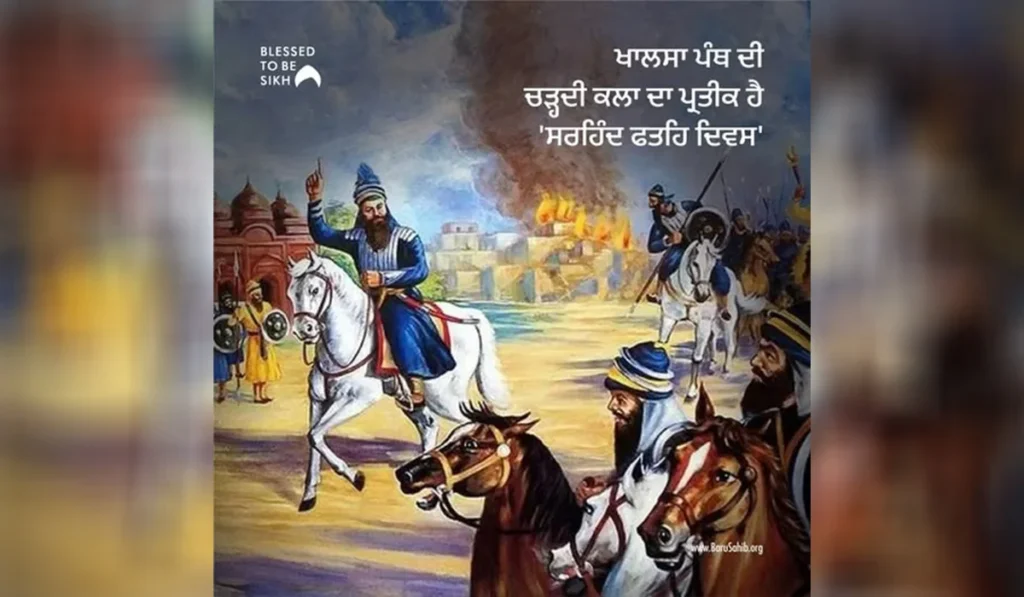
Wazir Khan was no minor functionary. He commanded a professional army equipped with more than 48 artillery pieces, war elephants, and thousands of trained cavalry. His forces had years of Mughal military organisation behind them. Against this, Banda Singh Bahadur led a force that relied on speed, terrain, and the kind of commitment that does not wait for favourable odds.
On 12 May 1710, the two armies met at Chapparchiri. The Mughal artillery opened the battle, but the Sikh cavalry pressed forward with a ferocity that disrupted the organised defence. Bhai Baj Singh and Bhai Fateh Singh drove directly into Wazir Khan’s position. In the close fighting that followed, Wazir Khan was killed. His death broke whatever discipline remained in the Mughal ranks. The army scattered. The Khalsa’s war cry rose across the field.
The Establishment of Khalsa Rule
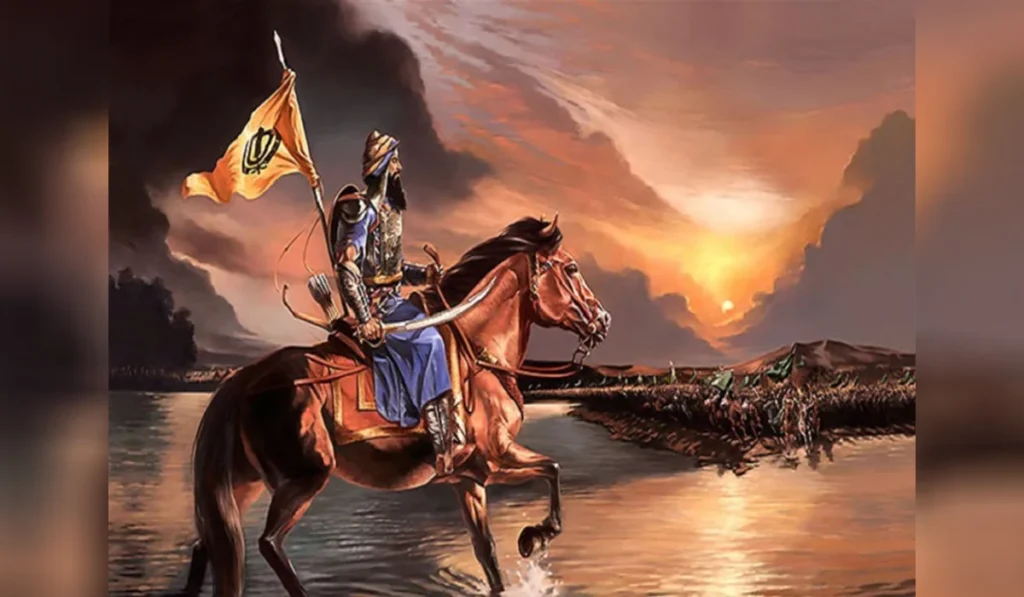
Two days later, on 14 May 1710, the saffron flag was raised over the fort of Sirhind. Banda Singh Bahadur declared the Khalsa Raj. Bhai Baj Singh was appointed the first governor of Sirhind. Bhai Ali Singh of Salaudi was named deputy governor.
On 27 May 1710, Banda Singh convened the first open court, the Darbar-e-Aam, and issued coins and an official seal in the name of the Khalsa. The coin bore a Persian inscription that read: “The sword of Guru Nanak granted victory in both worlds, and the triumph of Guru Gobind Singh is by the grace of the True Lord.” The official seal bore the phrase “Deg Teg Fateh O Nusrat Be-Dirang,” a phrase that remains part of the Sikh Ardas to this day.
A new calendar, the Nanakshahi Sammat, was introduced. The administration was functioning within days of the battle.
Land to Those Who Till It
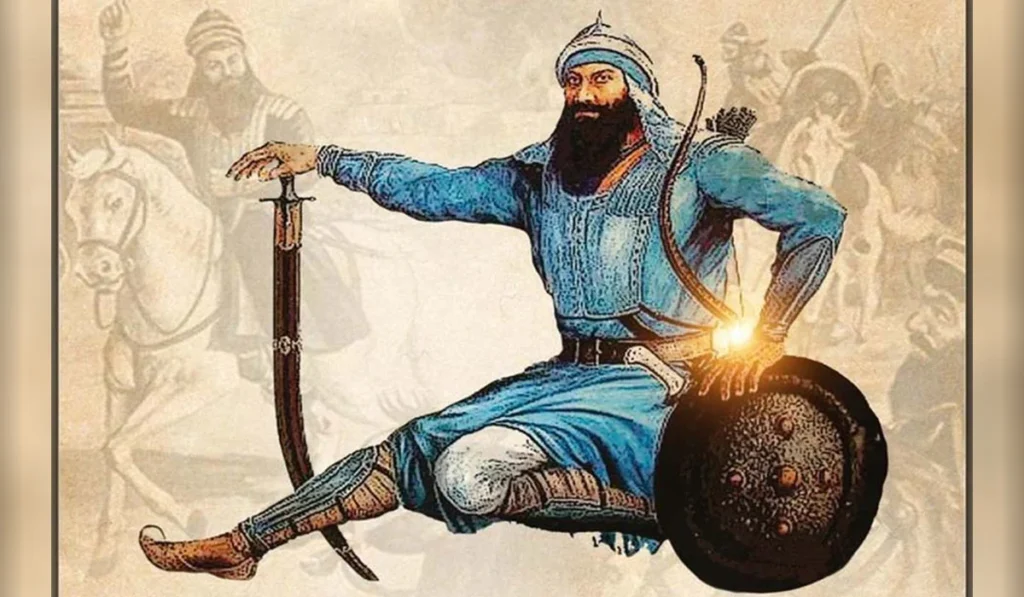
What distinguished Banda Singh Bahadur’s rule from the standard pattern of conquest was the agrarian reform he enforced almost immediately. He abolished the jagirdari system, the feudal arrangement by which landlords held permanent rights over land and the people who worked it. He declared that land belongs to the one who farms it.
At a stroke, peasant cultivators who had never held title to anything became landowners. Generations of debt, obligation, and tied labour were voided. Some historians consider this among the earliest systematic land reforms in recorded South Asian history, carried out not in the language of theory but through administrative orders with immediate effect.
What It Changed
The fall of Sirhind accelerated the decay of Mughal authority in Punjab. More than that, it changed the Sikh conception of what was possible. The community had spent the preceding decades under sustained persecution. After Sirhind, they governed. They issued currency. They administered territory. They collected revenue.
The Khalsa Misl confederacies that rose in the following decades, and the empire that Maharaja Ranjit Singh built in the early nineteenth century, both traced their lineage to the confidence established at Chapparchiri on a May morning in 1710.
Today, a 328-foot tower called the Fateh Burj stands at the battlefield. It is the tallest victory tower in India. It commemorates not only a military outcome but the two boys who were walled into the foundations of a city, and the man who ensured that city answered for what it had done.
12 May 1710 remains one of the few dates in South Asian history where a victory was won simultaneously on a battlefield, in an administrative office, and in the memory of a people.


Leave a Comment