


Why the Sikh Guru cannot be confined to a single day of remembrance, as in Guru Purnima
I. The Guru Principle in Sikh Thought
Few words in the Sikh vocabulary carry as much theological weight as the Guru. In everyday Punjabi usage the term has been loosely borrowed to describe any teacher or mentor, but within the Sikh framework it denotes something far more specific and far more exalted: the voice of the timeless divine, manifesting itself in history so that a bewildered humanity might find its way back to truth. Guru Nanak did not present himself as a prophet in the conventional sense, still less as a deity to be worshipped. He described himself, and was in turn described by his successors, as a vehicle through which the divine word, the Shabad, was communicated. The Guru, in this understanding, is not primarily a person but a principle, an illumination, a light. The persons who bore the title across ten successive generations were the vessels; the light they carried was one and continuous.
This distinction matters enormously, because it explains why Sikhism, alone among most world traditions founded on a charismatic teacher, was able to make the transition from a living human Guru to a scriptural Guru without any rupture in its theology. The principle was never anchored to the body of any one man. It was anchored to the Word.
II. The Ten Gurus: One Light, Ten Vessels
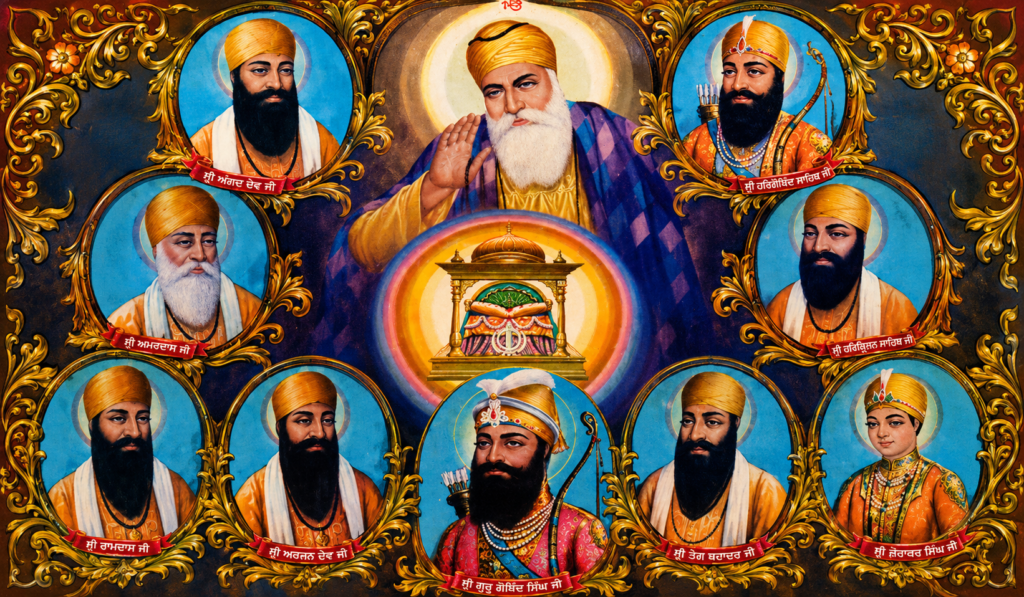
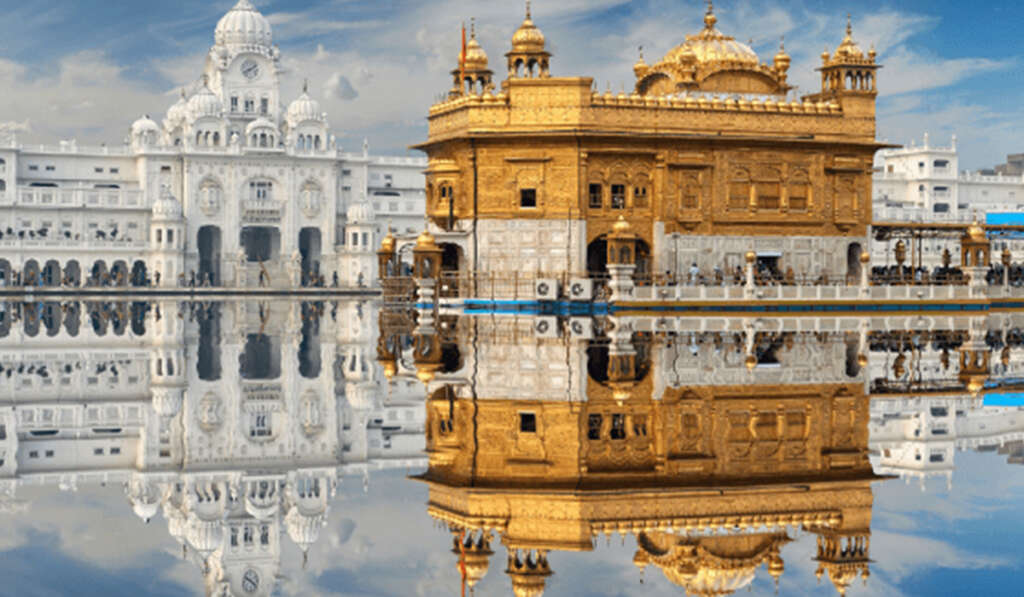
From Guru Nanak in 1469 to Guru Gobind Singh in 1708, ten Gurus occupied what Sikh tradition calls the Guruship, or Gurgaddi. Each successor Guru was understood not as founding a new faith but as the same light passing into a new lamp; the phrase commonly used is that of one flame lighting another candle without diminishing itself. Guru Nanak’s compositions, and those of his successors who wrote in the same spirit and often under the same pen-name of Nanak, were gathered, tested and finally compiled by the fifth Guru, Arjan, into the Adi Granth at Amritsar in 1604. This was itself a remarkable act of institutional foresight: the Guru, while very much alive and functioning as the temporal and spiritual head of the community, was already assembling the scripture that would one day succeed him.
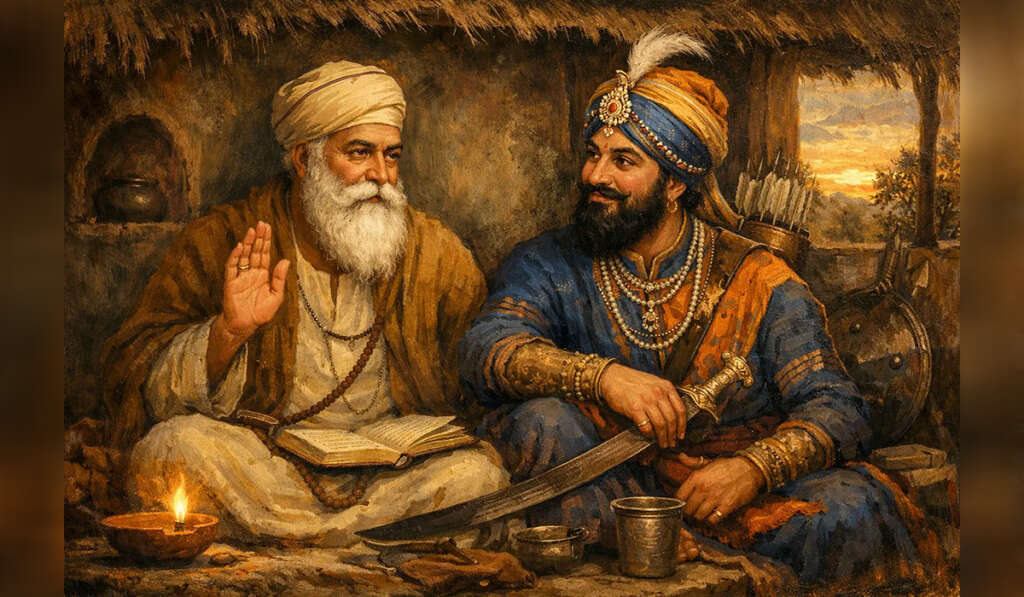
The tenth Guru, Gobind Singh, gave this evolution its final and irrevocable form. In 1708, shortly before his death at Nanded, he formally ended the line of personal Gurus and installed the compiled scripture, henceforth called Sri Guru Granth Sahib, as the permanent and perpetual Guru of the Sikh people. He is recorded to have instructed the community to look upon the holy Granth as they had looked upon him, and to seek guidance from its verses rather than from any living successor. This was not an abdication but a culmination: the human Gurus had, across two centuries, been progressively transferring authority away from personal charisma and towards the Word itself, and Guru Gobind Singh simply completed a movement that Guru Nanak had begun.
III. Sri Guru Granth Sahib: The Eternal, Living Guru
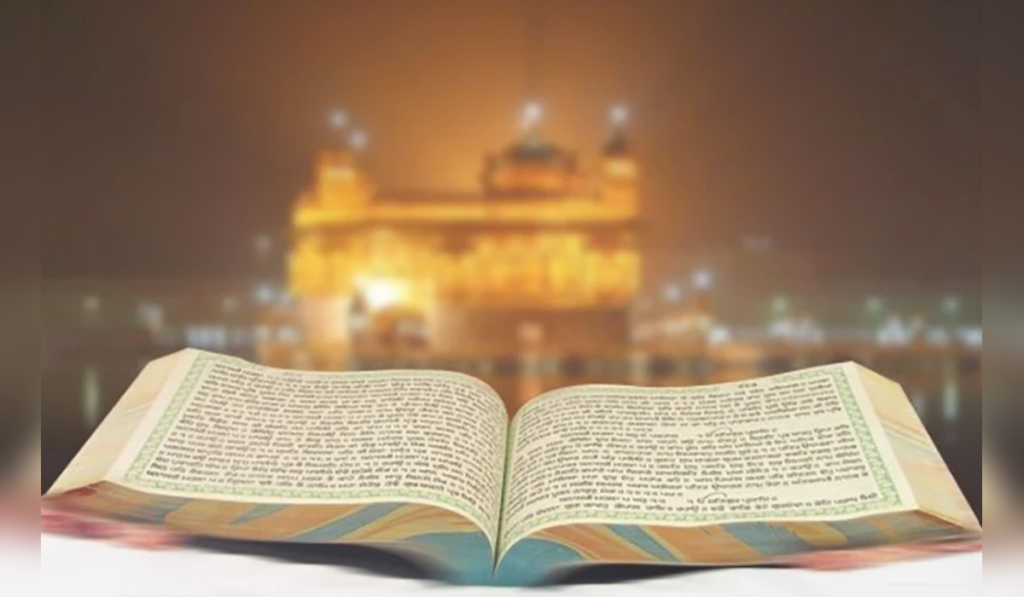
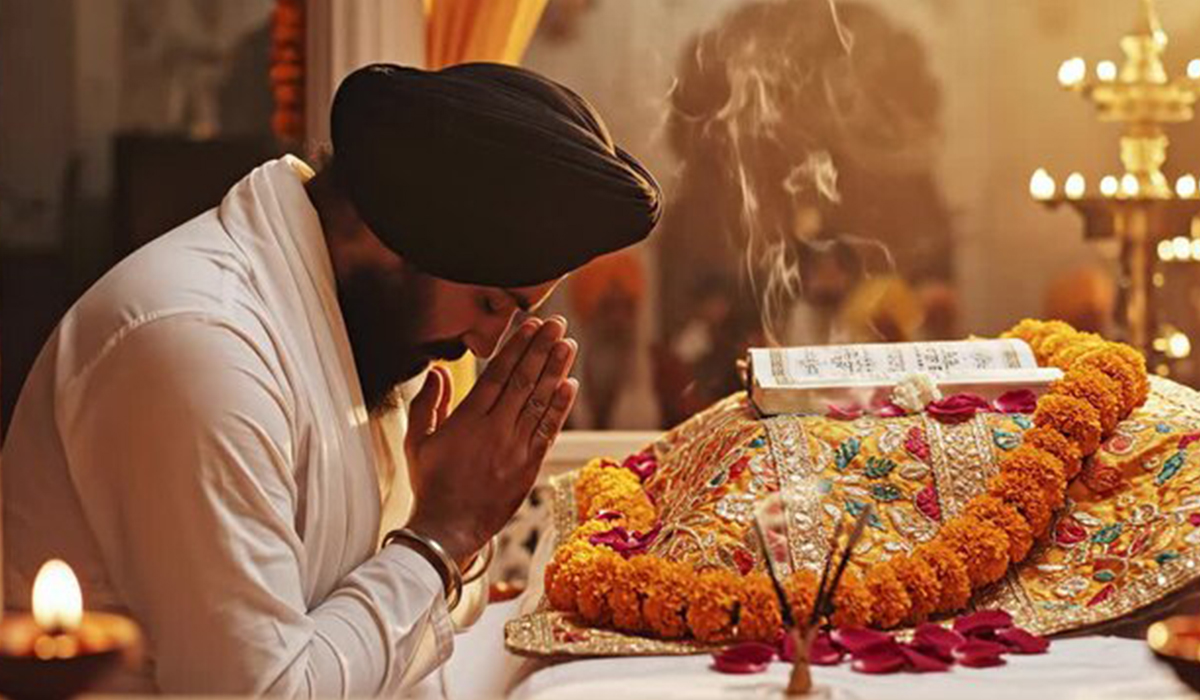
Sri Guru Granth Sahib is therefore not a holy book in the sense that other traditions possess holy books. It is not a text about the Guru, or a record of the Guru’s sayings compiled by later disciples; it is installed, addressed, and approached as the Guru himself, in a literal and continuing sense. This is why a Gurdwara is, at its physical and theological centre, simply the room in which Sri Guru Granth Sahib is seated under a canopy on a raised throne, the Palki, attended with the same ceremonial deference that would once have attended a living Guru: a formal awakening each morning, a Chaur waved above it, and a formal retiring each night.
The scripture itself is remarkably ecumenical for what is treated as the very embodiment of the divine Guru. Alongside the compositions of six of the Sikh Gurus, it includes the verses of Hindu Bhakti saints such as Kabir, Ravidas, Namdev and Trilochan, and of the Muslim Sufi Sheikh Farid, arranged not as commentary but as scripture proper, on equal footing with the Gurus’ own hymns. The unifying criterion was never the author’s creed or birth but the spiritual authenticity of the utterance. In this sense Sri Guru Granth Sahib is less a sectarian text than a compendium of realised truth, gathered under the authority of the Sikh Gurus and sealed as eternally valid.
IV. Veneration as a Daily Discipline, Not an Annual Event
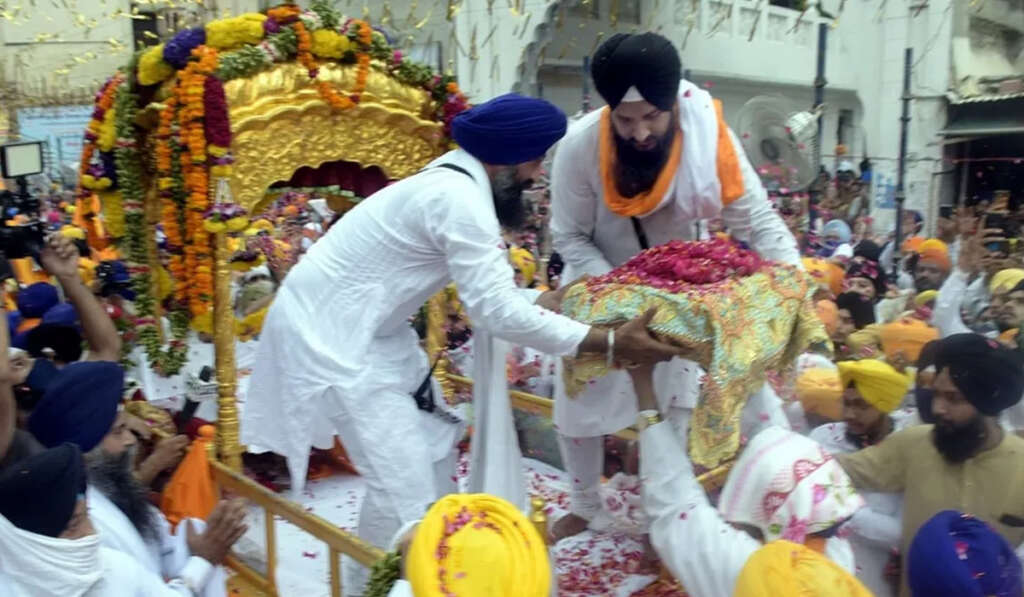
It follows from all of this that veneration of the Guru in Sikhism is not, and structurally cannot be, an occasion confined to a single calendar day. A practising Sikh’s day is meant to begin with Nitnem, a set of prescribed morning and evening prayers drawn directly from Sri Guru Granth Sahib, and to be punctuated throughout by Naam Simran, the remembrance of the divine Name as revealed through the Guru’s word. The daily ritual of Prakash, the ceremonial opening and enthronement of Sri Guru Granth Sahib each morning, and Sukhasan, its ceremonial closing and retiring each night, are performed in Gurdwaras across the world without a single day’s interruption, precisely because the Guru is held to be a living, continuously present reality rather than a historical figure to be honoured on an anniversary.
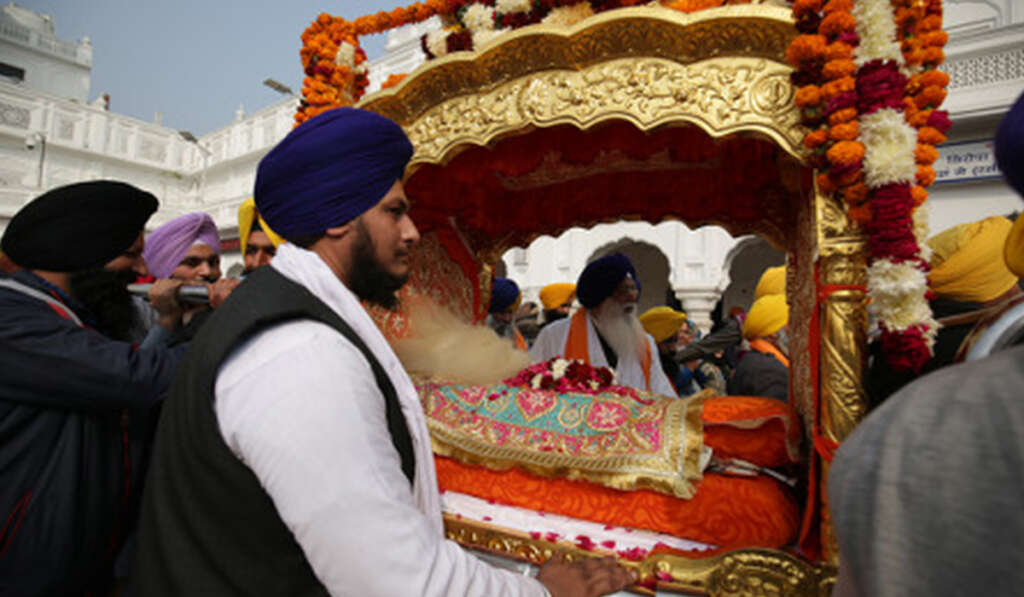
The major occasions on which Sikhs gather in larger numbers, the Gurpurbs marking the birth or the martyrdom anniversaries of particular Gurus, are certainly significant, and are marked with Akhand Path, unbroken forty-eight-hour readings of the entire Sri Guru Granth Sahib, processions and community service. But these are best understood as intensifications of a devotion that is otherwise constant, rather than as the sole appointed moments for it. To venerate the Guru only on a designated day would, within the Sikh framework, be a category error: it would treat as episodic a relationship that Guru Gobind Singh explicitly intended to be perpetual and unmediated by calendar or occasion.
V. A Gentle Word on Guru Purnima
It is worth distinguishing this, with due respect, from the observance of Guru Purnima in the wider Indic tradition. Guru Purnima, falling on the full moon of the month of Ashadha/ Sawan/Shravan, is rooted in a rather different conception of the guru: as a revered human teacher, historically associated with the sage Vyasa, to whom disciples across Hindu, Buddhist and Jain traditions express gratitude on an appointed day each year, often through the ritual of guru puja. It is a beautiful and entirely legitimate expression of reverence within those traditions, and many Sikhs, particularly in mixed or composite cultural settings, are not unfamiliar with its warmth.
But it sits uneasily when transplanted wholesale onto the Sikh understanding of Guru, for two reasons. First, the Sikh Guru is not primarily a revered human teacher to whom homage is periodically paid; from 1708 onward the Guru is a scripture that is continuously present, continuously consulted, and continuously obeyed, not commemorated. Second, Sikhism has, since Guru Nanak, resisted the idea of Guru Puja in the sense of worship directed at a human person, precisely to guard against the deification of any individual, including the ten Gurus themselves. The reverence a Sikh owes Sri Guru Granth Sahib is not, therefore, an annual tribute paid to a departed teacher’s memory; it is a daily, moment-to-moment orientation of life around a scripture that is held to speak in the present tense.
VI. Conclusion
The genius of the Sikh Guru tradition lies precisely in this seamless continuity: from Guru Nanak’s Shabad, through nine successor Gurus, into the permanent scriptural Guruship of Sri Granth Sahib. It is a theology that deliberately outgrew the limitations of personal charisma, and with it, the limitations of the single commemorative day. A Sikh does not set aside one Purnima in the year to remember the Guru; a Sikh is, in principle, never without the Guru, since Sri Guru Granth Sahib sits enthroned in Gurdwaras the world over, opened each morning and consulted every day, offering counsel that is meant to be lived rather than merely observed.



Leave a Comment