

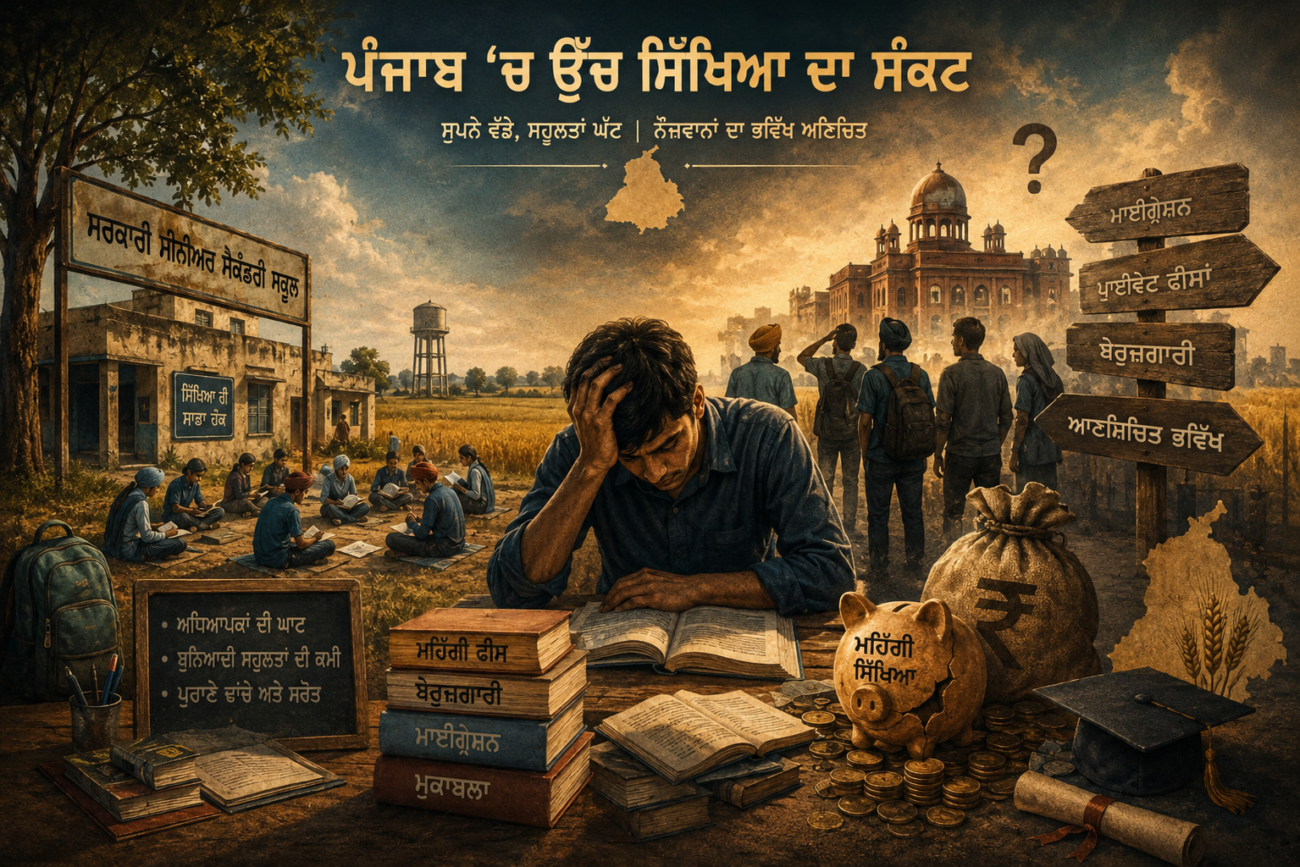

Higher education forms the strong foundation of the economic and social development of any nation. It not only equips human resources with technical and academic knowledge but also develops the capacity for research, innovation, and the delivery of quality education. Recognising this, the Government of Punjab established public universities and government colleges after Independence to provide higher education opportunities to the state’s youth and accelerate Punjab’s development.
Punjab’s higher education system has produced not only graduates but also competent citizens and professionals who have made significant contributions to India’s economic, social, scientific, and cultural progress. The universities and government colleges established after Independence have educated millions of students, enabling them to serve the nation as teachers, scientists, doctors, engineers, lawyers, judges, civil servants, entrepreneurs, and public representatives.
The greatest contribution of Punjab’s higher education system has been the Green Revolution. Scientists and researchers at Punjab Agricultural University, Ludhiana, played a historic role in transforming Punjab into the “Granary of India” by developing high-yielding crop varieties, scientific farming techniques, soil testing methods, pest management systems, and agricultural mechanisation. As a result of this scientific research, India achieved self-sufficiency in food production and succeeded in feeding millions of people.
Similarly, Panjab University, Chandigarh; Guru Nanak Dev University, Amritsar; and Punjabi University, Patiala have produced thousands of highly qualified professionals through advanced education and research in science, law, languages, literature, economics, management, and sports. Graduates from these institutions are serving in the Indian Administrative Service (IAS), Indian Police Service (IPS), the judiciary, defence services, universities, research institutions, and international organisations in positions of great responsibility.
Punjab’s higher education system has not only generated employment but has also driven social transformation. Millions of young people from rural and economically weaker families have received higher education through government colleges, improved their families’ economic conditions, and emerged as new leaders in society. The expansion of women’s education has also significantly strengthened social and economic empowerment across Punjab.
Today, in the era of the knowledge-based economy, the importance of higher education has increased more than ever before. Strong universities and government colleges provide the foundation for research, innovation, start-ups, industrial development, the digital economy, and sustainable agriculture. Therefore, protecting and strengthening Punjab’s higher education system is not merely an educational concern but a matter of the state’s economic development, social progress, and future prosperity.
At present, Punjab has 12 government universities, 16 private universities, five national-level institutes, and 64 government colleges operating under the Department of Higher Education. To promote higher education in rural areas, former Prime Minister Dr Manmohan Singh facilitated the establishment of 33 constituent colleges in Punjab. In addition, the state has 152 government-aided colleges and 427 private self-financing colleges.
Despite such an extensive institutional network, Punjab’s higher education system is currently facing a severe crisis. The crisis is the alarming shortage of regular Assistant Professors in government colleges. At present, only 136 regular professors are serving across Punjab’s 64 government colleges, against a sanctioned strength of 2,353 posts. This means that only about six percent of the approved faculty positions are occupied by regular teachers. This is a direct violation of the University Grants Commission (UGC) norms, which require that 90 percent of the teaching staff should be regular appointments. The situation is expected to worsen further, as of these 136 professors, 43 are scheduled to retire in 2026 and another 26 in 2027.
The most disturbing fact is that from 1996 to 2021—a period of nearly 25 years—the Punjab Government made no regular recruitment of teachers in government colleges. Before this period, even during the years of terrorism and political instability, the government regularly recruited teachers in 1991, 1993, 1994, 1995, and 1996. Even in 1999, the government recruited only a limited number of Assistant Professors in the English discipline.
The situation that has developed between 1996 and 2025 due to government policy and bureaucratic neglect poses a serious threat to the education system. Only regular teachers can ensure quality education, academic discipline, and meaningful research. How can temporary teachers, whose own future remains uncertain, provide comprehensive education to students? The shortage of regular faculty has not only affected students’ futures but has also severely damaged the quality of higher education in Punjab.
From 1996 to 2021, successive governments and the bureaucracy effectively blocked the recruitment of regular teachers for an extended period. This prolonged inaction has seriously undermined Punjab’s higher education system and jeopardised the state’s future. It has not only weakened educational standards but has also shattered the aspirations of thousands of young people who dreamed of becoming professors.
In 2021, the Punjab Government recruited 1,158 Assistant Professors and Librarians. Although the recruitment was merit-based and free from corruption, the Supreme Court set it aside on 14 July 2025, holding that the government had failed to follow the prescribed recruitment procedure. The Punjab Government was unable to demonstrate before the Court why it had departed from the established process.
It would have been better if the government had sought the assistance of the then Higher Education Secretary, Mr Krishna Kumar, who had introduced and implemented the new recruitment procedure. He could have explained why the revised procedure had been adopted. As a result of the cancellation of this recruitment, government colleges and students suffered enormous losses, while the futures of these teachers and their families were also adversely affected because of governmental and bureaucratic negligence.
In view of this situation, the present Punjab Government—which came to power on the promise of improving education and healthcare—must take immediate action. The government should enact legislation to regularise the services of the 1,158 Assistant Professors and Librarians, thereby securing their future. Such a step would not only ensure quality education for students but would also clearly demonstrate the government’s commitment to education.
Government colleges are the institutions that have produced thousands of scientists, doctors, civil servants, teachers, and political leaders for Punjab. Their future is now at risk because of the absence of regular faculty recruitment, and this will directly affect future generations of students as well as Punjab’s long-term development.
Therefore, the present government must act immediately to protect higher education. Enacting legislation to regularise the services of the 1,158 Assistant Professors and Librarians, ensuring quality education in government colleges, and protecting the education sector from administrative failures should be the first priority. Such measures will not only strengthen colleges but also restore confidence among young people aspiring to pursue higher education.
There is no doubt that part-time and guest faculty teachers have served these colleges for many years despite receiving meagre salaries. The government should therefore safeguard the services of these teachers while implementing a policy-based system of regular recruitment. Only then can Punjab’s higher education system be protected from further decline.
The time for delay has passed. The future of students, teachers, and Punjab itself awaits decisive action.


Leave a Comment