



The Falcon in Sikh History: A Symbol of Valor, Freedom, and Chardi Kala
Punjab’s state bird, the Baaz (falcon), is becoming a subject of discussion and commotion in the upcoming 2027 Punjab assembly elections. Recently, an article written by Divya Goyal Gopal with a main headline in India’s famous newspaper, The Indian Express, sparked discussion on this very subject. In this article, the perspectives of Punjab’s regional party Shiromani Akali Dal and the current government Aam Aadmi Party were discussed. It mentioned that recently, an attack took place on the president of Punjab’s regional party Shiromani Akali Dal, Sardar Sukhbir Singh Badal, at Nanded Sahib in Maharashtra, due to which he sustained physical injuries and was admitted to the hospital. This news from The Indian Express reported that Biba Harsimrat Kaur Badal, who is the wife of Sukhbir Singh Badal and a current MP, spoke about Punjab’s state bird, the falcon, in a statement. She associated this falcon with the falcon of Kalgidhar Patshah Sri Guru Gobind Singh Ji, stating that where Sukhbir Singh Badal was admitted to the hospital, a falcon was seen circling around it. Biba Harsimrat Kaur Badal’s statement was that this is Kalgidhar Patshah’s falcon and it is circling the hospital for the protection of Sukhbir Singh Badal; when Kalgidhar Patshah himself is present here for our protection, we have no fear of anyone.
Following this statement, the current government’s Chief Minister Sardar Bhagwant Singh Mann commented on that falcon, saying that it is possible a falcon came there, but that falcon did not reach there for the protection of Sardar Sukhbir Singh Badal, rather to protect its eggs from them. Furthermore, the current Chief Minister of Punjab, Bhagwant Singh Mann, gave various statements regarding this incident from different political stages. To the extent that during a political conference held in Mohali, a falcon was seen flying over his stage, and he said that this falcon has come to thank him.
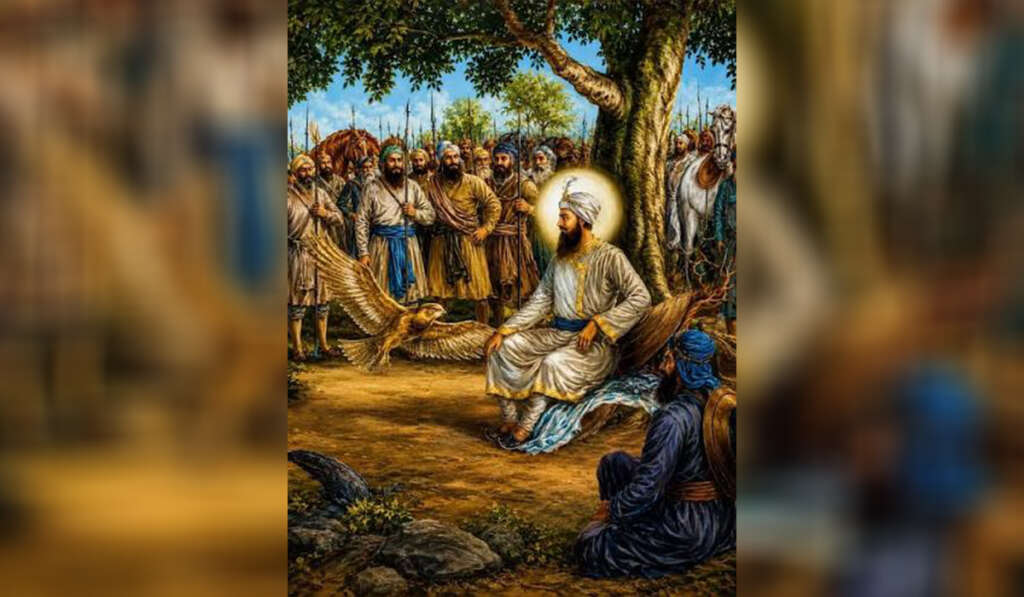
In the present times, all these things seem laughable. Why did Kalgidhar Patshah, the Master of Falcons, Sri Guru Gobind Singh Ji, keep a falcon with him? We all should know about this. Even though the falcon was prevalent before Sri Guru Gobind Singh Ji, because in 1634 AD, Sri Hargobind Maharaj fought the Battle of Amritsar precisely because of a falcon. Due to the sudden death of Mughal Emperor Jahangir in Kashmir, his son Shah Jahan immediately took over the throne. Guru Hargobind Ji knew that Prithi Chand’s son Meharban and Chandu’s son Karam Chand had poisoned Shah Jahan’s ears against the Guru. The Guru already had the realization that he would inevitably have to fight a war with the newly crowned emperor. Once, Emperor Shah Jahan, while hunting from Lahore, came towards Amritsar. At that time, Guru Hargobind Ji was also hunting with his Sikhs. Both sides unknowingly reached close to each other, but a confrontation did not occur. The Emperor had a white falcon which was sent as a rare gift by the King of Persia. Just as the Emperor was about to return to Lahore, a waterfowl flew up and the Emperor released his white falcon after it. The Emperor turned towards Lahore. But that white falcon and the waterfowl came under the domain of the Sikh army. When the Sikhs released their falcon, it immediately caught the waterfowl. When the waterfowl was caught, that white falcon also came into the grasp and under the control of the Sikh contingent. Seeing such a beautiful falcon, the Sikh soldiers were very happy and they took that falcon and headed towards Amritsar. As soon as the Mughal soldiers found out about this, they talked to the Sikh soldiers and told them that this falcon belongs to the Mughal Emperor Shah Jahan. They demanded that the falcon be returned. But the Sikhs refused to do so. After a long conversation, a clash broke out between the two sides and the Mughals had to face defeat. Several were killed right there, and those who survived went to Lahore and told the whole matter to the Emperor. Mughal Emperor Shah Jahan sent his brave soldier Mukhlis Khan towards Amritsar with an army of more than 7,000 and told him to capture that fakir alive and present him before me, the one who has committed this insolence, and who does not even fear the Mughal Emperor.

Mukhlis Khan marched towards Amritsar with his army, and a fierce battle took place near the Lohgarh Fort. Guru Hargobind Maharaj also actively participated in this battle himself. Many Sikh soldiers were also killed; Painde Khan, Baba Bidhi Chand, and many other Sikh soldiers fought with great courage and brought victory to the Guru in this battle. After this, Guru Hargobind Ji also celebrated the marriage of his daughter Bibi Viro with great pomp and show. This battle occurred precisely because of a royal falcon. After this, the tenth Guru, Sri Guru Gobind Singh Ji, started keeping a falcon with him. After Guru Hargobind Ji, a similar battle was fought by Guru Gobind Singh Ji for a falcon in Sri Anandpur Sahib. Even then, a Muslim soldier had captured Guru Gobind Singh Ji’s falcon, so displaying his royal independence and royal splendor, Guru Gobind Singh Ji fought a battle with that Muslim soldier and achieved victory. This meant that if your falcon is captured by someone, they are challenging your independence. Thus, demonstrating his sovereignty, the Guru gave a fitting reply to that challenge and achieved victory. This famous couplet is associated with the tenth Patshah, Guru Gobind Singh Ji:
Chirian naal main baaz ladawan,
Giddran nu main sher banawan,
Sawa lakh se ek ladawan,
Tabe Gobind Singh Naam kahawan

The falcon is also a symbol of freedom and it proves that any person who has kept this falcon with them is living their life with an absolutely independent spirit. Meaning that they are not under the threat of any political or social pressure. When Guru Gobind Singh Ji kept this falcon with him, it simply meant that he was completely independent of the hill kings and the Mughal emperors. He had his own independent dominion. The falcon is always a symbol of freedom, and if it is kept confined in a cage, it gives up its life; furthermore, a falcon never eats prey killed by another. A falcon always hunts its own prey and fills its stomach only by hunting for itself. A falcon can be made a pet bird, but it cannot be held captive. Another significance of the falcon in ancient times was that the direction of the wind was determined by its flight. Because the falcon is the only such bird that flies in the direction opposite to the wind. A falcon never flies along with the flow of the wind. So in ancient times, the tradition of keeping falcons came to our India from the Persian countries. The kings of Persian countries used to keep falcons with them. After them, the Mughal emperors kept falcons with them, and after that, the all-sacrificing Kalgidhar Patshah Sri Guru Gobind Singh Ji is addressed by the name ‘Baajanwale’ (Master of the Falcons) even in the present day. It is precisely because of Guru Gobind Singh Ji keeping a falcon that he was considered an independent ruler and a fearless-minded statesman of that time; after him, even up to the present day, many Khalsas of the Guru keep falcons with them. They always keep the falcon perched on their arm or on their turban, which signifies their freedom, fearlessness, and royal grandeur.

Leave a Comment