
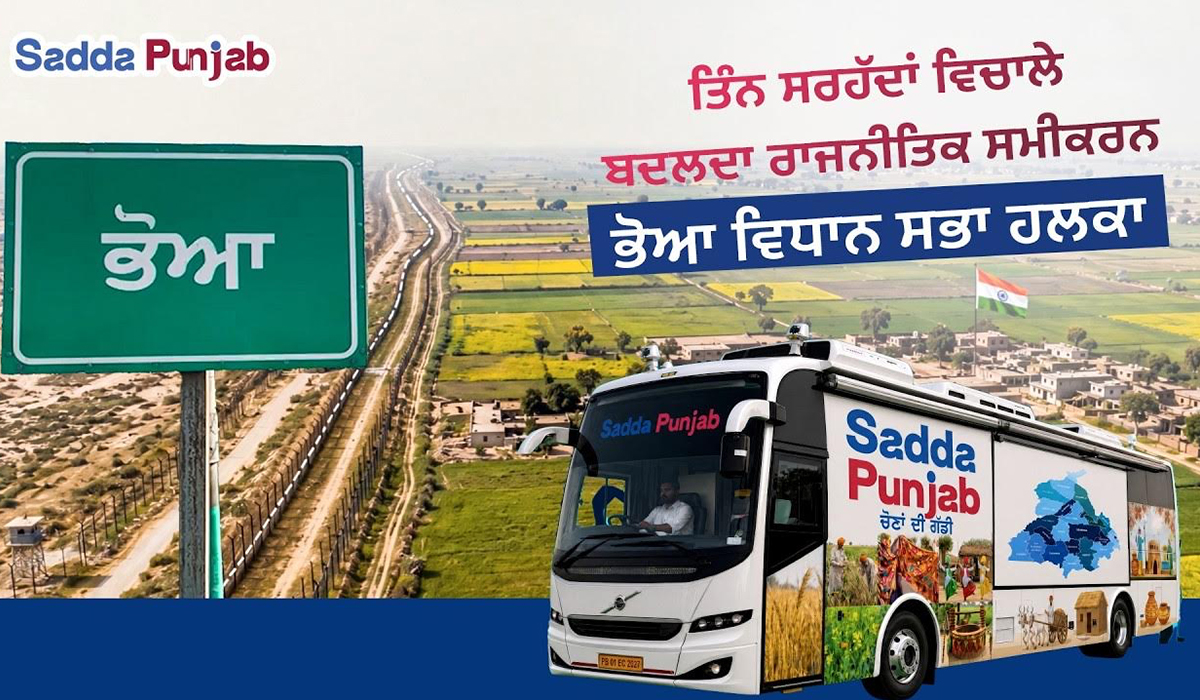

Bhoa Assembly Constituency Number 2 in Pathankot district of Punjab is an SC-reserved constituency and a part of the Gurdaspur Lok Sabha constituency. Following the 2008 delimitation, Bhoa gained its current identity as an assembly constituency, and an MLA was elected from here for the first time in 2012. Geographically, this constituency lies at the northern tip of Punjab, closely bordering the international boundary with Pakistan as well as areas adjoining Jammu & Kashmir and Himachal Pradesh. Rivers like Ravi and Ujh, the topography of the Kandi belt, and border villages make the social and political landscape of Bhoa quite distinct from many other Punjabi constituencies.
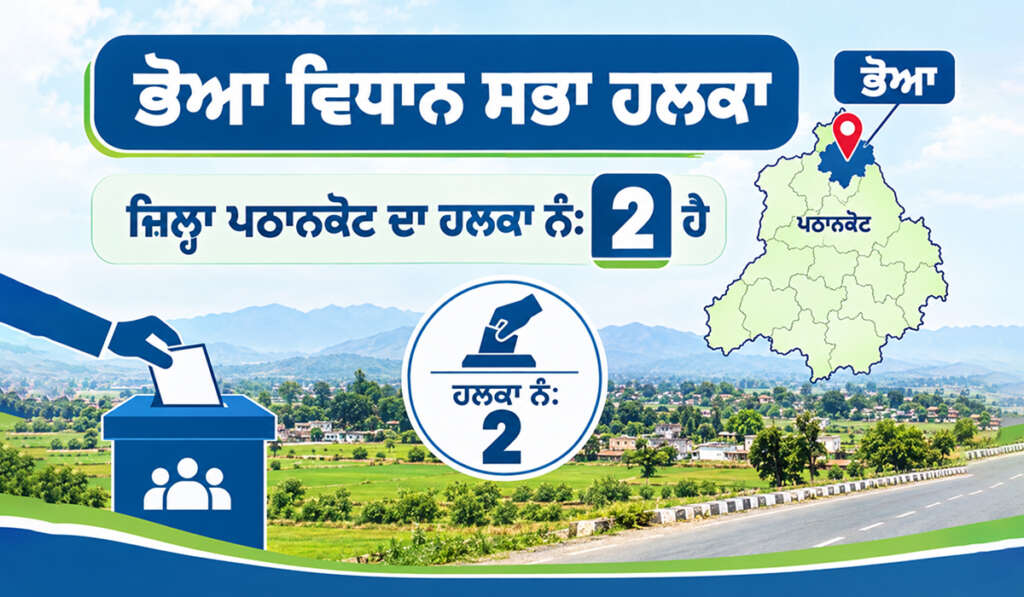
Bhoa’s significance isn’t solely tied to its status as a border constituency. Here, geography is directly linked to the daily lives of the people. Areas like Bamial and Narot Jaimal Singh are located right next to the international border. The waters of the Ravi and Ujh, rainwater flowing from the Kandi region, agriculture, roads, and border security—all these issues intertwine with the local politics.
Another aspect of this geography relates to security. During the 2016 Pathankot airbase attack, it emerged that the infiltrators had entered India through the Bamial sector. Consequently, the role of Bhoa’s border villages is not limited to the electoral map; this area holds significant importance in the context of the nation’s border security as well.
New Political Identity Formed After the 2008 Delimitation
Bhoa in its present form came into existence after the delimitation of 2008. Prior to this, a large portion of this area was attached to the Narot Mehra assembly constituency. The first assembly election in Bhoa took place in 2012, and Seema Kumari of the BJP won the seat. Following that, Joginder Pal of the Congress became the MLA in 2017, and Lal Chand Kataruchak of the Aam Aadmi Party (AAP) won in 2022.
These three elections also reveal an interesting pattern in Bhoa’s politics. The BJP in 2012, Congress in 2017, and the Aam Aadmi Party in 2022—three different parties won from here in three distinct elections. This means that since the constituency was formed, no party has secured a consecutive second term.
The contest in the 2022 election was quite close. AAP’s Lal Chand Kataruchak received 50,339 votes, while Congress’s Joginder Pal got 49,135 votes, resulting in a narrow winning margin of just 1,204 votes.
Lal Chand Kataruchak has maintained a distinct grip on local politics. He served as the Sarpanch of Kataruchak village six times and also held the position of a Cabinet Minister in the Punjab Government after becoming an MLA in 2022.
Largely Rural, But Issues Aren’t Limited Just to Agriculture
To understand the electoral structure of Bhoa, it is essential to understand its rural character. A large part of the constituency’s population lives in villages, and agriculture is a primary foundation of the local economy. Alongside this, daily wage laborers, small businessmen, families with members in government jobs, or the army and security forces also form part of the local society.
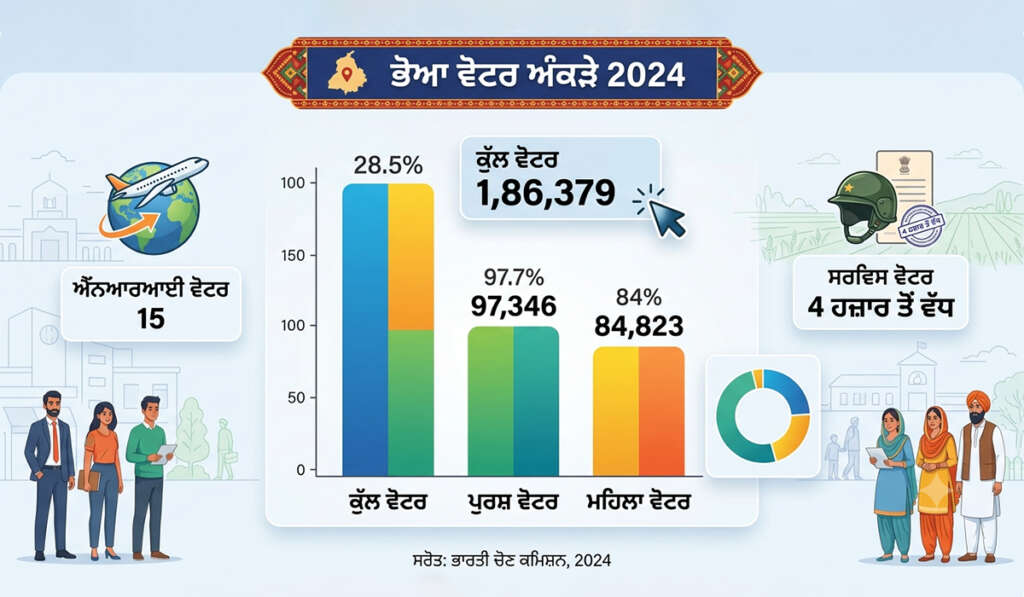
According to the 2024 voter statistics you provided, Bhoa had a total of 1,86,379 registered voters. These included 97,346 male and 84,823 female voters. Additionally, 15 NRI and over 4,000 service voters were registered. Being an SC-reserved constituency, the Scheduled Caste population also plays a crucial role in the electoral equation. The Pathankot district administration is also in the process of finalizing the 2026 voter list, which could further alter the constituency’s electoral picture ahead of the upcoming elections.
However, the daily concerns of the people of Bhoa cannot be understood merely through voter numbers or electoral statistics. The geography of the Kandi region also impacts developmental work here. Rainwater from the hilly areas reaches the fields and villages, while rising water levels in the Ravi and Ujh rivers create a flood risk for border villages.
After heavy rains and water release in 2025, the waters of Ujh, Jalalia, and Ravi affected several villages in the Bhoa constituency. Crop damage occurred in many places, and roads and embankments were also damaged. In 2026, following heavy rainfall in Himachal, conditions for rising water levels arose again in the border areas of Pathankot.
Therefore, flooding here is not merely an issue of natural disaster. Crops for farmers, roads for villages, and transportation for common people—all three are affected simultaneously. The long-standing local demand for permanent flood protection measures can be understood in this context.
Roads, Employment, and the Issue of Mining
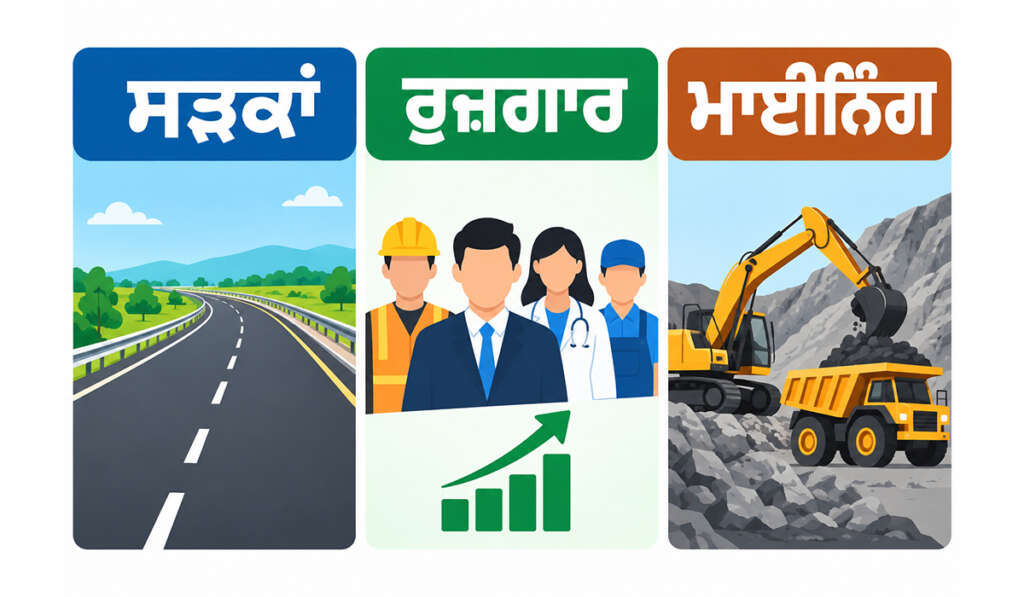
A major necessity for many villages in Bhoa is better internal roads and bridges. If connectivity linking border villages to main roads is poor, it impacts schools, hospitals, agriculture, and daily commuting. In 2026, link roads and infrastructure in Bhoa are being viewed as significant political issues ahead of the upcoming elections. According to reports, major development works related to link roads and three bridges in the constituency are also receiving attention.
However, the problem of roads cannot be linked solely to building new ones. Sand and gravel mining in the Ravi River area and the movement of heavy vehicles are also part of local discussions. In 2025, reports regarding alleged illegal mining surfaced in the Bhoa area of the Ravi River. Mention was made of a large number of trucks and machinery present in certain locations. While it wouldn’t be accurate to treat all mining-related claims as equally true—since the outcomes of government investigations and legal actions vary from case to case—the issue remains.
At the ground level, local concerns include the movement of heavy trucks, their impact on fields and roads, and questions regarding water levels. Reports in 2026 also highlighted that the movement of heavy tippers associated with mining has increased pressure on the link roads of some villages.
The question of employment is equally crucial. Due to limited local job opportunities for educated youth in the villages, many young people look toward the army, government jobs, or cities outside Punjab. Therefore, the discussion of development in Bhoa does not stop at roads or bridges; it also connects to local employment, education, and healthcare facilities.
Healthcare facilities are also a distinct challenge for border and rural areas. Serious patients have to travel to Pathankot or other nearby cities for major treatments. Consequently, the need for a better local healthcare infrastructure, specialist doctors, and emergency facilities finds its place in electoral discussions.
Which Way Will Bhoa’s Politics Sway Before 2027?
The record of the last three elections in Bhoa indicates that voters here have not allowed any single party to maintain a firm, continuous hold. The victories of the BJP in 2012, Congress in 2017, and AAP in 2022 are a clear sign of this. The winning margin in 2022 was just 1,204 votes, making Bhoa highly competitive.
Heading towards the 2027 elections, the biggest test in the constituency’s politics will be how people perceive the development work of the past few years and whether issues related to roads, bridges, flood protection, health, employment, and the needs of border villages impact their electoral decisions.
To understand the politics of Bhoa, one must also study its map. On one side is the international border, on the other the geography of the Kandi region and rivers; in between lies the agricultural and rural economy, accompanied by expectations for employment and basic amenities. The shifting political decisions in every election since the constituency was formed also suggest that it is difficult to consider this area the permanent stronghold of any single party.
Therefore, Bhoa’s electoral story before 2027 will not merely be about which party saves its old base. The real test will be how much change the people—from the border villages to the Kandi region—feel in their daily lives. The electoral contest in Bhoa will be fought on party symbols as always, but voting decisions will also be influenced by life experiences tied to roads, water, fields, employment, and the border.

Leave a Comment