

The War of ’65: The Braves of Punjab
As soon as the month of September arrives, the memory of the 1965 India-Pakistan war is refreshed. This was an era when the soldiers of the Indian Army held the fronts with courage and determination on the borders. To understand this war, the memories of those who witnessed the situations firsthand on the battlefield are highly significant.
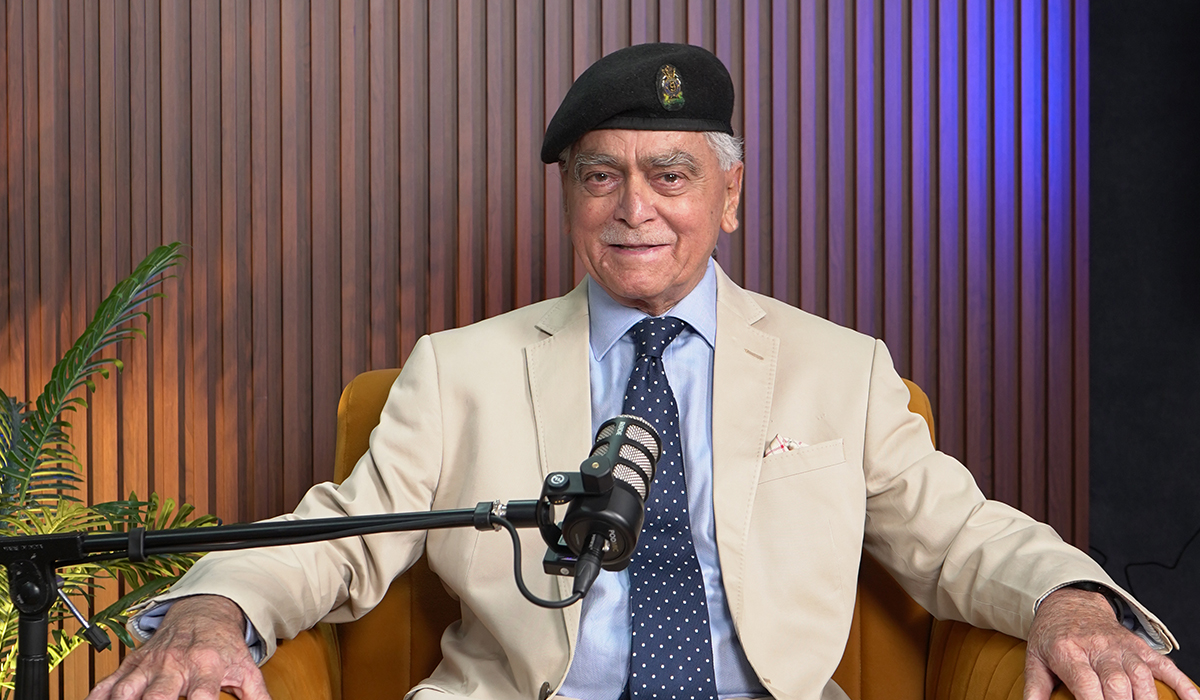
In this context, in ‘Sadda Punjab’s’ special podcast series ‘Gallan Unplugged’ episode ‘The War of 65—The Braves of Punjab’, a detailed conversation was held with retired Lieutenant General Tajinder Singh Shergill. The special thing is that in the 1965 war, three members of his family—his father Major General Rajinder Singh ‘Sparrow’, his brother, and Tajinder Singh Shergill himself—participated in the war from the Indian Army’s side.
In this interview, he spoke in detail about the causes of the 1965 war, the spread of the war from Kutch to Kashmir and Punjab, important fronts like Haji Pir and Khemkaran, his family’s military legacy, and the role of Punjabis during the war.
Question: Why did the circumstances for the 1965 India-Pakistan war arise?
Lieutenant General Tajinder Singh Shergill:
In my opinion, there were several reasons for this. Firstly, Pakistan had received highly modern weapons and military equipment from America. They had weapons, tanks, and aircraft for their armored divisions. This increased their confidence in their military strength.
Secondly, the Pakistani government felt that the Indian Army had weakened after the 1962 Sino-Indian war. Because of this, they formed the perception that action could be taken against India.
Along with this, Pakistan had its own calculations regarding Kashmir. They felt that if any action was taken in Kashmir, the local people would support them.
Question: Can the battle of Kutch be considered the starting link of the 1965 war?
Answer: In April 1965, the Pakistani army attacked the Kutch region. Our troop deployment there was comparatively less. For the first time, we also saw their M48 Patton tanks there. This battle was not on a very large scale, but Pakistan gained some success there. Later, through dialogue and diplomatic efforts, this conflict was halted. But from this, Pakistan realized that it could think about a larger operation against India.
Question: What was ‘Operation Gibraltar’ in Kashmir?
Answer: On August 12, Pakistan launched ‘Operation Gibraltar’. Under this, several units of Pakistani army soldiers were sent into Kashmir without military uniforms. Their expectation was that the Kashmiri people would stand with them.
But this did not happen. The people of Kashmir did not support them and even provided information about many locations to the Indian Army. Thus, this plan did not succeed as they had expected.
Question: How do you remember the battle of Haji Pir?
Answer: Haji Pir was a very crucial area. On August 28, Major Ranjit Singh Dyal and a contingent of his Para Battalion marched towards Haji Pir. A large part of the night was spent on the way, and by morning they captured Haji Pir.
In this operation, many soldiers, including Major Ranjit Singh Dyal, displayed unparalleled bravery. They were later honored with the Maha Vir Chakra.
Question: How did the direction of the war change after this?
Answer: Pakistan realized that its plan in Kashmir had not succeeded as expected. After this, it attacked towards Akhnoor. This operation was known as ‘Operation Grand Slam’.
Along with this, airstrikes also took place. Following this, India decided to retaliate, and the war expanded beyond Kashmir to the fronts of Punjab.
Question: What was India’s war strategy?
Answer: India had set some main objectives. One objective was to give Pakistan such a response in Kashmir that it would not attempt it again. The second objective was to reduce the strength of the modern weapons and tanks Pakistan had received.
Along with this, a crucial instruction was that only as much land should be taken as was necessary for military operations. This land was to be returned once the war ended and peace was established.
Another important aspect was not to cause damage to civilian areas. The army was instructed not to target ordinary citizens.
Question: How did the war reach Punjab?
Answer: After September 6, the war spread across various sectors of Punjab. Khemkaran, Khalra, Barki, the Lahore axis, Dera Baba Nanak, and Sialkot became important areas.
A unit advancing towards Lahore had crossed the Ichhogil Canal on the very first day. Later, due to some communication reasons, they were called back. The battle of Dograi was also very significant. During the battle of Phillora in the Sialkot sector as well, the Indian Army carried out a crucial operation.
Question: What was the role of tanks in the 1965 war?
Answer: Tanks played a major role in the Sialkot sector. Pakistan had Patton tanks and had prepared several armored units.
During the war, the Indian Army destroyed many Pakistani tanks. In the operations at Asal Uttar and the Sialkot sector, a large number of Pakistani tanks were damaged.
In my view, if we look at the objectives of the war, the objective of damaging Pakistan’s armored strength was largely achieved.
Question: When you found out that the war was about to start, what was the first thought that came to your mind?
Answer: “When the news of the war arrived, there was no weeping or wailing.”
In movies about war, we often see families crying and hugging. But our atmosphere was something else. This is Punjab. Our land has seen a lot, and the backbone of our people is very strong.
My regiment was in Ambala, and I was on a two-month leave at that time. I had gone to my elder brother in Nagaland. When I read about the war situation in the newspapers, I decided to return.
I came home to Jalandhar. Then one day, a call came asking me to come back. I had already made my preparations. The map case and necessary luggage were ready. We moved forward via a night train.
Question: Your father and brother were also in the war. What was the atmosphere at home like?
Answer: This was not an unusual thing in our family. My father was also in the army, and my elder brother and I were in the army too. Later, both of us reached the rank of Lieutenant General.
There were many such families in Punjab where two or three brothers served in the army and fought wars. But the names of most of them did not come to the forefront in history. For us, this was duty. We went for duty. There was no crying or wailing.
Question: Did your father give you any special advice before going to the war?
Answer: For him too, it was just duty. He had fought many wars himself. He had the experience of several fronts in Jammu and Kashmir like Naushera, Jhangar, Cheeta Force, Zojila, Uri, and Chakothi.
The 1947-48 war had also lasted a long time. So war was not a new thing for him. His nature was also very straightforward—if it’s a duty, the duty must be fulfilled.
Question: How did the name ‘Sparrow’ get associated with your father?
Answer: My father had a very good memory, and he used to sing right from the beginning. Once, in an English literature class, the children were given a long poem to memorize.
When the principal asked who could recite the poem, my father raised his hand. He recited the entire poem. The name of that poem was ‘I Am a Little Sparrow’.
The principal said—”Yes, you are a little sparrow in class and on the hockey field.” He also played hockey very well. After this, the name ‘Sparrow’ got attached to him, and later on, this name became famous in the army as well.
The Khemkaran Front and a Young Officer’s War
Question: On which front were you personally during the 1965 war?
Answer: When the war started, my elder brother was in the eastern sector in Nagaland. After a few days, his unit also came to our area and reached the Khemkaran and Khalra sector.
My entire war was in the Khemkaran area. I was a Second Lieutenant at that time. Initially, I had one troop with me; later, I was given more troops. My call sign was ‘Yankee’.
“My heroes were not just soldiers, but also the common people of Kashmir”
Question: Who were the biggest heroes for you in the 1965 war?
Answer: My heroes also include the common people of Kashmir. Pakistan expected that the people of Kashmir would support them, but that did not happen. They stood with the Indian Army and helped by providing information. This was a very big deal.
My other heroes are the people of Punjab. Whenever an army arrives at the border, the people of Punjab help them. From building bunkers to providing food and drink for the soldiers—the relationship of Punjab with the common people is different.
Question: Do you still remember any incident of help provided by the people of Punjab during the war?
Answer: Yes. When we were deployed near a village during Kutch, our 14 tanks were parked around an orchard. One evening, a woman in a white salwar-kameez and white dupatta came to us with two men. They had brought two baskets. They told us that they had brought this for us.
There is such a relationship in Punjab that the soldiers are considered their own, and relationships like aunt or grandmother are formed with everyone. This is a distinct quality of Punjabi society.
“Punjab doesn’t belong to just one religion; it belongs to all Punjabis”
Question: How do you connect the partition and the history of Punjab with the war?
Answer: Punjab has seen a lot. At the time of partition, Punjab and Bengal suffered the biggest blows. People left their lands, their homes, and there was massive bloodshed.
During the time of the Lahore Durbar, Maharaja Ranjit Singh’s empire was spread over a very large area. At that time, Punjab had its own distinct identity.
Even today, the people of East and West Punjab share many common traditions regarding language, food, customs, and weddings. Religion may be different, but many commonalities of Punjabiyat still exist today.
On the battlefield, it wasn’t religion, it was comradeship
Question: What would you say about the role of soldiers of different religions in the 1965 war?
Answer: People of different religions fought together in the Indian Army. On the Khemkaran front, Company Commander Abdul Hamid was also a great hero. He had a recoilless rifle, and he targeted several Pakistani tanks. He was martyred and received the Param Vir Chakra.
In the Sialkot sector too, soldiers from different backgrounds fought bravely. This is a great strength of the Indian Army that people of different religions and regions unite and fight for the country. For me, the army itself is a hero.
The Right Decision at the Right Time—The Importance of Command in War
Question: How do you view the decisions of the commanders in the 1965 war?
Answer: Many senior commanders of that time had seen combat in the Second World War. Their experience was of very large-scale wars. Therefore, they thought on a massive scale.
But the 1965 war ended in just 23 days. During this time, the situations changed rapidly on many fronts, and commanders had to make immediate decisions. In a war, it’s not just the weapons, but the right decision at the right time that is also highly crucial.
Question: Do you feel that the military legacy of Punjabi families is still alive today?
Answer: Absolutely. There are many families in Punjab whose multiple generations have been in the army. In many families, two or three brothers went to wars at the same time.
In my own family, my father, my brother, and I were connected to the 1965 war. But this is not just the story of our family. Many households in Punjab have given their sons for the defense of the country.
This is why the soil of Punjab is associated with memories of wars and sacrifices.
In Conclusion…
The 1965 war was not just a military battle fought on the borders. The stories associated with it encompass everything—military strategy, the bravery of soldiers, the cooperation of ordinary people, the sacrifices of families, and the social and historical memory of Punjab.
Lieutenant General Tajinder Singh Shergill’s memories offer this generation a crucial opportunity to understand that era. In his conversation, one thought emerges repeatedly—for a soldier going into a war, it is primarily a duty.
And behind this duty, there isn’t just one soldier, but his family, his village, his land, and the memories of that society.
‘The War of 65—The Braves of Punjab’ is an effort to remember this very legacy and pass on the stories of these people to the next generation.
Leave a Comment