

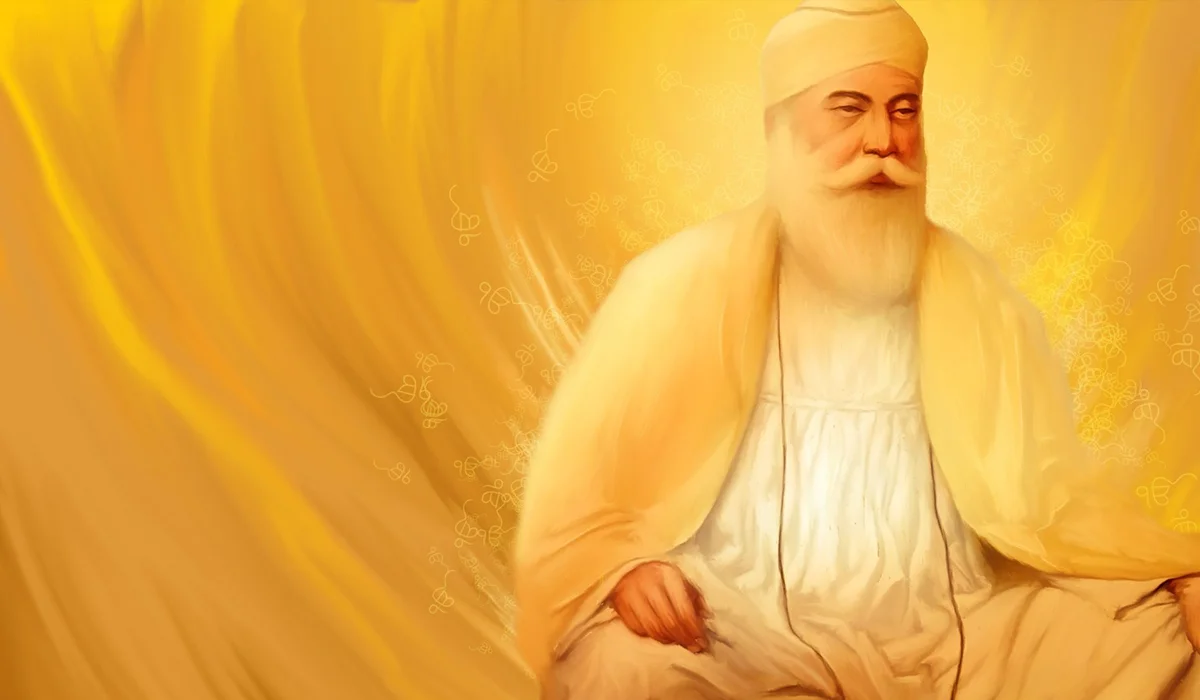

Bhai Gurdas—a devoted figure within the Sikh tradition—is credited with transcribing the first official edition of the Guru Granth Sahib. At the behest of the fifth Guru, Arjan Dev, he composed forty poems in a distinctive style; these have gained recognition and popularity as the “Key to the Sri Guru Granth Sahib.” These poems are known as *Vaars*, and this specific collection is referred to as *Vaaran Bhai Gurdas*. Bhai Gurdas, a skilled historian and a polyglot proficient in multiple languages, was born in 1551. He became the *Jathedar* of the Akal Takht in 1606 and served in this role until his death in 1636. In one of his *Vaars*, he describes the arrival of Guru Nanak Dev Ji on earth with these words:
Satguru Nanak pargateya, miti dhund jag chaanan hoya.
Jeo kar sooraj nikleya, taare chhipe, andher paloya.
In other words, when Satguru Nanak Dev appeared, the fog of ignorance and delusion enveloping the world lifted, and the universe was bathed in the light of wisdom. Just as the stars vanish and darkness is dispelled the moment the sun rises, the appearance of Guru Nanak eradicated ignorance, superstition, discrimination, and spiritual darkness, allowing the light of truth to spread.
It is a fact that the era in which Guru Nanak appeared on Indian soil was a time of profound societal crisis. His life spanned the period from April 15, 1469, to September 22, 1539. India in the latter half of the fifteenth century was not only unstable externally but was also deeply fragmented internally. The Lodi Sultanate of Delhi was gradually losing its power, and there was a looming threat of foreign invaders from the northwest. However, during that era, a crisis far greater than political instability loomed over the soul of society. In his significant work *Guru Nanak Reinterpreted* (published in 1965), the scholarly Punjabi writer Narayan Singh noted that religion had lost its living consciousness and had become synonymous with external symbols, rituals, and caste divisions. A person’s worth came to be judged not by their character, but by their birth.
Religion had lost its compassion, the caste system had devoured the individual, and the sacred sentiment of faith had been reduced to mere ritualism. The moral degradation of those in power had reached its peak. Guru Nanak described this atmosphere with the words: “Raje singh mukadam kutte” (Kings have become lions, and their officials are like dogs). Elsewhere, he wrote: “Kali hoi kutte-muhi, khaj hoa murdar”—meaning, what a *Kaliyuga* (dark age) has descended, where people have acquired the faces of dogs and have turned into consumers of carrion.
In Part 145 of Sri Guru Granth Sahib, Guru Nanak has drawn a more comprehensive picture of this time in which the vision of a poet is not that of a historian:
Kal kaati, raaje kasaai, dharam pankh kar udreya.
Koor amaavas, sach chandarma, deesai naahi keh chadheya.
This means that Kaliyuga has become a sharp knife and kings have turned into butchers; It is as if religion has grown wings and has flown away somewhere far away. The new moon of lies is in full swing and the moon of truth is nowhere to be seen.
This is an amazingly effective metaphor and therein lies the beginning of the journey of his unique philosophy of life.
Some men in history are not the founders of any religion. He comes as the voice of the wounded conscience of a civilization. After his arrival, not only the method of worship changes, the way of looking at humans also changes. In the list of such great men, Guru Nanak’s name will always be taken with great respect and honor along with Gautam Buddha, Jesus Christ and Kabir. Guru Nanak’s work was not merely the establishment of a new sect. At that time, he gave such a moral mirror to India in which a person got his identity not by birth but by his deeds.
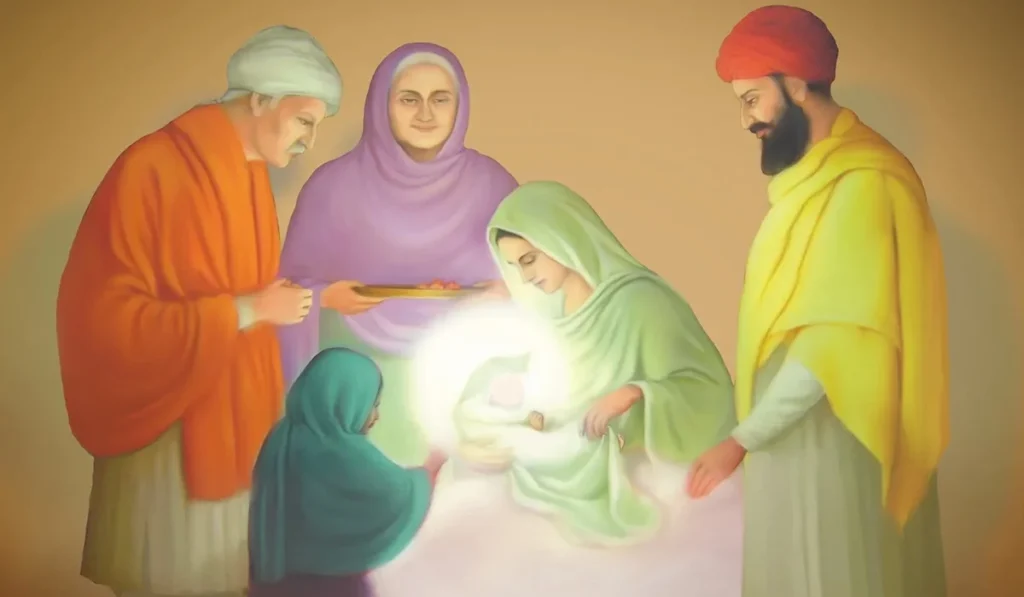
Guru Nanak was born in a Khatri Bedi family of Rai Bhoi di Talwandi. Father Mehta was the Patwari of Kalu village and mother Tripta was a housewife of religious and sensitive nature. According to Sikh tradition, many supernatural stories are associated with his birth. It is said that the Muslim midwife Daulatan was astounded by his extraordinary personality at the time of his birth and astrologers predicted greatness in his future.
Since childhood, Nanak was different from ordinary children. At the age of five, he started education in the village school, where he proved to be more inquisitive and sharper than his teacher Gopal. Later he studied Vedas and Hindu philosophy under the supervision of Guru Brijnath. He also learned Persian and Arabic from a Muslim Maulvi Syed Hasan.
His elder sister Nanaki and local Muslim landowner Rai Bular were among the first to recognize his spiritual qualities. The father wanted his son to do business and take care of the accounts, Nanak’s mind was engrossed in sadhus, Sufis and spiritual contemplation.
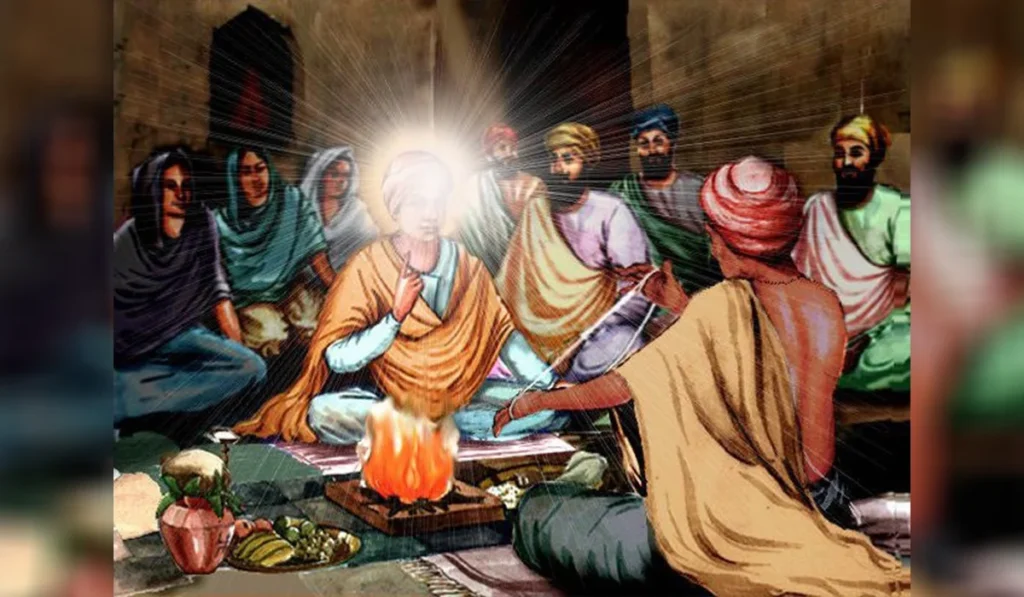
At the age of nine, when her sacred thread was to be performed, she refused to wear it, asking, “If this thread will make me religious, will those who do not have this thread remain away from God?” Parts of Sri Guru Granth Sahib 471: This statement of his is still counted among the highest interpretations of Indian religious thought:
Daya kapaah, santokh soot, jat gandhi, sat vat.
Ehu janeu jee-a ka, hai ta paande ghat.
Explaining this context, Narayan Singh writes that Guru Nanak was not opposed to religious symbols per se; rather, he opposed situations where a symbol is stripped of its moral significance and becomes merely a mark of social privilege.
The fundamental principle of Guru Nanak’s entire religious philosophy is ‘Ik Onkar’ (One God). This is not merely a declaration of God’s oneness but also the philosophical basis for human equality. If God is one, then His creation is also one. If creation is one, how can caste distinctions exist? If the light is one, on what basis can there be high and low status?
Later, the famous verses of Kabir—compiled in the Guru Granth Sahib—express this very truth most powerfully: the Divine first manifested His light, and from that light, all beings were created. When all are made of the same light, who is high and who is low?
Avval Allah noor upaaya, kudrat ke sab bande.
Ek noor te sab jag upjiya, kaun bhale ko mande.
Guru Nanak’s entire social philosophy stems from this very idea.
In *Guru Nanak Reinterpreted*, Narayan Singh writes that Guru Nanak felt a natural affinity with those who worked with their hands—farmers, carpenters, laborers, artisans, and the like. He regarded them as the foundation of society. Nanak did not merely pity the poor; he sat amongst them.
During his travels, Guru Nanak once visited Saidpur, a place now part of Eminabad in Pakistan. There, he stayed at the home of a poor carpenter named Bhai Lalo. In that same town lived a corrupt official named Malik Bhago. Malik Bhago had organized a lavish feast with the intention of displaying his opulence. When he learned that a renowned saint visiting the city was staying at a carpenter’s home instead of his own, he felt both surprised and insulted. He sent a messenger to invite him, but Guru Ji declined. A second messenger was also politely turned away. Finally, when Malik Bhago arrived in person, Guru Ji had to go; he took Bhai Lalo’s simple, dry bread along with him.
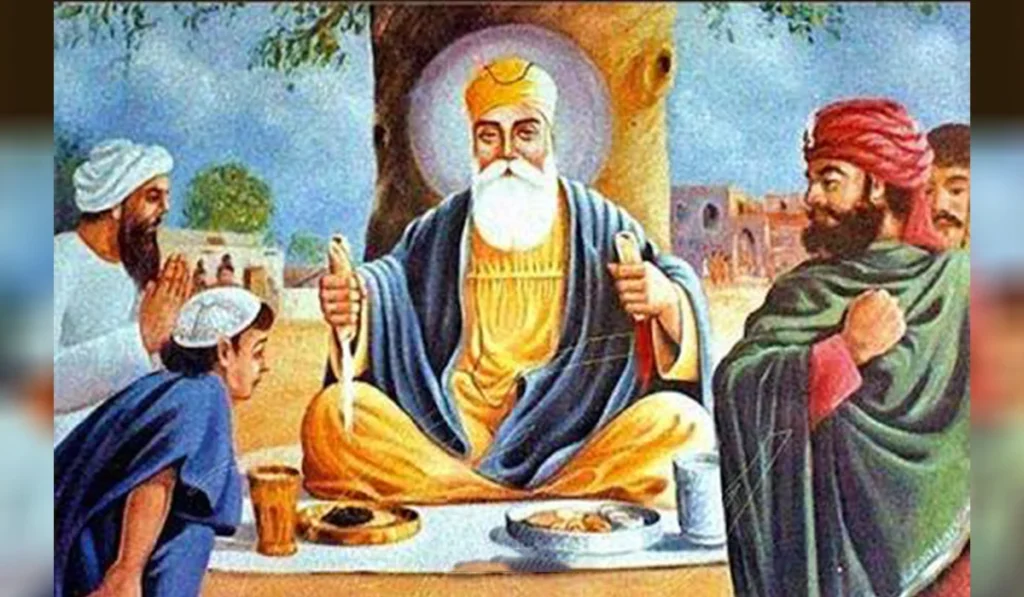
Upon arriving, Guru Nanak held Bhai Lalo’s bread in one hand and Malik Bhago’s rich delicacies in the other, squeezing both. Legend has it that milk oozed from Lalo’s bread, while blood dripped from Bhago’s food. More than the miracle itself, the significance of this story lies in the metaphor that encapsulates the essence of his philosophy: bread is not made of wheat alone; the nature of one’s earnings and labor is also baked into it.
It is in *Raag Asa* (Ang 15) of the *Sri Guru Granth Sahib* that one finds the most powerful proclamation of Guru Nanak Dev’s anti-caste and egalitarian vision. He does not merely preach equality; he declares his solidarity with the most marginalized sections of society. He states that he wishes to live among those who are even more neglected and scorned than the castes deemed lowest in society. What point is there in competing with or envying the wealthy and the elite?
Neecha andar neech jaat, neechi hoo at neech.
Nanak tin kai sang saath, vaddian siu kya rees.
In the Indian religious tradition, this was the first time a saint accorded spiritual dignity to manual labor. On page 1245 of the *Sri Guru Granth Sahib*, he stated that one who earns through honest labor and shares a portion with others is the one who recognizes the true path of life:
Ghaal khaae kichh hathahu dei,
Nanak raahu pachhaanahi sei.
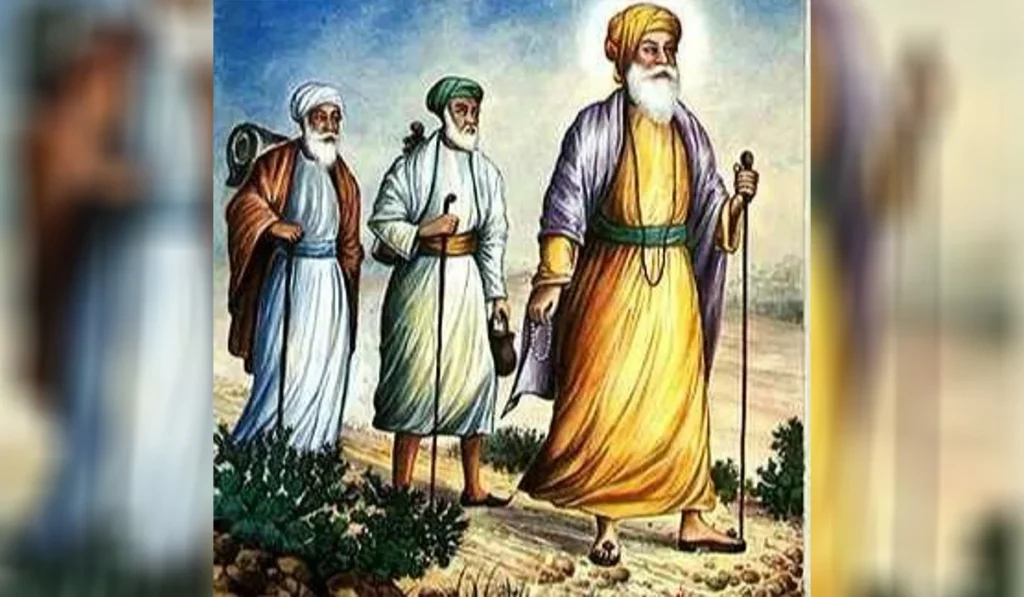
Guru Nanak fully understood that, alongside caste-based discrimination, mutual religious animosity among the people was a major challenge facing the country. Between 1499 and 1527 CE, Guru Nanak Dev Ji undertook five extraordinary journeys known as *Udasis*. During these travels, he covered a distance of over 28,000 kilometers across South Asia, Central Asia, and the Middle East. He traveled on foot, engaged in dialogue with people, and spread a message of transformation. Throughout this time, he interacted equally with scholars, saints, rulers, and common people.
Published in 1962 by the Guru Nanak Academy in Pakistan, *Hamara Nanak* (Our Nanak) is a significant Urdu book. Authored by Abdullah Ghiyani, the book views Guru Nanak not merely as the founder of the Sikh faith, but as a figure belonging to the shared spiritual heritage of the Indian subcontinent. Ghiyani writes that Guru Nanak did not belong to any single community; rather, he served as a bridge of dialogue between Hindu and Muslim societies. He respected the ethical and spiritual teachings of both Islam and Hinduism while opposing rituals, hypocrisy, caste-based arrogance, and religious fanaticism.
According to Abdullah Ghiyani, Nanak’s fundamental message was that God is One and that all human beings essentially belong to the same family. Therefore, claiming superiority based on caste, religion, race, or sect is contrary to the will of God. He also inspired both Hindus and Muslims to engage in introspection.
Sultanpur Lodhi is the place where Guru Nanak’s spiritual persona took definitive shape. If Nankana Sahib was his birthplace, Sultanpur Lodhi can be described as the starting point of his spiritual awakening and public mission. He arrived in Sultanpur Lodhi around 1485–1487 CE at the behest of his elder sister, Bibi Nanaki, and her husband, Jai Ram. At that time, Jai Ram was employed under Daulat Khan Lodi, a local administrator of the Lodi regime. With his assistance, Nanak secured a job in Daulat Khan’s granary. It was in Sultanpur that his friendship with Bhai Mardana deepened; Mardana played the *rabab* and later became a constant companion during his *Udasis* (spiritual journeys).
Guru Nanak spent approximately fourteen or fifteen years here. During this period, he married Mata Sulakhni, and his two sons, Sri Chand and Lakhmi Das, were born. Outwardly, he was a government employee and a householder, but inwardly, his mind was becoming increasingly immersed in spiritual contemplation.
According to tradition, one day Nanak went to the local Kali Bein River for his morning bath. He was not seen by anyone for the next three days. When he returned, a profound spiritual transformation had taken place within him. It was following this experience that he declared: “There is no Hindu, no Muslim.”
Sikh tradition regards this as a moment of divine realization or enlightenment. It was from this point that Guru Nanak’s public mission began. The essence of his religious philosophy was neither to negate Hinduism nor Islam; rather, he posed the same question to both communities: “Do you truly live according to your faith? If not, what is the point of merely calling yourselves Hindu or Muslim?”
In Part 140 of Sri Guru Granth Sahib he addresses the Muslims thus:
Mihar maseet, sidak musalla, hak halaal Quraan.
Saram sunnat, seel roza, hohu Musalmaan.
That means kindness is your mosque, reverence is your namaz. If honest earning is your Quran, modesty is your Sunnah and virtue is your fasting, then you are a true Muslim.
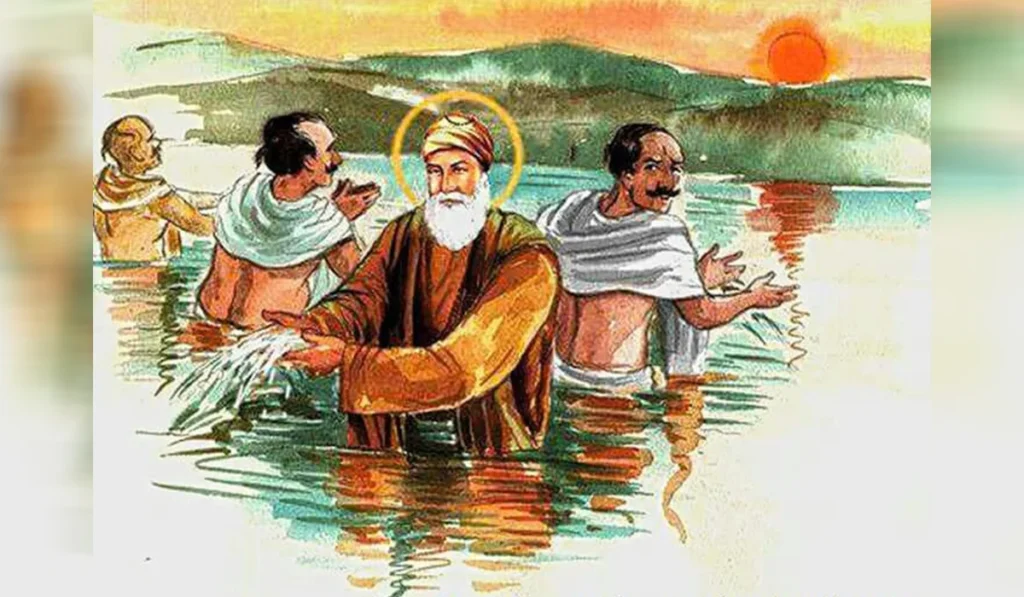
One incident is from Haridwar. People were offering water towards the sun. He started throwing water in the opposite direction. People started laughing and asking, “What are you doing?” He said, “I am giving water to my fields in Punjab.” Everyone laughed and said, “How will the water travel this far?”
Nanak smiled and said, “If your water can reach the sun millions of miles away, then why can’t my water reach Punjab?”
Guru Nanak wanted to lead the man entangled in the web of religion and caste to the path of morality and truth. She also found that the general attitude towards women in medieval India was full of contradictions. The goddess was worshipped, but she did not have equality. She was considered the pivot of the household, but no one heard her voice in important decisions of the house. In many religious traditions it was even said to be the cause of attachment, illusion and sin. Guru Nanak challenged this notion and said that birth takes place only through a woman, upbringing takes place only through a woman and marriage takes place only through a woman. There is friendship only with women, the path of life runs through women only. There is no relationship without a woman. Then how can that be called bad, from whose womb even a king is born:
Bhand jammee-ai, bhand nimmee-ai, bhand mangan vee-aahu.
Bhandahu hovai dostee, bhandahu chalai raahu.
Bhand muaa, bhand bhaalee-ai, bhand hovai bandhaan.
So kio mandaa aakhee-ai, jit jammehi raajaan.
This was a denial of the entire mental structure which considered women less than human beings. In this respect too, Guru Nanak thought far ahead of his time. His legacy became even richer after his death. Guru Arjan Dev put his basic philosophy into words when he said, “One father, one and the same.” That means we all are children of the same Supreme Father.
The idea sown by Guru Nanak did not end with him. Guru Angad gave it language, Guru Amardas gave it social organization, Guru Ramdas and Guru Arjan gave it institutional form and Guru Teg Bahadur gave his head for it. Guru Gobind Singh transformed Nanak’s speech into a collective force that directly challenged inequality based on birth.
It was not by chance that the five Pyaras whom Guru Gobind Singh initiated from the same nectar vessel while laying the foundation of the Khalsa Panth on the day of Vaisakhi in 1699, represented the working class of the society for whose rights Guru Nanak had fought the first major battle. Among these five Pyaras, Bhai Daya Singh Khatri was a shopkeeper, Bhai Dharam Singh was a Jat farmer, Bhai Himmat Singh Jhewar used to carry water, Bhai Mohkam Singh Chhimba was a tailor while Bhai Sahib Singh was a barber.
In fact, Guru Gobind Singh went one step further and did the same work which Guru Nanak had started while sitting at Bhai Lalo’s house. Later he also wrote that “Manas ki jaat sabhi eka pehchaanbo.” And even among the human race, the people most dear to him are those who are destitute and deprived of resources. In this sequence, he also gives an important guideline for the Sikh community, which is known for bravery:
Soora so pachhaanee-ai, jo larai deen ke het.
Purja purja katt marai, kabhoo na chhaadai khet.
Compared to the rest of India, caste-based inequalities are generally far less prevalent in Punjab. Labor is held in high regard, and the social status of women there is, by and large, significantly better. The clear result of this is reflected in the region’s economic and social prosperity.
In his book *Sikhism: A Guide for the Perplexed*, published in 2013, Arvind-Pal Singh Mandair states that Guru Nanak’s objective was not merely to establish a new religious sect, but to show humanity the path to restoring its fractured relationships—with the self, with society, and with all of creation.
To remember Guru Nanak is to bow with reverence before a foundational stone of society – a figure whose clear-sighted vision knew exactly when to stand with someone and when not to.



Leave a Comment