


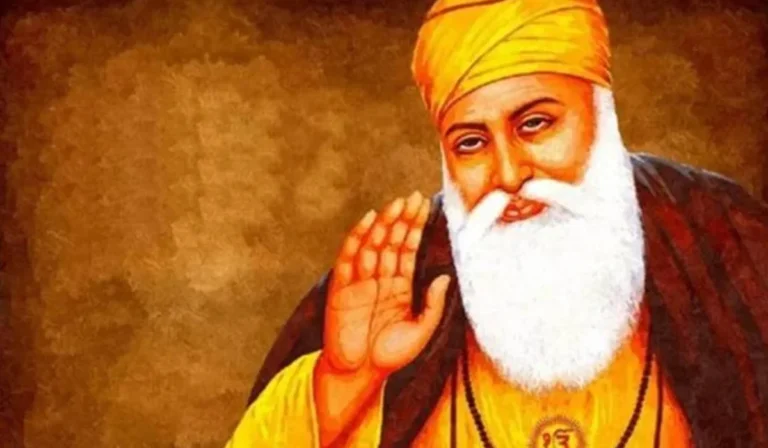
Talwandi had the great fortune of being the place where Guru Nanak Dev Ji spent the first 32 years of his life and opened many new paths of thought and understanding. Sultanpur, too, has the distinction of being the place where Guru Nanak Dev Ji spent four and a half important years of his youth.
It was there that the call of “Tera, Tera” arose. It was there that society was given the understanding that neither Hindu nor Muslim identity alone defined the human being. It was there that the Mool Mantar, which brought spiritual solace to a suffering world, was revealed. The beginning of Jap is also associated with Sultanpur.
Sultanpur is an ancient town situated on the banks of the Safed Bein along an old imperial road. In the eleventh century, the town is said to have been established by Sultan Khan Lodi, an officer of Mahmud of Ghazni.
When Guru Nanak Dev Ji reached Sultanpur around 1500 CE, the town was under Daulat Khan Lodi. Sultanpur was part of Daulat Khan’s jagir. Daulat Khan Lodi was related to Sikandar Lodi and was the uncle of Ibrahim Lodi. He later came into conflict with his nephew Ibrahim.
Bhai Jai Ram, who served as a diwan under Daulat Khan Lodi, recommended Guru Nanak Dev Ji for employment at the Modikhana, or state granary.
Complaints frequently reached Daulat Khan that the Modikhana was not being managed properly and that provisions were not being distributed correctly. Eventually, after repeated complaints, Daulat Khan ordered a surprise inspection of its accounts.
The accounts, however, were found to be completely accurate. Even though Guru Nanak Dev Ji would weigh provisions for farmers and labourers while repeating “Tera, Tera”, the accounts remained perfectly balanced. The verification continued for three days. The accounts were examined by a munshi named Jako Rai.
When the Nawab asked about the result of the inspection, Jako Rai reportedly said, “Nawab Salamat, 321 rupees are due in Nanak’s favour.” The Nawab then ordered treasurer Bhawani Das to pay the amount to Guru Nanak Dev Ji.
Guru Ji asked that the money be distributed among the needy and is said to have remarked that where hard work is so undervalued, where truth is abandoned and suspicion and falsehood prevail, it becomes impossible for him to continue working. Guru Nanak Ji then decided that he would no longer manage the Modikhana.
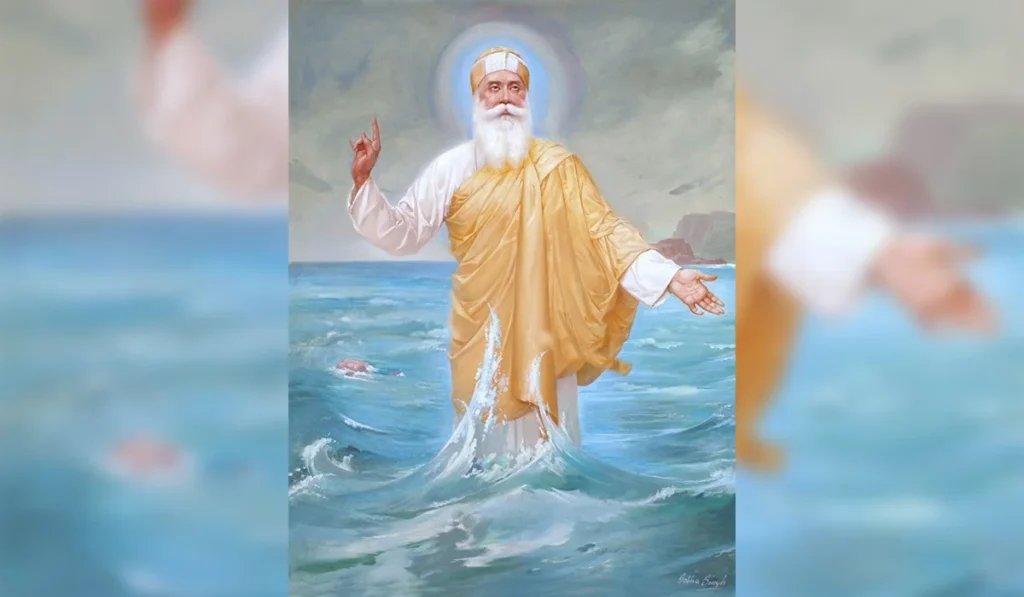
One morning, when he went to bathe, he did not return. The entire town was thrown into confusion. People began saying that Guru Nanak Ji had disappeared after entering the Bein, or that some river creature might have taken him. Four days later, Guru Nanak Ji re-entered the town from the direction of the Bein after making what tradition describes as a historic spiritual decision. He had returned, it is said, carrying from the Divine Court the gift of humility. As soon as Guru Nanak Dev Ji emerged from the Bein, he uttered:
“Na ko Hindu, na Musalman.”
From this point onward, Guru Nanak Dev Ji’s fame began to grow rapidly. Some orthodox defenders of religious authority could not accept that people were praising Baba Nanak. When they heard the declaration “Na ko Hindu, na Musalman,” they urged Daulat Khan to take strict action against him. Daulat Khan refused.
The Qazi reportedly told him that he was making a mistake. When Baba Nanak was summoned before the court and asked who he was, Guru Nanak Ji replied that he knew nothing apart from Waheguru. He explained that the body may be called Hindu or Muslim, but he stood apart as a witness to both.
The Qazi, however, was not satisfied. He said that if all were one, Guru Nanak Ji should join them in offering namaz. Kanhaiya Lal writes in Tarikh-i-Punjab that Guru Ji went with the Nawab for the prayer. News spread across the town that Nanak Ji might become a Muslim that day. When the Nawab and Imam stood for namaz, Guru Nanak Ji did not join them. After the prayer ended, the Nawab asked why.
Guru Ji replied that while physically standing in prayer, the Nawab was mentally buying horses in Kabul, while the Imam was worried that his mare’s foal might fall into a well.
Similarly, the minds of the others were occupied with their own worldly concerns. They were not truly praying with their hearts. Guru Nanak Ji therefore said that he had not joined such a prayer and that it was better not to pray than to perform prayer without sincerity. Everyone present knew the distractions within their own minds, so no one could challenge Baba Nanak. They began to recognise him as a spiritually enlightened person.
Daulat Khan was astonished by this revelation and sought forgiveness from Baba Nanak. Guru Nanak Ji then repeated the decision he had already made: he would no longer remain in Sultanpur. He would instead travel to every place from where falsehood, injustice, and misguided religious practice emerged.
According to Bhai Gurdas Ji, Baba Nanak had contemplated deeply and seen that humanity, having lost sight of its true ideals, was crying out in distress. He therefore stepped into the wider world to reform and guide it.
First the Nawab, then Jai Ram Ji, followed by Guru Nanak Ji’s wife and children, his parents, and his in-laws all attempted to persuade him to remain. But he remained firm in his resolve. A new rabab had also been prepared for Mardana, and the direction of the journey had already been decided.
According to Twarikh Guru Khalsa, after the accounts were finally settled, 160 rupees were found to be due to Guru Nanak Dev Ji. Before his departure, the Nawab and Jai Ram Ji repeatedly suggested that this amount be placed in the names of Guru Nanak Dev Ji’s sons. Guru Nanak Dev Ji, however, had already distributed the money among the needy before leaving Sultanpur.
Thus, after four and a half years of revolutionary words and actions, Baba Ji set out around 1500 CE with rababi Bhai Mardana towards major Hindu religious centres to reinforce ideals expressed in teachings such as:
“Bhekhi Prabh na paeeai.” and “Ta kichh ghaal pave dar lekhe, je us di nadar hove.”
Historians write that during Guru Nanak Dev Ji’s Udasis, he confronted two major forces. One was extreme religious rigidity among Muslims, and the other was deeply rooted superstition among Hindus. Guru Nanak Dev Ji overcame neither through political authority, fear, nor temptation, but through compassion, understanding, and spiritual insight.
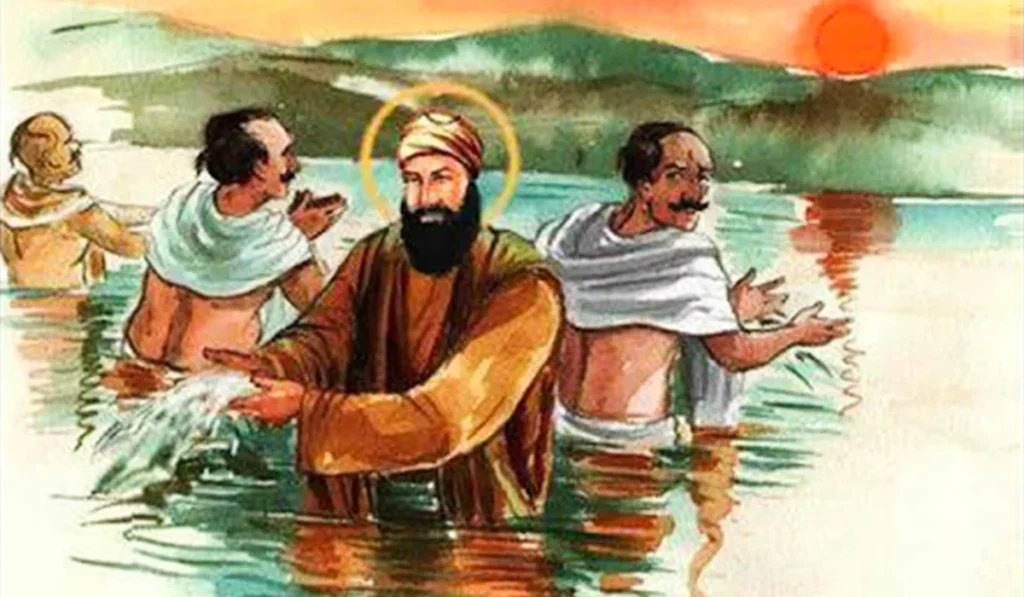
Among the most famous episodes from Guru Nanak Dev Ji’s Udasis are the story of offering water towards the west at Haridwar and the incident at Jagannath Puri involving the hypocritical ascetic’s vessel. Guru Nanak Dev Ji travelled in all four directions—east, north, south, and west.
During the first Udasi, Guru Ji is described as wearing saffron-coloured clothes; during the second, white garments; and during the third, blue attire. These outward forms were also adopted, according to tradition, as part of his engagement with different spiritual traditions while seeking and communicating a philosophy beneficial to all humanity.
Bhai Gurdas Ji writes that when Baba Nanak returned from the Udasis, he removed the garb of an Udasi and once again wore ordinary worldly clothes. He then settled in one place and began teaching people a practical way of life.
Bhai Gurdas Ji writes:
“Phir Baba aaya Kartarpur, bhekh Udasi sagal utara
Pahir sansari kapde, manji baith kia avatara.”
Until then, society had largely accepted the belief that after entering the stage of vanaprastha or renunciation under the traditional varna-ashrama system, a person could not return to household life. But once Guru Sahib’s Udasis were complete and their purpose fulfilled, he removed the ascetic garb. This too was a powerful challenge to rigid social conventions and discrimination. Bhai Mardana accompanied Guru Nanak Dev Ji throughout the Udasis after leaving Sultanpur.
With his rabab, which Bibi Nanaki—Guru Nanak Dev Ji’s sister—is said to have had specially made at her own expense, Mardana maintained the musical expression of devotion throughout Guru Nanak Dev Ji’s journeys.
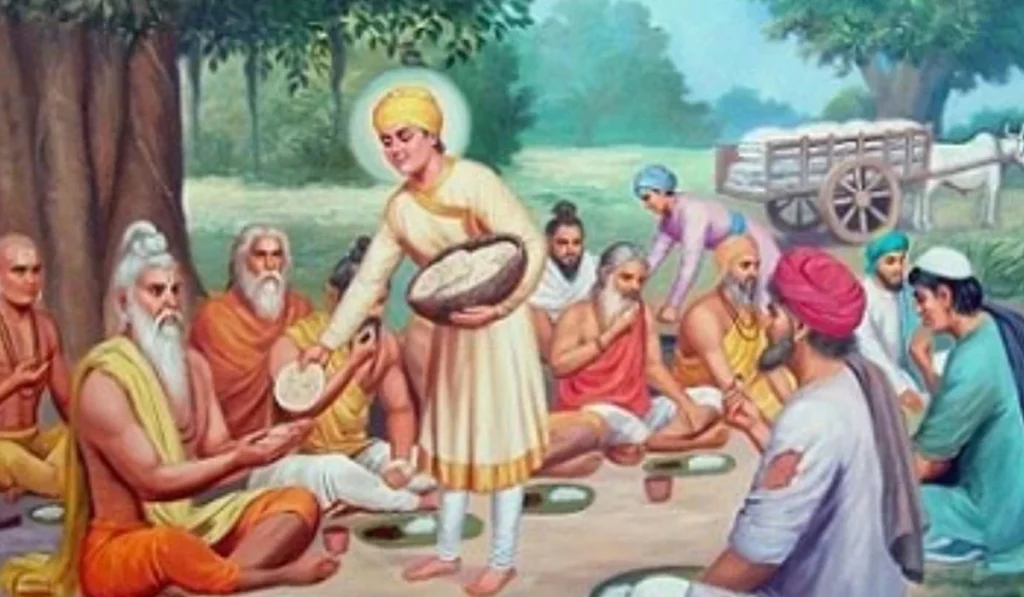
Guru Nanak Dev Ji travelled not only across India but also to Sri Lanka, Nepal, Bhutan, Baghdad, and Persia. He taught people to earn through honest labour, remember the Divine Name, and share with others. He also emphasised the importance of kirtan. Guru Nanak Dev Ji established the traditions of Pangat and Sangat.
The idea was that people would first sit together in one row and share langar, and then participate together in the Sangat of Guru Nanak Dev Ji. Making everyone sit together in one Pangat was intended to weaken ego and eliminate distinctions of high and low, caste, and social status.
Guru Nanak Dev Ji lived in the physical form for a total of 70 years, five months, and 17 days. He spent the final 18 years of his life at Kartarpur, the town he himself had established. There he continued to guide the Sikhs.
He nurtured and strengthened the new religious tradition that had developed during the period of the Udasis. Those who accepted Guru Ji’s teachings became the Guru’s Sikhs and entered the Sikh faith. Sangat travelled from distant places to reach Guru Nanak Dev Ji at Kartarpur.
The traditions of Pangat and Sangat continued, and Guru Nanak Dev Ji continued imparting his teachings to the Sikhs. It was at Kartarpur that Guru Nanak Dev Ji chose Bhai Lehna over his own two sons, Baba Sri Chand Ji and Baba Lakhmi Das Ji, and gave him the name Angad, establishing him as the bearer of the Guru’s second spiritual light.
Bhai Lehna was the one who successfully passed the tests set by Guru Nanak Dev Ji. He was appointed as the second manifestation of Nanak’s spiritual light.
With five paise and a coconut, the ceremonial tilak on the forehead, and the administration of Charan Pahul, Bhai Lehna was given the name Angad and became the second Guru of the Sikh faith, Guru Angad Dev Ji.
At the age of 70, Guru Nanak Dev Ji merged into the Divine Light in 1539 CE. After bestowing the Guruship, Guru Ji lived for only around four more months. Guru Nanak Dev Ji’s bani was later included with great reverence by Guru Arjan Dev Ji in the Adi Granth. According to several historians, Guru Nanak Dev Ji had also collected compositions written by various Bhagats and Bhatts during his visits to their associated places. These compositions too were later incorporated into the Adi Granth by Guru Arjan Dev Ji, the fifth spiritual light of Guru Nanak.
According to several historical texts, a dispute arose over Guru Nanak Ji’s mortal remains, but it was resolved in time. His final rites were performed on the banks of the Ravi. However, tradition holds that when the ashes of the pyre were later examined, no bodily remains were found. Afterwards, the Muslims built a tomb on one side, while others built a samadhi on the other. The two structures shared a common wall.
Robert N. Cust wrote that nowhere else in the world could one easily find the tomb and samadhi of the same person standing together with a common wall between them. With the passage of time, both the tomb and the samadhi eventually disappeared.
“Nanak zi jahan raft
Gul az bagh birun shud.”
Meaning: Guru Nanak departed from this world as a blossoming flower falls from the garden.
Leave a Comment