

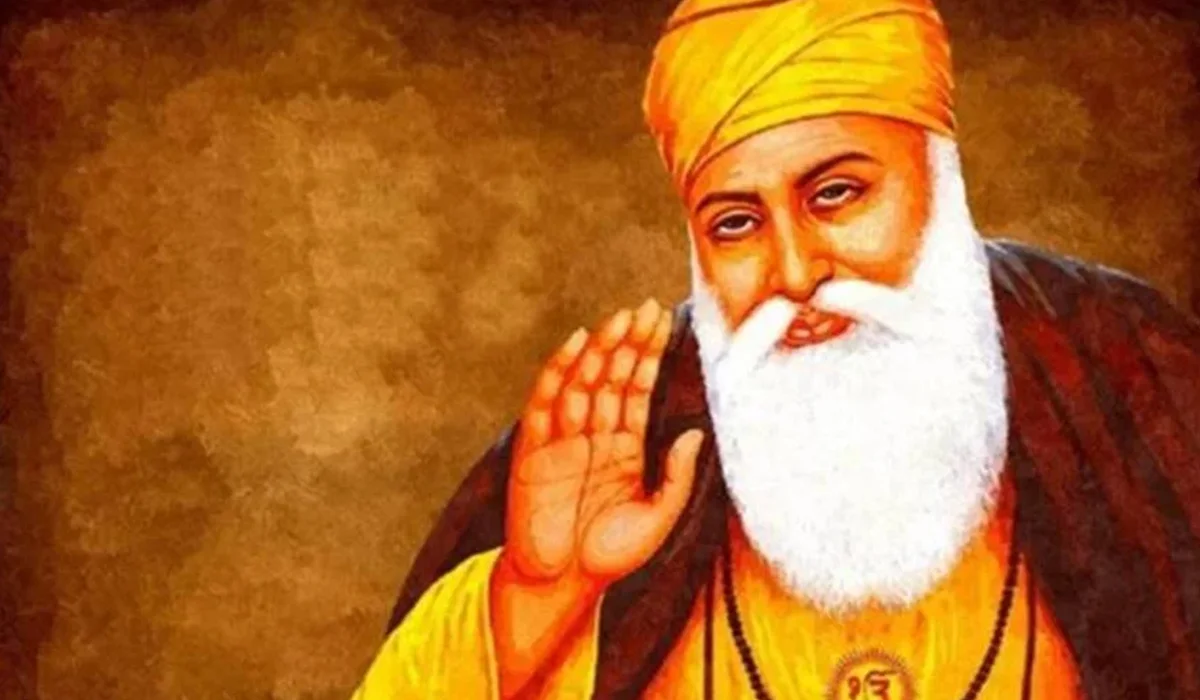

The three centuries before the advent of Sri Guru Nanak Dev Ji are sometimes described as the dark centuries. On 24 July 1206 CE, Hindustan came under the rule of former slaves. In a short span of time, the newly established regime expanded into a vast empire. There were scattered attempts at resistance, but the political control of Hindustan had largely passed into the hands of the successors of Muhammad Ghori. By the time the Rajput rulers of India fully realised the situation, large parts of Hindustan had already come under foreign rule.
Qutb-ud-din Aibak and, after him, Iltutmish consolidated the Slave Dynasty. Alauddin Khalji is described in historical accounts as having imposed severe measures upon the Hindu population. Firoz Tughlaq further intensified the burden by imposing jizya. He did not stop at jizya, but also imposed pilgrimage taxes and other levies connected with Hindu religious practices. The Hindu population of Hindustan had to bear this social and economic pressure.
While enduring these social and economic hardships, the population suffered another devastating blow with the invasions of Timur. At one command of Timur, one lakh prisoners are said to have been killed.
Later, Bahlol Lodi of the Lodi dynasty defeated the Sayyids and took control of Delhi. After Bahlol’s death, his son Nizam Khan assumed the name Sikandar Lodi and ruled until 1517 CE. Sikandar Lodi came to be associated with the title “But-Shikan” and is described as having ordered the destruction of temples. Historical accounts do not provide a complete count of the temples destroyed during his reign.
When Guru Nanak Dev Ji was born, Sikandar Lodi was ruling from Delhi. Sikandar Lodi appointed Daulat Khan as the governor of Sultanpur in Punjab. Daulat Khan remained loyal during Sikandar’s lifetime, but when Ibrahim Lodi ascended the throne of Hindustan, Daulat Khan began conspiring against him and, along with Alam Khan Lodi, invited Babur to India.
Daulat Khan believed that with Babur’s help he could defeat Ibrahim Lodi and eventually occupy the throne of Delhi himself. His calculations proved wrong, and the Lodi rule ultimately disappeared from Hindustan.
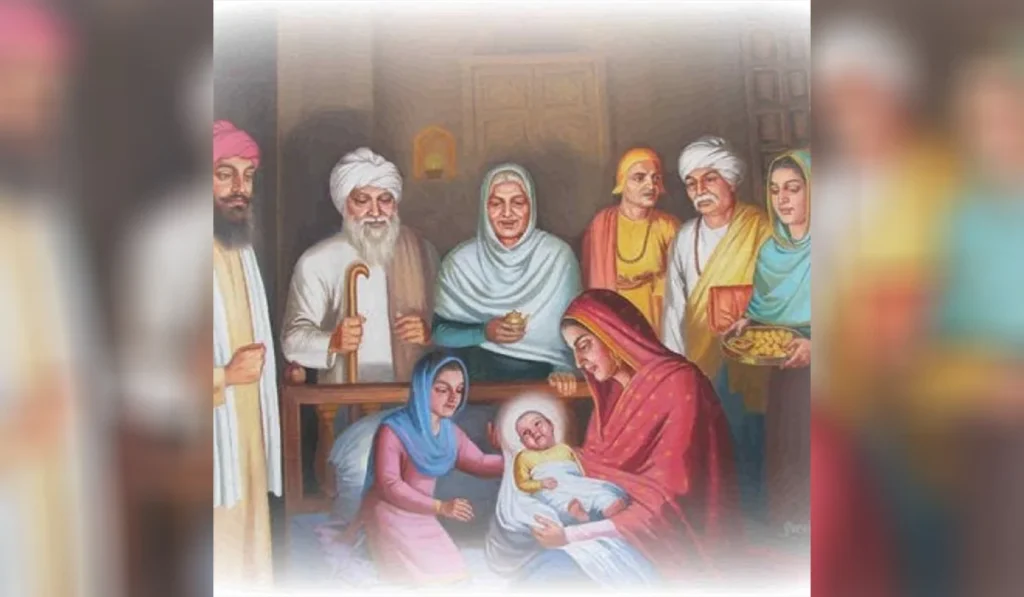
Guru Nanak Dev Ji was born on 15 April 1469 CE at Rai Bhoi Ki Talwandi to father Mehta Kalu, Kalyan Chand Das Bedi, and Mata Tripta Ji. Bhai Gurdas Ji writes:
“Satgur Nanak pragatia, miti dhund jag chanan hoa
Jio kar sooraj niklia, tare chhape andher paloaa.”
Mata Tripta Ji was naturally filled with joy, but Daulatan Dai and Tulsan too were overwhelmed by what they witnessed at the time of the child’s birth. When Mehta Kalu tried to offer Daulatan Dai money placed in a tray, she is said to have replied, “Let it be, Mehta Ji. I am already fulfilled. I have been blessed.”
Daulatan is also said to have told Mehta Kalu, “With these hands I have helped deliver many children, but I have never witnessed anything like what happened today. He smiled gently at me as though he were an elderly saint and even seemed to communicate with me.”
With the passage of time, Rai Bhoi Ki Talwandi came to be known as Nankiana and later as Nankana, which today lies in Pakistan. At the time of Guru Nanak Dev Ji’s birth, the condition of society has been described in these words:
“Raje sheeh, mukadam kutte, jai jagain baithe sutte
Chakar nahda pain ghaao, rat pit kutteho chat jaao.”
Many historical sources contain accounts of Guru Nanak Dev Ji’s life and genealogy. They mention names such as Guru Nanak Dev Ji, Baba Lakhmi Chand Ji, Baba Dharam Chand Ji, Baba Manak Chand Ji, Baba Datar Chand Ji, Baba Tara Chand Ji, Baba Duni Chand Ji, Baba Ram Kaur Ji, Baba Arjan Das Ji, Baba Dahar Das Ji, Sri Ganda Singh Ji, Kavi Ganesh Singh Ji, Hari Singh, Shakti Singh, and Shyam Singh. The later names are associated roughly with the first half of the nineteenth century, while some deaths are placed in the first quarter of the twentieth century.
Ordinary children announce their arrival in this world by crying, but historical texts describe Baba Nanak as an extraordinary child. With the arrival of Baba Nanak, it is said that not only did creation experience joy, but the world also received a new message. Sayyid Muhammad Latif writes that the words always present on Baba Nanak’s lips were:
“Tu Nirankar Kartar, Nanak banda tera hi.”
In Tarikh-i-Punjab, it is written that Mardana’s rabab constantly echoed the sentiment: “Nanak banda tera hi.” Whenever Guru Nanak Ji asked Mardana Ji to play the rabab, he would say:
“Mardania, chhed rabab, koi sifat Khuda de didar di kariye.”
At the time of his birth and childhood, people could not understand the deeper meaning of what he was saying. The world was familiar only with “I” and “mine,” but here had arrived someone whose language was:
“Tera tera, hau tera, tera nao.”
When the newborn child was nine days old, Pandit Hardayal gave him the name Nanak. At one month of age, if someone called out, he would look intently in that direction. At three months, he could sit while supporting his neck. At four months, he was dressed in a small garment. At six months, he began responding to voices. At seven months, he could sit cross-legged. At eight months, he is described as sitting in a meditative posture like saints. At nine months, he began walking and uttering “Baba, Baba.” By one year of age, he could walk carefully. At a year and a half, he began uttering “Waheguru, Waheguru.”
At the age of two, when he went to play with other children, he would offer them such meaningful advice that their parents would come to see the child who had spoken those words.
Kanhaiya Lal, the author of Tarikh-i-Punjab, writes that even at a young age Nanak Ji displayed habits associated with elders. He rarely went outside the house and did not play like ordinary boys. He considered remembrance of God more important than other activities. He remained silent most of the time, did not speak unless spoken to, and carried out whatever task his parents gave him with sincerity.
When Baba Nanak reached the age of seven, he was sent for formal education. He asked the teacher such questions that the teacher was astonished by the depth and perfection of the child’s words and became convinced that this child possessed spiritual wisdom from birth.
When he was later sent to a Muslim teacher, the Maulvi too was amazed by Guru Nanak Dev Ji’s spiritual insight.
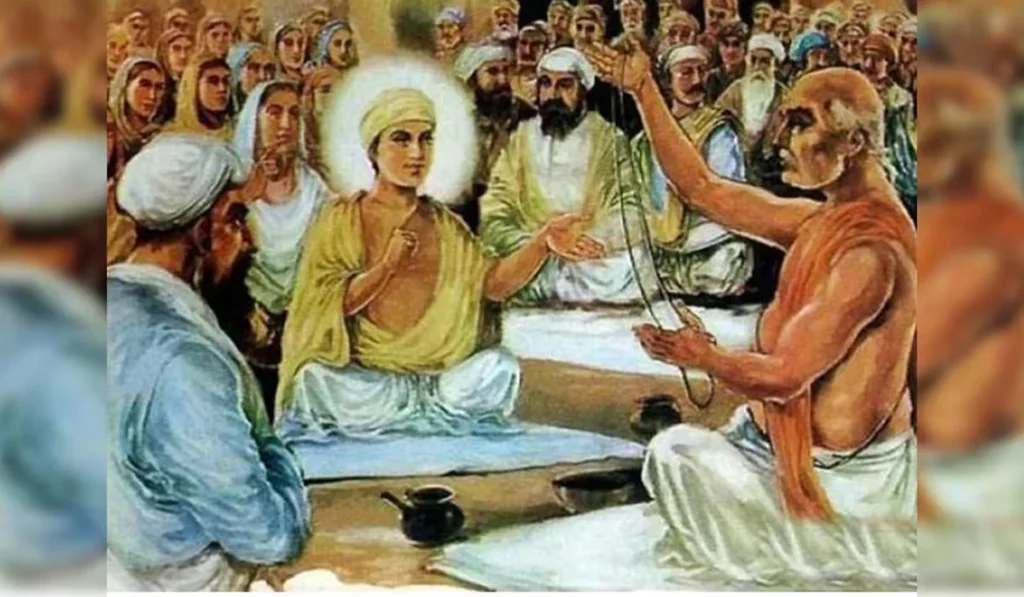
When Guru Nanak Dev Ji reached the age of nine, the time came for the ceremony of wearing the janeu. In front of the assembled community, Baba Nanak refused to wear the sacred thread. This was presented as an early challenge to an old social order. It was a powerful criticism of ritualism and inequality.
The Brahmin’s janeu was traditionally made of three strands, the Khatri’s of two, and the Vaishya’s of one, while the Shudra was denied the right to wear it altogether. By refusing to participate in such a ritual, Baba Nanak asserted the principle of equality and attempted to lead society away from meaningless ritual practices.
At the age of ten, when he took buffaloes to graze in the fields, he would sometimes become deeply absorbed in the remembrance of God. The buffaloes would wander into the crops of others. Complaints were made, but when people went to inspect the fields, the crops were said to appear even greener and healthier.
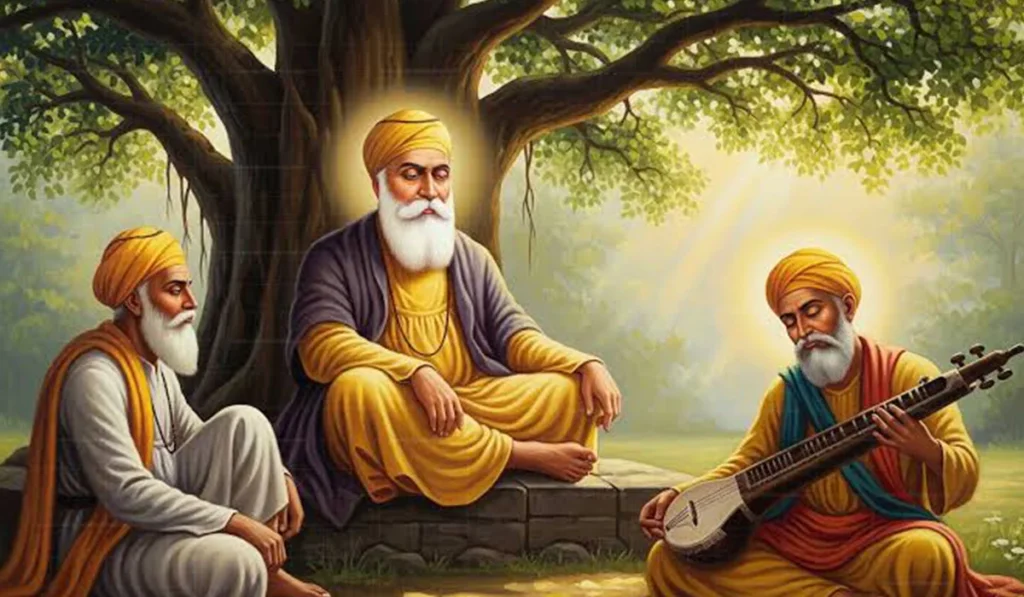
With the passage of time, Guru Nanak Dev Ji increasingly devoted himself to kirtan. Regarding his devotion to God, Munshi Sujan Rai writes in Khulasat-ut-Tawarikh that Guru Nanak’s close companion was a rabab player named Mardana, who sang Guru Nanak Dev Ji’s bani in a deeply moving and soulful voice.
Kirtan, in this tradition, took birth at Talwandi. Baba Nanak’s shabad and Mardana’s rabab created a spiritual combination for which, it is said, the world has never found an equal. “Mardana” was a title given to him by Guru Nanak Ji. His original name is described as Dana. Bhai Dana Ji’s father was Bhai Badre and his mother was Lakho.
According to Bhai Kahn Singh, the author of Mahan Kosh, Mardana Ji was born at Talwandi in 1459 CE. By this calculation, he was ten years older than Guru Nanak Ji. Bhai Mardana Ji had two sons, Razada and Sajada. Sajada Ji remained in Talwandi, while Razada Ji later settled in Kartarpur.
Baba Nanak and Mardana became extremely close. Their bond is reflected in words once spoken by Mardana Ji. In his characteristic manner, he said: “Baba, tera mera bahuta antar nahin. Tu Rabb da doom hai, main tera doom.” He then said:
“Tai Khudai paia hai, main Khudai dekhia hai.”
Mardana Ji requested:
“Benati hai ke mainu vichhorna nahin aap nalo, na ithe na uthe.”
Guru Nanak Ji blessed him and replied:
“Mardania, tudh uppar meri khushi hai. Jithe tera vasa, uthe mera vasa.”
When Guru Nanak Dev Ji reached the age of eighteen, he began engaging in trade and would travel to the market at Chuharkana for the salt trade. On one occasion, he fed hungry Abdals there. When Mehta Kalu Ji became angry, Guru Nanak Ji replied that he had made a “Sacha Sauda”, a true bargain.
The Abdals were a Sufi group devoted to the remembrance of Allah. Guru Nanak Ji explained that feeding those hungry seekers was the true bargain. After this episode, Mehta Kalu Ji arranged his marriage.
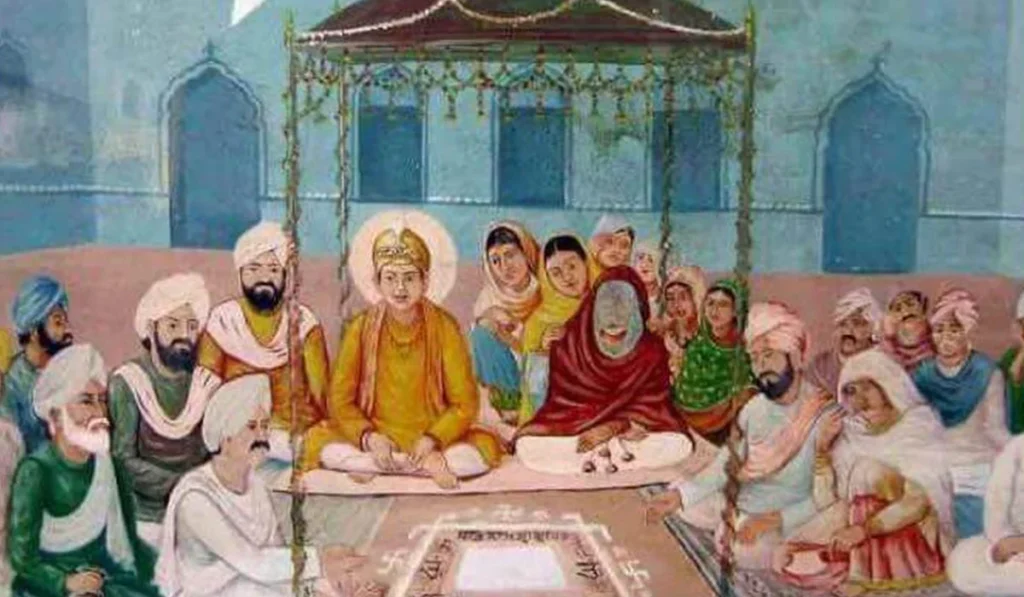
The engagement took place around Baisakhi, and the wedding was held at Batala. Guru Nanak Dev Ji’s father-in-law, Bhai Mula Ji, was a resident of Batala, and his elder daughter was named Sulakhni. The wedding procession travelled to Batala. People from different castes joined the baraat, and everyone ate together at one place.
Guru Nanak Dev Ji conducted the marriage above conventional ritual distinctions. The account states that Vedic rituals were not performed and that kirtan alone formed the spiritual centre of the ceremony. After the marriage, Baba Sri Chand Ji was born in 1496 CE, and exactly two years later Baba Lakhmi Das Ji was born.
When Guru Ji reached the age of thirty-two, Bhai Jai Ram Ji, Guru Nanak Dev Ji’s brother-in-law, came from Sultanpur to take him there. To support his household and family life, Guru Nanak Dev Ji agreed to move to Sultanpur.
When he was preparing to leave, Mata Sulakhni Ji requested to accompany him, but Guru Nanak Dev Ji told her that she should wait for some time. After Guru Nanak Dev Ji was appointed to manage the Modikhana, one of the first things he did was send Mardana Ji to bring his wife and children to Sultanpur.
Leave a Comment