
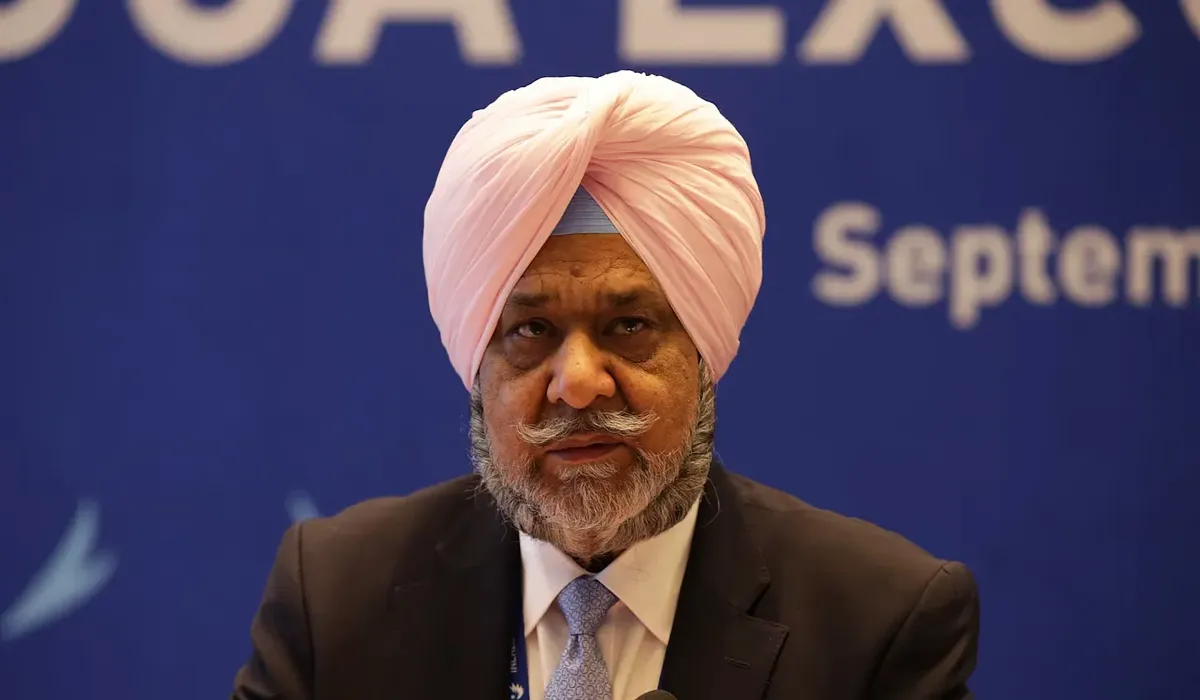

A five-time Olympian who carried India’s tricolour at five Games and became its first Asian Games shooting gold medallist, Raja Randhir Singh spent the second half of his life dismantling the barriers
I. The Patiala Inheritance
Raja Randhir Singh, who passed away at his New Delhi residence on 27 May 2026, was many things in one life: a five-time Olympian, India’s first Asian Games shooting gold medallist, a twenty-seven-year Secretary General of the Indian Olympic Association, and ultimately the first Indian to be elected President of the Olympic Council of Asia. He was 79.
Born in Patiala in 1946, he was the son of Raja Bhalindra Singh, younger brother of Maharaja Yadavindra Singh—the same Patiala house that had given India its first Test cricket captain from among its royals and its first serious institutional engagement with the Olympic movement. His father served on the Indian Olympic Committee from 1947 to 1992; his uncle played Test cricket for India. Randhir Singh was thus the fourth generation of a sporting family whose contribution to Indian athletics has no parallel in its depth or continuity. In his final years, his renal function had deteriorated progressively. Characteristically, he declined to undergo a kidney transplant, choosing instead to rely on traditional medication, remedies and procedures. Surrounded by family, his end was peaceful.
A first cousin of former Punjab Chief Minister Captain Amarinder Singh, he inherited not only a name but an obligation: to carry the Patiala tradition of sporting patronage into the post-royalty, post-privy-purse era of Indian sport, where titles counted for nothing and results counted for everything.
II. Five Olympics, One Asian Games Gold
As a trap shooter, Randhir Singh was first identified as reserve for the Tokyo 1964 Olympics—a recognition of promise even before he had reached his peak. He went on to represent India at five successive Games: Mexico 1968, Munich 1972, Montreal 1976, Moscow 1980, and Los Angeles 1984. Five Olympic appearances is a record of endurance that commands respect in any era; across a span when Indian shooting had neither the infrastructure nor the international exposure it has today, it borders on the extraordinary.
His competitive high-water mark came at the 1978 Asian Games in Bangkok, where he won gold in men’s trap—making him the first Indian to win a shooting gold at the Asian Games. He returned to Delhi’s home Asian Games in 1982 to claim individual bronze and team silver. He also competed at Seoul 1986, Hiroshima 1994, and the Commonwealth Games in Edmonton 1978. These achievements earned him the Arjuna Award and the Maharaja Ranjit Singh Award in 1979.
What distinguished him as an athlete was not exceptional natural gift but disciplined commitment: the willingness to show up, year after year, at the intersection of India’s administrative indifference to sport and the cold demands of international competition.
III. The Administrator: Twenty-Five Years at the IOA
It is as an institution-builder that Randhir Singh’s legacy will endure most durably. He served as Honorary Secretary General of the Indian Olympic Association from 1987 to 2014—a continuous twenty-seven-year tenure that is without precedent in the history of Indian sport governance. Through that span, Indian athletes competed at nine Olympic Games and multiple Asian and Commonwealth Games cycles. Much of the logistical, diplomatic, and coordinative work that made those participations possible passed through his office.
His critics noted a blunt, sometimes combative style that generated its share of institutional friction. His defenders—and they were many, and well-placed—pointed to an administrator who genuinely knew the sporting world from the inside, who had stood on the field of play himself and understood what athletes needed. Both characterisations had merit; neither cancels the other.
IV. Global Reach: IOC, OCA, and the Asian Sports Movement
Randhir Singh’s administrative ambition extended far beyond Indraprastha. He served as Secretary General of the Olympic Council of Asia from 1991 to 2015, giving him unmatched influence over the architecture of Asian sport across a quarter-century of rapid economic and geopolitical change in the region. His IOC membership (2001–2014), and subsequent honorary membership, placed him at the table where global Olympic policy is set, budgets are allocated, and host city decisions are made.
The capstone of his administrative career came at the 44th OCA General Assembly in New Delhi in September 2024, when he was elected unopposed as President of the Olympic Council of Asia—the first Indian, and the third member of the Patiala royal family, to hold that office. He relinquished the position in early 2026 as his health declined. The photograph from that General Assembly—a visibly frail but composed Randhir Singh accepting the mandate of forty-five national Olympic committees—captures both the tenacity and the cost of a life given entirely to sport.
He also served on multiple IOC commissions, represented the IOC on the World Anti-Doping Agency (WADA) Foundation Board, and held positions with the Sports Authority of India, the Association of National Olympic Committees (ANOC), and the Afro-Asian Games Council. Closer to home, he was a key figure in securing New Delhi as the host city for the 2010 Commonwealth Games — an event that, whatever its subsequent organisational controversies, represented India’s most ambitious assertion of its place in global sport.
V. Family: Two Marriages, A Shooting Heir
Randhir Singh’s personal life bore the complexity that a public life of such duration often produces. He was married twice. His first marriage was to Uma, with whom he had two daughters, Mahima and Sunaina (Muffy). His second marriage was to Vanita, sister of Arvind Khanna, the former Punjab MLA—a connection that double-linked the Patiala sporting dynasty to the political landscape of Punjab. From this marriage he has a daughter, Rajeshwari “Ria” Kumari, who has carved out her own identity in the sport her father helped institutionalise. Ria is a national and international-level trap shooter of considerable repute. In January 2021 she won gold in the women’s trap event at the Asian Online Shooting Championship, hosted by the Kuwait Shooting Federation. At the 2023 Hangzhou Asian Games she won a team silver medal in women’s trap — a medal presented to her on the podium, in one of sport’s more arresting tableaux, by her own father, who was then serving as Acting President of the OCA. The family’s shooting lineage thus extends, unbroken, into the third generation.
That a daughter should have taken up the gun is perhaps the most eloquent testimony to the world Randhir Singh built—a world where shooting was no longer merely a royal pastime but a serious competitive discipline with the infrastructure, the federation, and the pathways to make excellence possible.
VI. Legacy
The National Rifle Association of India, in announcing his passing, described him as “one of the most respected sports administrators in India, Asia and the International Olympic Committee” whose efforts were “invaluable to the development of shooting sports and the Olympic movement.” That is institutional language. The human reality it encodes is a man who bridged two worlds—the shooting range and the boardroom—and who found, in the organisational machinery of international sport, a vocation as demanding and as disciplined as the one he had pursued with a gun.
Indian shooting today—its multiple Olympic medals, its robust national federation, its pipeline of young talent—did not emerge from a vacuum. It emerged, in considerable part, from decades of patient infrastructure-building in which Randhir Singh was a central figure. That the connection is not always made explicit is a measure of how thoroughly good administration disappears into the results it enables.
From Patiala’s firing ranges to the corridors of the IOC in Lausanne, from Bangkok 1978 to the OCA General Assembly of 2024, Raja Randhir Singh devoted his life to sport not as a vocation of convenience but as a matter of conviction. He is survived by the institutions he helped build and the athletes whose path he cleared. Punjab mourns a distinguished son; Indian sport mourns one of its most consequential administrators.
The writer is a retired IAS officer of the 1984 batch, Punjab cadre, and the founder-editor of The KBS Chronicle.


Leave a Comment